Physician-poet who led Angola's liberation struggle and became its first president
"Our land, our mother / we shall return." Lines from the poem "Havemos de voltar" in the 1974 collection Sacred Hope (Sagrada Esperança).
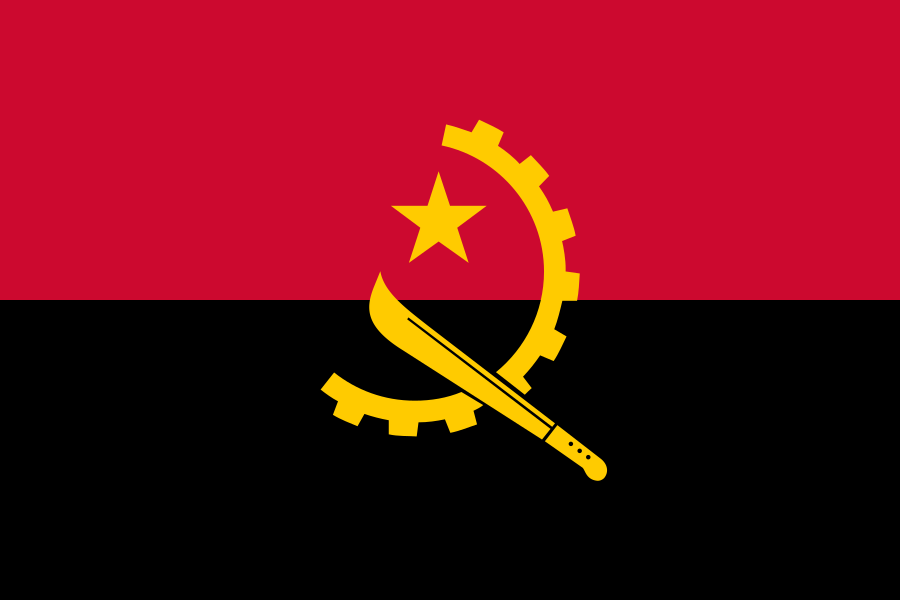
Physician and poet who led Angola's independence struggle. He was president of the MPLA at its founding in December 1956 and, after imprisonment and exile, was elected its effective chairman at the December 1962 conference, leading the independence war until 1974. He became the first president of the People's Republic of Angola on 11 November 1975, building a one-party socialist state in close alignment with the USSR and Cuba while crushing a 1977 coup attempt and carrying out mass purges.
Career timeline
1947Left for Portugal; studied medicine at Coimbra and Lisbon universities while joining anti-colonial student activism
1956Became the MPLA's president at its founding (Viriato da Cruz was secretary-general)
1960–1962Arrested by the PIDE, imprisoned in Lisbon; escaped in 1962 and went into exile in Congo-Léopoldville
1962–1974Elected effective chairman at the MPLA conference; led the independence war and built ties with the USSR, Cuba and Yugoslavia
1975Became first president of the People's Republic of Angola on 11 November; declared a socialist course
1975–1979Defended the state in civil war with Cuban troops and Soviet aid; suppressed Nito Alves's 1977 coup attempt
1977Reorganized the MPLA into the MPLA-Workers' Party, adopting Marxism-Leninism as official doctrine
A young premier who bore responsibility at the revolution’s threshold
He later recalled accepting the premiership as “a bad decision.”
András Hegedüs was a Hungarian Communist politician and sociologist whose path ran from loyal cadre of the Rákosi regime to critic of the system. Backed by Rákosi and Ernő Gerő, he became prime minister, but during the 1956 Revolution he signed the appeal for Soviet military intervention and bore responsibility for a paralysed leadership. After returning from Moscow, he built a significant career in sociology, protested the 1968 invasion of Czechoslovakia, and was expelled from the party.
Career timeline
1942Joined the illegal Hungarian Communist Party
1945–1947National secretary of MADISZ
1951–1953Minister responsible for agriculture
1953–1955First deputy chairman of the Council of Ministers
1955–1956Chairman of Hungary’s Council of Ministers
1956Signed the appeal for Soviet intervention during the revolution
1963–1968Founded and led the Hungarian Academy of Sciences sociology group
1973Expelled from the Hungarian Socialist Workers’ Party
Founding president who theorized Ujamaa and led non-aligned socialist Tanzania for 24 years
“We, in Africa, have no more need of being 'converted' to socialism than we have of being 'taught' democracy. Both are rooted in our past — in the traditional society which produced us.” — essay 'Ujamaa', 1962
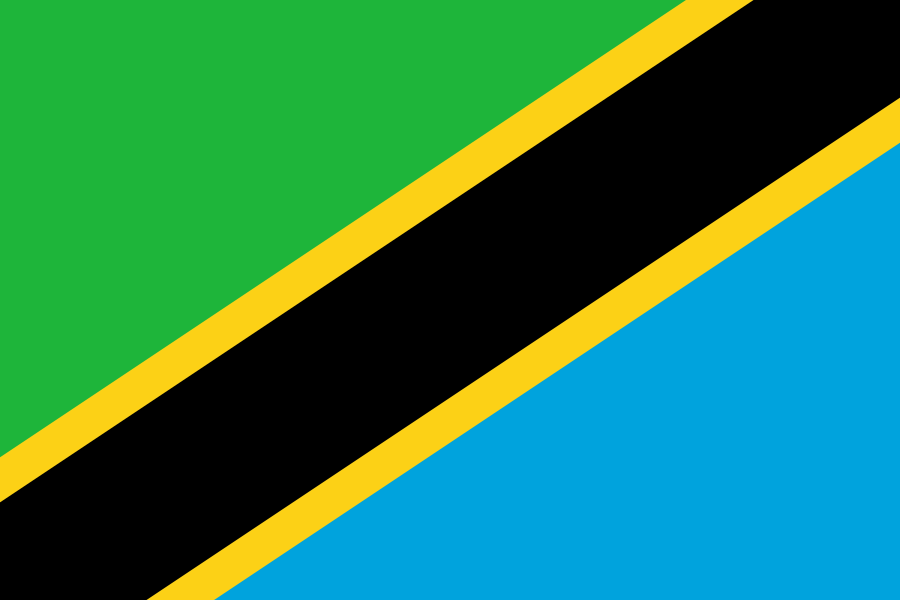
Founding president of Tanzania (1964–1985), anti-colonial leader, and the most influential theorist of African socialism. He founded TANU in 1954 and led Tanganyika to independence through non-violent struggle. The 1967 Arusha Declaration established Ujamaa, a homegrown development model fusing traditional communal life with modern socialism, nationalizing banks and industry while dramatically expanding education and healthcare. Throughout his presidency he backed southern African liberation movements and stood at the center of the Non-Aligned Movement. In 1985 he voluntarily stepped down, one of the few African leaders to orchestrate a peaceful transfer of power, and spent his final years mediating the Burundian Civil War.
Career timeline
1949–1952Studies at Edinburgh University — MA in education and politics
1954Founds the Tanganyika African National Union (TANU)
1960–1961Chief Minister then first Prime Minister of Tanganyika
1961.12Tanganyika wins independence
1962–1964First President of Tanganyika — republic proclaimed
1964Union with Zanzibar — United Republic of Tanzania
1967Arusha Declaration — Ujamaa socialism, nationalization of banks and major industries
1978–1979Tanzania–Uganda War — leads overthrow of Idi Amin
1985Voluntarily resigns the presidency — peaceful transition of power
1985–1990CCM party chair — criticizes successor's neoliberal turn
1996–1999UN-mandated mediator in the Burundian Civil War
Architect of Đổi Mới and prime minister of Vietnam
In a 2007 BBC Vietnamese Service interview he said "There are a hundred ways of being a patriot. The motherland of Vietnam doesn't belong to one person, one party or one group only", acknowledged the party's "serious mistakes" in the south after 1975, and urged national reconciliation.
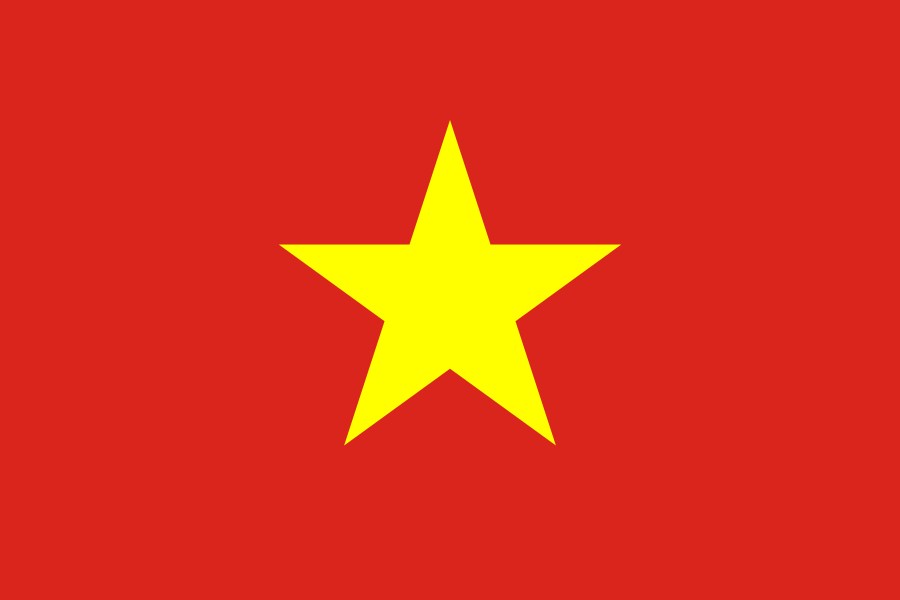
Vietnamese politician and economic reformer. Born in 1922 to a peasant family in Vĩnh Long province in the Mekong Delta, he joined the Indochinese Communist Party in 1939 and fought in the wars against the French and then the US and South Vietnamese forces. He was party chief in Ho Chi Minh City from 1976 to 1982 and deputy prime minister from 1982 to 1991; as prime minister (1991–1997) he drove the Đổi Mới reforms and Vietnam's opening to the outside world. He died in Singapore on 11 June 2008.
Career timeline
1939Joined the Indochinese Communist Party
1946–1954Fought in the First Indochina War
1976–1982Party chief in Ho Chi Minh City
1982–1991Deputy prime minister
1991–1997Prime minister
1995Vietnam joined ASEAN and normalised relations with the US
Singapore’s founding prime minister, who led the city-state through independence and its early development
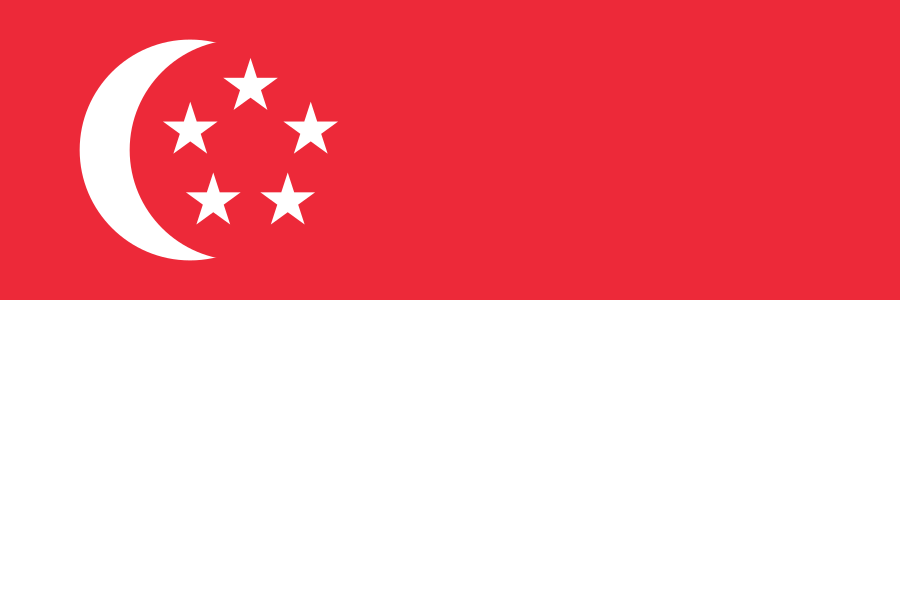
Lee co-founded the People's Action Party in 1954 and served as Singapore's prime minister from 1959 to 1990. He pursued merger with Malaya, helping form Malaysia in 1963, but Singapore separated from the federation and became independent in 1965. His government drove industrialisation and expanded public housing and education, while also using defamation law and detention without trial and restricting the press, public assembly, labour activism and civil liberties. He met Deng Xiaoping in 1978 to discuss Vietnam and later helped shape ASEAN's opposition to Vietnam's invasion of Cambodia.
Career timeline
1954Co-founded the People's Action Party
1959–1990Prime Minister of Singapore
1963–1965Represented Singapore as an MP in the Malaysian Parliament
Cuban revolutionary commander credited with defeating the 1961 Bay of Pigs landing (Brigade 2506)
During the Bay of Pigs invasion of 17 April 1961, Fidel Castro ordered him to command the militia and regular-army battalions fighting Brigade 2506; late on 19 April 1961 he was among the forces that broke through to Playa Girón and forced the invaders' surrender.
Cuban Communist and military leader, and later vice-president of the Council of Ministers. Born in Santiago de Cuba, he joined the Revolutionary Armed Forces (FAR) after the 1959 revolution and held many state posts, including minister, vice-president and deputy. He was among the longest-lived historic leaders of the Cuban Revolution.
Career timeline
1978–2012Vice-president of the Council of Ministers
The US president who declared the Cold War over with Gorbachev at Malta, yet whose caution nearly let history slip away
At the Malta joint press conference Bush declared: 'We can realise a lasting peace and transform the East-West relationship to one of enduring co-operation. That is the future that Chairman Gorbachev and I began right here in Malta.'
George H. W. Bush went from World War II naval aviator to oil magnate to the 41st president of the United States, bringing to the White House foreign-policy experience unmatched by any predecessor: CIA director, UN ambassador, and de facto ambassador to China. Upon taking office in 1989 he ordered a strategic review of Soviet policy, the so-called 'Bush pause,' that frustrated Gorbachev, but at the Malta summit that December the two leaders jointly confirmed the Cold War's end, and Bush's steady support for German reunification helped anchor the new European order. He built a multinational coalition to expel Iraq from Kuwait in the Gulf War, then lost his 1992 re-election bid after breaking his 'no new taxes' pledge amid a recession.
Career timeline
1924Born in Milton, Massachusetts, into a wealthy political dynasty
1942–1945Navy torpedo-bomber pilot; shot down at Chichijima, rescued by submarine
Husák's right hand who ran the normalization cabinet for eighteen years, then fell backing Gorbachev's perestroika
Asked why he lost, Štrougal answered: 'I underestimated the dissidents.'
A Czechoslovak communist politician who served as prime minister from January 1970 to October 1988: the face, alongside Gustáv Husák, of the 'normalization' regime that crushed the Prague Spring. A law graduate and career party functionary, he rose through the agriculture and interior ministries to become deputy premier under Dubček; after the 1968 Warsaw Pact invasion he abandoned his initial reservations and joined Husák's anti-reform camp, replacing Oldřich Černík as premier. Over eighteen years he cultivated a reputation as a pragmatic technocrat, and in the late 1980s his sympathy for Gorbachev's perestroika brought him into conflict with hard-line party chief Miloš Jakeš, who forced him out. Expelled from the KSČ after the Velvet Revolution, he was prosecuted in old age over Iron Curtain deaths; the case was halted by dementia, and he died in 2023 at ninety-eight.
Career timeline
1924Born in Veselí nad Lužnicí; his communist father died in a Nazi concentration camp
1945–1948Joins KSČ; graduates in law from Charles University
1959–1961Minister of Agriculture, Forestry and Water Management
1961–1965Minister of the Interior, overseeing the StB
1968Deputy PM and Chairman of the Economic Council under Černík
1968.11–1970.01KSČ Central Committee secretary and Presidium member; aligns with Husák's normalization
1970.01–1988.10Prime Minister of Czechoslovakia: 18-year tenure
1988–1990Resigns after conflict with Jakeš; expelled from KSČ after the Velvet Revolution
The 39th U.S. president whose administration marked both the peak and the end of détente
After the Soviet invasion of Afghanistan, Carter declared in his January 1980 State of the Union: 'An attempt by any outside force to gain control of the Persian Gulf region will be regarded as an assault on the vital interests of the United States of America.'
A Georgia peanut farmer and Baptist, Carter rose from Navy nuclear submarine officer to become a 'New South' governor who pledged to end racial discrimination. Elected president in 1976 as a Washington outsider, he brokered the Camp David Accords, returned the Panama Canal, and normalized diplomatic relations with the People's Republic of China. In June 1979 he brought détente to its peak by signing SALT II with Brezhnev in Vienna, only to withdraw the treaty from Senate consideration after the Soviet invasion of Afghanistan that December, proclaiming the Carter Doctrine and closing the era of détente. After leaving office he founded the Carter Center, dedicating his post-presidency to human rights, public health, and conflict mediation, and was awarded the Nobel Peace Prize in 2002.
Congo's first prime minister: one speech made him the empire's target
“History will one day have its say… Africa will write its own history.” — last letter to his wife from prison, 1960
Independence leader and first prime minister of the Congo. His unscheduled 1960 independence-day speech indicting colonial violence before King Baudouin made him a global symbol; within three months he was deposed and the following year killed with CIA and Belgian complicity.
Career timeline
1958Founds the Congolese National Movement
1960.05Wins the first elections; first prime minister
He worried that the Malta Summit was premature, yet ultimately helped make it happen.
Brent Scowcroft was a former U.S. Air Force officer and national-security official whose realist approach emphasized disciplined policy coordination between presidents, diplomats, and military leaders. As national security adviser to Gerald Ford and George H. W. Bush, he helped manage arms policy and European diplomacy during the final years of the Cold War. He initially regarded the 1989 Malta Summit as premature because it might raise expectations without producing results, but then helped the administration navigate the meeting and the rapid transformation of U.S.-Soviet relations. In later years he continued to favor alliances and international institutions, criticizing the Iraq invasion and unilateralism.
Career timeline
1947Graduated from West Point and commissioned as a U.S. Air Force second lieutenant
1953Earned an M.A. in international relations from Columbia University
1967Earned a Ph.D. in international relations from Columbia University
1972–1973Military Assistant to President Richard Nixon
1973–1975Deputy Assistant to the President for National Security Affairs
1975–1977National Security Adviser to President Gerald Ford
1989–1993National Security Adviser to President George H. W. Bush
2001–2005Chairman of the President's Foreign Intelligence Advisory Board
The last RSFSR premier who tried not to break Russia away
October 1989, at the CC CPSU meeting on the RSFSR political system: "Creating a separate Russian Communist Party is the path to splitting the Soviet Union." He directly opposed Gorbachev's plan.
A Soviet institutional figure who rose from aviation plant engineer to first secretary of the Kuibyshev and Voronezh regions. Sidelined as ambassador to Cuba under late Brezhnev, he was politically revived when Andropov sent him to Krasnodar to purge corruption. In 1983 he became chairman of the RSFSR Council of Ministers and a full Politburo member, leading the Russian republic's government for five years; immediately after Chernobyl he served as deputy chairman of the government commission dealing with the disaster. In 1988 he moved to chairman of the RSFSR Supreme Soviet Presidium, but when Gorbachev pushed for a separate Russian Communist Party in the final years of perestroika, Vorotnikov openly opposed it, defending the RSFSR within the union framework to the end.
Career timeline
1942–1960Kuibyshev aviation plant: engineer → party committee secretary
Leader of the hemisphere's first socialist revolution: forty-seven years against imperialism
“History will absolve me.” — courtroom speech after Moncada, 1953
Leader of Latin America's first successful socialist revolution. He opened the struggle against the Batista dictatorship with the 1953 Moncada attack, seized power through guerrilla war in 1959, and defended socialist Cuba for forty-seven years against US blockade and pressure.
Career timeline
1953The Moncada attack — 'History will absolve me'
1954Clandestinely published his courtroom defense as History Will Absolve Me
1956–1959Lands from the Granma; guerrilla war in the Sierra Maestra
1959Overthrows Batista; the revolutionary government
1961–1962Repels the Bay of Pigs invasion; the Missile Crisis
Catholic intellectual of Solidarity who became the Eastern Bloc's first non-communist prime minister
We split away the history of our recent past with a thick line. We will be responsible only for what we have done to help extract Poland from her current predicament, from now on.
A Polish Catholic lay intellectual, he founded and edited the independent monthly Więź in 1958 and served in parliament from 1961 to 1971 as part of the Znak Catholic deputies' circle, practicing conscientious opposition within the system. He led Solidarity's board of experts during the Gdańsk strike of 1980, became the first editor of Tygodnik Solidarność, was interned for a year under martial law, and emerged as a key architect of the 1989 Round Table negotiations. On 24 August 1989 he was appointed prime minister, the first non-communist head of government in the Eastern Bloc in over forty years, and launched radical market reforms through the Balcerowicz Plan while declaring a 'thick line' separating the new government from the past. After losing the 1990 presidential election to Lech Wałęsa, he founded the Democratic Union and led it through the post-communist transition.
Career timeline
1958–1981Founds and edits the Więź monthly
1961–1971Sejm deputy, Znak Catholic circle
1980Heads Solidarity board of experts, Gdańsk strike
Kennedy's speechwriter whose pen chose 'quarantine' over airstrikes at the nuclear brink
Asked if he wrote 'ask not what your country can do for you,' his lifelong reply was: 'Ask not.'
John F. Kennedy's chief speechwriter and closest adviser, whom Kennedy called his 'intellectual blood bank.' During the 1962 Cuban Missile Crisis, he opposed the Joint Chiefs' call for airstrikes and backed the naval blockade, drafting Kennedy's October 22 televised address and choosing the word 'quarantine' over 'blockade' to avoid the legal implication of a declaration of war. He later called it 'the Kennedy speech with the greatest impact on the planet,' and also drafted the president's secret correspondence with Khrushchev. After the assassination he wrote Johnson's 'Let Us Continue' address, resigned in 1964, and spent decades as an international lawyer and author, endorsing Barack Obama in 2008.
Career timeline
1953–1961Chief legislative aide to Senator John F. Kennedy
1961–1964Special Counsel and chief speechwriter to President Kennedy
1964–1966Author (Kennedy, international bestseller)
Carter's National Security Advisor who drew the Soviet Union into the Afghan trap
That secret operation was an excellent idea. It had the effect of drawing the Russians into the Afghan trap… The day that the Soviets officially crossed the border, I wrote to President Carter: We now have the opportunity of giving to the USSR its Vietnam war.
Polish-born American political scientist and strategist, National Security Advisor under President Jimmy Carter (1977–1981). He drove the human-rights campaign against the Soviet Union, normalization with China, and the Camp David Accords, and articulated the Carter Doctrine committing U.S. force to the Persian Gulf. On July 3, 1979, he signed the finding authorizing covert aid to the Afghan mujahideen while warning Carter it could induce Soviet intervention; in 1998 he called it an 'excellent idea' that drew the USSR into 'its Vietnam war,' fueling the debate over whether the U.S. deliberately trapped the Soviet Union in Afghanistan. After the Cold War, his book The Grand Chessboard (1997) championed Eurasian geostrategy and NATO expansion, exerting a lasting influence on American statecraft.
Career timeline
1977–1981National Security Advisor
1973–1976Director, Trilateral Commission
1966–1968Member, Policy Planning Council, State Department
1960–1972Professor, Columbia University; Director, Research Institute on Communist Affairs
The premier who declared martial law in May 1989, called “the butcher of Beijing”; Zhou Enlai’s ward
An engineer who became premier in 1987, declared martial law in Beijing on 20 May 1989, and was the government official held responsible for the military crackdown of 3-4 June.
From Sichuan, he was raised under the protection of Zhou Enlai and his wife after the Nationalists executed his father in 1931. Trained in hydroelectric engineering at the Moscow Power Institute, he rose through the electricity ministry and succeeded Zhao Ziyang as premier in 1987. After the televised dialogue with student representatives collapsed on 18 May 1989 he declared martial law in Beijing on 20 May and was the government’s responsible official for the crackdown of 4 June. As premier he pushed through the Three Gorges Dam, and he chaired the National People’s Congress Standing Committee from 1998 to 2003. He died in 2019.
The agronomist who pushed a sovereignty declaration through the Soviet system and led Estonia out of the empire
Lukyanov warned him of a ten-year sentence for 'anti-constitutional activity.' Rüütel stood his ground: 'We will convene the Supreme Council and put the Declaration of Independence to a vote,' inadvertently saying 'Independence' instead of 'Sovereignty,' as he later recalled.
An agricultural economist from the Estonian island of Saaremaa, Rüütel rose through the Soviet system: rector of the Estonian Agricultural Academy, Communist Party functionary, and finally chairman of the Presidium of the Estonian SSR Supreme Soviet in 1983. On 16 November 1988, defying Moscow's threat of imprisonment, he pushed the Estonian sovereignty declaration through the legislature, opening the first crack in the Soviet edifice; in 1990, as chairman of the Supreme Council, he declared Soviet rule illegal and initiated the transition to restored independence. After independence he was elected president in 2001 and served until 2006, steering Estonia into NATO and the European Union.
Career timeline
1949–1950Senior agronomist, Saaremaa Executive Committee agricultural department
1955–1957Teacher, Tartu School of Agricultural Mechanization
1957–1963Senior zootechnician and director, experimental farm of the Veterinary and Animal Husbandry Research Institute
1963–1969Director, Tartu Reference State Farm
1969–1977Rector, Estonian Academy of Agriculture
1977–1979Secretary for agriculture, Central Committee of the Communist Party of Estonia
1979–1983First Deputy Chairman, Council of Ministers of the Estonian SSR
1983–1990Chairman, Presidium of the Supreme Soviet of the Estonian SSR
1990–1992Chairman, Supreme Council of the Republic of Estonia
Writer and economist, rapporteur of Benin's National Conference
In the 10 March 1991 first round he took third place with 165,174 votes (14.21%); one reference gives 162,498 votes instead.
Beninese writer, economist and politician. Born in Porto-Novo in 1929, he served as Dahomey's information minister from 1960 to 1963. In the 1991 presidential election he placed third in the first round with 14.21% as the candidate of Notre Cause commune, and in 2006 he became Benin's first Médiateur de la République.
Career timeline
1958–1960In Paris wrote L'Afrique révoltée and Afrique debout and edited the left-wing paper L'Étudiant Noir.
1960–1963Secretary of state at the presidency and information minister of Dahomey.
1964–After a Harvard International Affairs Center appointment he taught at the Geneva Graduate Institute and Georgetown University.
1991–1996National Assembly deputy and chair of the commission on foreign relations, cooperation, development, defence and security.
1996–1999Minister of Planning, Economic Restructuring and Employment Promotion.
2006–2013First Médiateur de la République of Benin.
On 24 May 1990, in a Supreme Soviet session broadcast live nationwide, Ryzhkov said bread and food prices were unjustifiably low and had to rise. As ration cards appeared in hundreds of Soviet cities in 1989–1990, the televised statement shattered public confidence in his government.
Born 28 September 1929 in the village of Dyleevka, Donetsk Oblast, Ukrainian SSR, into a miner's family, and died in Moscow on 28 February 2024 at 94; his family background is described as Russian. He rose from general director of Uralmash and first deputy chairman of Gosplan to chairman of the Council of Ministers in September 1985, holding office until the Council of Ministers was dissolved on 26 December 1990 while remaining formally head of government until Pavlov took over on 14 January 1991. After a December 1990 heart attack he ran in the 1991 Russian presidential election, finishing second to Yeltsin with about 13.36 million votes. He was elected to the State Duma in 1995 and joined the Federation Council in 2003.
The chancellor who seized the initiative on the German question with a ten-point unification plan days before Malta
On 28 November 1989, Kohl rose in the Bundestag without having told his allies, or even his own foreign minister. President Bush received Kohl's letter summarizing the Ten-Point Plan just as the chancellor was already speaking in Bonn.
A Christian Democratic Union (CDU) politician who served sixteen years as chancellor of West Germany and reunified Germany, leading both European integration and German reunification. On 28 November 1989, without consulting his allies, he presented a 'Ten-Point Plan' for German unity to the Bundestag; days later, at the Malta summit, the German question dominated the proceedings on his terms. The following year, on 3 October 1990, Germany was reunified; together with French president François Mitterrand, Kohl drove the Maastricht Treaty and the introduction of the euro. He achieved reunification by extending the West German system into the former East, and after his long tenure ended with electoral defeat in 1998, he resigned as CDU honorary chairman amid a party donations scandal.
Career timeline
1959Elected to the Landtag of Rhineland-Palatinate (youngest member)
1969–1976Minister-President of Rhineland-Palatinate
1973–1998Chairman of the Christian Democratic Union (CDU)
1976–1982Leader of the CDU/CSU opposition in the Bundestag
1982–1998Chancellor of the Federal Republic of Germany
1989.11.28Presented the Ten-Point Plan for German unity to the Bundestag
1990.10.03Presided over German reunification
1998Defeated in federal elections; resigned as CDU chairman
Accepting power from General Ramanantsoa, he declared, "Tsy hiambaho adidy aho, mon général!" ("I will not shirk my duty, my general!").
A Malagasy officer and politician who, as interior minister after 1972, promoted reorganization through traditional fokonolona communities. He became head of state in February 1975 and was assassinated soon afterward. His proposals should be distinguished from Ratsiraka’s later state planning.
Career timeline
1959Lieutenant in the French army, posted to the 12th Marine Infantry Battalion at Fianarantsoa
1969Commander of the National Gendarmerie, the first Malagasy officer to hold the post
1972Minister of the Interior under General Ramanantsoa's military government
1975.02Head of state and government, Minister of State for National Defense and Planning
In a New Year's address broadcast at 12:00 Moscow time on 31 December 1999: "I am resigning. I have done everything I could. … I want to ask you for forgiveness, because many of our hopes have not come true."
Born in Butka in the Urals in 1931 to a peasant family ruined as kulaks in collectivisation, he died in Moscow in 2007. A construction engineer who joined the party in 1961, he served as first secretary of the Sverdlovsk regional party (1976–85) and Moscow city party chief (1985–87), and was removed after criticising the leadership at the Central Committee plenum of 21 October 1987. He became an RSFSR people's deputy in 1990 and then chairman of the RSFSR Supreme Soviet (1990–91), winning the presidency in June 1991 and serving until 1999.
Career timeline
1976–1985First Secretary of Sverdlovsk region
1985–1987Moscow party chief; popular for attacking privilege
1987Removed after criticizing the leadership to its face
1989–1990Landslide deputy; chairs the Russian parliament; quits the party
1991.06President of Russia, the first direct election
1991.08Faces down the coup
1991.12Signs the Belavezha accords
1999.12.31Resigns, asking his people’s forgiveness
The scientist-president overthrown after the Congo's first free election
In 1977 a military tribunal sentenced him to death for complicity in Ngouabi's assassination, and only the intervention of Omar Bongo of Gabon saved him from the firing squad.
A biologist trained in agronomy and genetics who became prime minister of Massamba-Débat's government in 1963 at the age of 32. Under the People's Republic he was sentenced to death for alleged complicity in Ngouabi's assassination, then released into exile in France; at the 1991 sovereign national conference he led the early rounds for transitional prime minister before losing the fourth ballot to Milongo. In 1992 he led the social-democratic UPADS to victory over Sassou Nguesso and became the Congo's first democratically elected president, only to be driven into exile again by the 1997 civil war.