First People's Commissar of Justice under Lenin: the Left SR who defended revolutionary legality against the Cheka
"Then why bother with a Commissariat for Justice? Let's call it frankly the Commissariat for Social Extermination!" — to Lenin, protesting a Cheka summary-execution clause, February 1918
Left SR lawyer, first People's Commissar of Justice in Lenin's coalition government. He championed revolutionary legality against the Cheka and resigned over the Brest-Litovsk Treaty. In exile he was a Yiddish writer and territorialist activist.
Career timeline
1906Joined the Socialist-Revolutionary Party while at Moscow University
1908Arrested, exiled to Tobolsk province for 2 years; later earned law master's at Heidelberg
1915Arrested for anti-war work, exiled to Ufa; practiced law and led Ufa Left SRs
1917Elected to Constituent Assembly (Ufa), Left SR Central Committee, executive of All-Russian Council of Peasant Deputies
1917.12–1918.03People's Commissar of Justice: restricted Cheka powers, freed political prisoners, issued Revolutionary Tribunal rules; resigned over Brest-Litovsk
1918Organized partisan detachments in Kursk and Taganrog; detained by Cheka for 4.5 months in 1919
1923Emigrated to Berlin, stripped of Soviet citizenship; co-founded 'Skify' publishing, joined Vienna International
1933–1957Co-founded Freeland League in London, pursued Kimberley Plan; edited Yiddish journal Afn Shvel; died in New York
Soviet Union
Soviet communism
1888–1961
○ Natural causes
Chairman of the USSR Supreme Court through the Great Terror and war
Solzhenitsyn recorded that Golyakov "knew the work of Tolstoi, Korolenko, and Chekhov." The chairman who approved every death sentence in the USSR left as his final work a singular book: "Court and Law in Fiction."
A peasant conscript who fought in WWI, joined the Bolsheviks in 1918, and rose through Civil War military tribunals to become Chairman of the USSR Supreme Court in 1938. For a decade spanning the Great Terror, World War II, and postwar reconstruction, he headed the entire Soviet judicial apparatus and served on the secret Politburo commission that approved every death sentence, giving legal form to the purges. Yet archival materials show he sought to maximize rehabilitations during periods of relative 'legality,' and as director of the All-Union Institute of Legal Sciences he authored over seventy scholarly works, including the singular 'Court and Law in Fiction' (1959).
Career timeline
1918Joined RCP (Bolsheviks)
1919–1925Chairman, Revolutionary Military Tribunal (14th Rifle Div., N. Caucasus MD)
1925Graduated in law, North Caucasus University
1925–1933Deputy Chairman, Revolutionary Military Tribunal, Belorussian MD
1931–1938Member, Military Collegium, USSR Supreme Court
1938.01–04Prosecutor of the RSFSR
1938–1948Chairman, Supreme Court of the USSR
1938–1947Director, All-Union Institute of Legal Sciences
1949–1956Director, All-Union Institute of Legal Sciences
Presiding judge of the Moscow show trials, Stalin's 'judicial guillotine'
To an Estonian lawyer he had just condemned to death, Ulrikh smiled and said: "So your profession came in handy after all!"
Chairman of the Military Collegium of the USSR Supreme Court (1926–1948) and the judicial face of the Stalin-era Great Purge. Born in Riga to a Baltic German revolutionary father and a Russian noble mother, he joined the Bolsheviks in 1910 and began his Cheka career in 1918. He presided over the Moscow show trials of Zinoviev, Kamenev, Bukharin, and Tukhachevsky (1936–1938), directing a body that handed down over 30,000 death sentences in two years. After the war he presided over the trials of Nazi collaborators Vlasov and Krasnov, and the leaders of the Polish Underground State. Reporting directly to Stalin outside the ordinary judicial hierarchy, he embodied a parallel justice system designed for political repression. Removed in 1948, he died of a stroke in 1951.
Career timeline
1910Joined RSDLP (Bolsheviks)
1914Graduated from Riga Polytechnical Institute, commercial dept.
1915–1917Podporuchik, Imperial Russian Army sapper battalion
1918–1919Head of Finance, NKVD and Cheka
1920Judge, Revolutionary Military Tribunal of the Republic
1921–1926Chairman, Military Collegium of RSFSR Supreme Court
1926–1948Chairman, Military Collegium of USSR Supreme Court
1935–1948Deputy Chairman, USSR Supreme Court
1948–1951Director, Higher Military-Juridical Courses, Military Law Academy
Founder of National Bolshevism, the exile who saw the Bolsheviks turning into Russian state-builders
The USSR is like a radish — red on the outside, but white on the inside — an insight repeated across Smena Vekh and later works.
A jurist and Kadet from Saint Petersburg. After graduating Moscow University (1913), he headed Kolchak's press bureau in the Civil War, then fled to Harbin where he published Smena Vekh (1921), founding the Smenovekhovstvo movement and arguing Bolshevism alone could restore Russian statehood. He described the NEP-era USSR as a radish: red outside, white inside. His ideas were debated at the XIV Party Congress by Stalin and Zinoviev (1925). He repatriated in 1935, taught in Moscow, and was arrested in June 1937 and shot on 14 September. His National Bolshevism resurfaced through Limonov and Dugin's NBP in the 1990s.
Career timeline
1913–1916Graduated Moscow University Law Faculty (1st class), privat-docent; joined the Kadet Party
1917–1918Ordinary Professor at Perm University, lecturing on state law and legal philosophy
1919–1920Chief of Kolchak government's Press Bureau; White ideological front during the Civil War
1920–1935Harbin exile: law professor and KVZhD advisor; founded Okno journal, launched Smenovekhovstvo with Smena Vekh (1921)
1925Published Under the Sign of Revolution; debated by Stalin and Zinoviev at the XIV Party Congress
1925–1934KVZhD Head of Education (1925–28), Library Director (1928–34); edited sinology bibliography
1935–1937Returned to USSR; professor at Moscow Institute of Transport Engineers; arrested June 1937, shot 14 September 1937
The Marxist legal philosopher who argued the legal form corresponds to commodity exchange: the most radical critic of Soviet law from within
In November 1936 he was appointed Deputy People's Commissar of Justice. On 20 January 1937, barely two months later, the NKVD arrested him at the pinnacle of the Soviet legal system he had theorized — the Marxist jurist who had argued law would wither away now stood before the most direct form of state power.
The most important Marxist legal theorist of the twentieth century. In his 1924 work The General Theory of Law and Marxism, he argued that the legal form derives from the commodity-exchange relation and, following Marxist premises, will wither away together with the state under communism. With Pyotr Stuchka he co-founded the law section of the Communist Academy (1922) and later became its vice-president and director of the Institute of Soviet Construction and Law. Appointed Deputy People's Commissar of Justice in 1936, he clashed openly with Andrey Vyshinsky's doctrine of 'proletarian law.' Arrested in January 1937 and executed that September, he was posthumously rehabilitated in 1956. His commodity-form theory remains widely studied in critical legal theory worldwide.
Career timeline
1918Judge in Moscow; joined RCP(b)
1920–1923People's Commissariat of Foreign Affairs; adviser at Soviet embassy, Berlin — helped draft the Rapallo Treaty
1922Co-founded law section of the Communist Academy with Stuchka
1924Published The General Theory of Law and Marxism — formulated the commodity-form theory of law
1927–1930Full member, then vice-president, Communist Academy
1931–1936Director, Institute of Soviet Construction and Law
1936–1937Deputy People's Commissar of Justice, USSR
A socialist constitutional scholar who sought to ground sovereignty in the people
At the 1944 Lebanon Conference, he sought to carry the Resistance's representation from liberated Greece into a national government.
Alexandros Svolos was a Greek constitutional scholar and socialist politician whose work connected labour rights to democratic constitutional order. During the Axis occupation, he chaired the Political Committee of National Liberation, helping lead administration in liberated areas and articulate institutions grounded in popular representation, while seeking cooperation between the Resistance and the government in exile at the Lebanon Conference. After liberation he became finance minister in the government of national unity, but resigned with the EAM ministers rather than endorse the dissolution of the resistance army. He pursued an independent socialist democracy between the established right and the communist movement, a position that gave his politics both influence and isolation in postwar Greece.
Career timeline
1915Earned a doctorate in constitutional law at the University of Athens and began teaching
1917–1920Director of Labour and Social Policy at the Ministry of National Economy
1929–1946Professor of Constitutional Law at the University of Athens
1941–1943President of the Committee of Macedonians and Thracians
1944.04–09President of the Political Committee of National Liberation, also secretary for foreign affairs, education, religion and popular enlightenment
1944.09–12Minister of Finance in the government of national unity
1945–1953President of the Socialist Party–Union of Popular Democracy
Founder of Soviet international law theory who conceptualized a distinct international law for the transitional period
Instead of dismissing international law as a bourgeois relic, he formalized a 'transitional' international law between systems — what Hans Kelsen called the 'insoluble conflict within the Soviet theory of international law.'
Founder of Soviet international law theory. His 1924 International Law of the Transitional Period conceptualized a distinct international law governing relations between capitalist and socialist systems. A pioneer of space law, he survived the Stalin purges to lay the institutional foundations of Soviet international legal scholarship.
Career timeline
1915Graduated from the Law Faculty of Moscow University
1918–1927Secretary of the Central Committee of the Russian Red Cross Society; head of its foreign department
1923Professor at Moscow State University
1924Published International Law of the Transitional Period — laid the foundations of Soviet international law theory
1938Awarded Doctor of Juridical Sciences degree
1945–1946Expert of the Soviet delegation to the UN Preparatory Commission; consultant at London and Paris CFM sessions
1946Corresponding Member of the USSR Academy of Sciences
1948–1952Director, Institute of Law of the USSR Academy of Sciences
1957Member of the Permanent Court of Arbitration at The Hague
1959Chairman, Commission on Legal Questions of Interplanetary Space, USSR Academy of Sciences
1960–1964Head of the Department of International Law, Law Faculty, Moscow State University
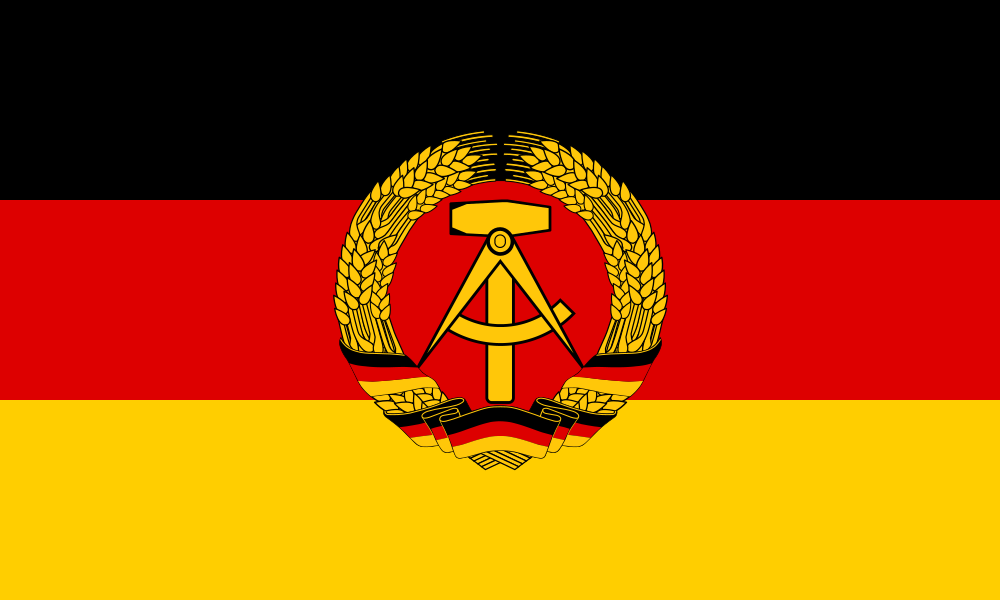
First East German justice minister, dismissed and imprisoned in 1953 after opposing the prosecution of striking workers
A toolmaker from Berlin, he joined the SPD in 1910 and sat in the Prussian Landtag from 1928 to 1933. Under the Nazis he took part in a resistance group and was twice imprisoned. After the war he supported the forced merger of the SPD and KPD, sat on the SED’s Central Committee, and in October 1949 became the GDR’s first Minister of Justice. In the trial of the Gladow gang he had adult criminal law applied unlawfully so that a death sentence was possible. In an interview with Neues Deutschland on 30 June 1953 he said that members of the 17 June strike leadership would not be punished on mere suspicion; denounced as an “enemy of the state and the party”, he was dismissed, expelled and arrested, and sentenced to eight years. Released and pardoned in 1956, readmitted to the party in 1958, he died in 1973.
Soviet Union
Soviet communism
1895–1967
○ Natural causes
Soviet judge at the Nuremberg IMT, death-sentence arbiter of the Great Purge
Before the Nuremberg trials convened, Nikitchenko said: "If… the judge is supposed to be impartial, it would only lead to unnecessary delays."
Deputy Chairman of the USSR Supreme Court (1938–1949) and Soviet judge at the Nuremberg International Military Tribunal (1945–1946), he was a key executor of Stalin-era judicial repression. Joining the Bolsheviks in 1916, he began his career in military tribunals during the Civil War and rose to deputy chairman of the Military Collegium under Vasily Ulrikh, presiding over the Moscow show trials that sentenced Zinoviev and Kamenev to death in 1936. He was one of three principal drafters of the London Charter establishing the IMT's legal framework, and at Nuremberg filed the sole dissenting opinion against the acquittals of Schacht, von Papen, and Fritzsche. Reprimanded by the Party Control Commission in 1940 for 'conveyor-belt' procedural violations in Far Eastern trials, he retired in 1951 and died in 1967.
Career timeline
1916Joined RSDLP (Bolsheviks)
1917–1918Acting commander, Red Guard detachment, Novocherkassk
1918–1920Political worker, 4th Army and Turkestan Front political directorates
1920–1924Deputy chairman and chairman, military tribunals of Semirechye Army Group and Turkestan Front
1924–1926Member, Military Court Collegiate, Moscow Military District
1926–1935Chairman, Military Tribunal, Moscow Military District
1935–1938Deputy Chairman, Military Collegium, USSR Supreme Court
1938–1949Deputy Chairman, USSR Supreme Court
1943Promoted to Major General of Justice
1945Soviet delegate to London Conference — drafter of IMT Charter
1945–1946Soviet judge, Nuremberg International Military Tribunal
1949–1951Head, Dept. of Linear Water Transport Courts, USSR Ministry of Justice
Soviet Union
Soviet communism
1897–1959
○ Natural causes
The justice commissar without a law degree who ran Soviet courts for a decade, from the Great Terror through the war-crimes trials
In July 1940 Rychkov and Prosecutor Pankratyev ordered: any worker more than twenty minutes late after lunch or leaving more than twenty minutes early was to be prosecuted for absenteeism and could be imprisoned.
A Ural factory worker turned justice commissar, he was the only holder of the post without higher education. As a Military Collegium member he took part in the Moscow show trials and chaired mass counter-revolutionary proceedings in the east. Appointed People's Commissar of Justice in 1938, he ran Soviet courts for a decade through the last terror wave, wartime judicial administration, and the post-war open trials of German war criminals. In 1940 he co-signed the decree making twenty minutes' lateness a criminal offence. Dismissed in 1948 after clashing with Party cadres, he served in deputy military-prosecutor posts and retired in 1955.
Career timeline
1909–1917Apprentice turner and metal turner, Nadezhdinsky plant, Urals
Soviet Union
Soviet communism
1897–1988
○ Natural causes
The Supreme Court chairman of rehabilitation who survived Orenburg
When Gorkin became Chairman of the Supreme Court in 1957, petitions poured in from old party members shot in the Stalin years, seeking posthumous rehabilitation. He himself had watched his entire Orenburg bureau perish in the purge.
A peasant-born Bolshevik (joined 1916). After his entire Orenburg party bureau perished in the Great Purge on his watch as first secretary, he became Chairman of the USSR Supreme Court in 1957 and spent fifteen years directing judicial rehabilitation of Stalin's victims.
Career timeline
1916Joined the RSDLP (Bolsheviks)
1917–1919Secretary of Tver City Soviet, Chairman of Tver Provincial Executive
1919Kursk Cheka board member, Penza rural department head
1934–1937First Secretary, Orenburg Regional Party Committee
1937–1938Secretary of the Presidium, USSR Central Executive Committee
1938–1953Secretary, Presidium of the USSR Supreme Soviet (Deputy 1953–56)
1956–1957Secretary, Presidium of the USSR Supreme Soviet (second term)
1957–1972Chairman of the USSR Supreme Court
1959–1961Chairman, Central Audit Commission of the CPSU
In court, he rejected the authorities’ division of the workers into ‘hooligans’ and argued that state violence had helped create the conditions for the explosion.
Stanisław Hejmowski was a Polish lawyer who defended political defendants and vulnerable people in the postwar years. After the 1956 Poznań workers’ uprising, he represented participants and argued that the cases had to be understood not as ordinary crime but as a social conflict produced by state policy and security-force violence. His advocacy challenged coerced investigations and the authorities’ portrayal of workers as hooligans, defending their dignity and legal rights. He was later punished through surveillance, a press campaign, a heavy fine, and suspension from legal practice.
Career timeline
1900Born in Libau, Courland
1924Graduated in law from the University of Warsaw
1928–1930Worked as a prosecutor in Poznań, then entered the bar
1946Defended Arthur Greiser before the Supreme National Tribunal
1956Defended Poznań June participants Jerzy Sroka and Roman Bulczyński
1959Became a major target of Polish security-service surveillance
1961Was suspended from practice and subjected to financial repression
East German jurist who succeeded Fechner as justice minister after the 1953 uprising and led its harsh political trials
Born into a liberal middle-class family in Bernburg, Anhalt, she was among the first women to study law in Germany. A Social Democrat, she married the physician Georg Benjamin, brother of Walter Benjamin, in 1926 and joined the KPD in 1927. Barred from practising law under the Nazis, she lost her husband in Mauthausen in 1942. After the war she worked in the justice administration of the Soviet zone, and as vice-president of the GDR Supreme Court presided over show trials of political undesirables and Jehovah’s Witnesses. On 15 July 1953 she succeeded Max Fechner, who had opposed prosecuting the striking workers, as minister of justice, and her heavy sentences against those arrested in June earned her the names “Red Hilde” and “the Red Freisler”. Ulbricht forced her to resign in 1967. She died in East Berlin in 1989.
Soviet Union
Soviet communism
1903–2007
○ Natural causes
The Supreme Court chairman who purged judges and was removed for rehabilitation measures
In January 1954, Volin's Supreme Court plenum issued a ruling that rehabilitated citizens could reclaim their confiscated housing. The Party leadership immediately branded the interpretation erroneous — and it became the decisive reason for his dismissal three years later.
Born the ninth child of a poor fisherman's family in Kuban, he fought in the Civil War, then rose through workers' faculties and the Leningrad State University law school to become a proletarian jurist. As Prosecutor of the RSFSR from 1939, he led the prosecutor's office through the late Great Terror and the war; as Chairman of the USSR Supreme Court from 1948, he personally organized and supervised judicial panels that purged sitting judges through 1952. But in January 1954 his court's plenum issued guidance suggesting rehabilitated citizens might reclaim their confiscated housing, a position the Party leadership soon branded erroneous, and in February 1957 he was dismissed. He served twelve more years as Deputy Chief Arbitrator of the State Arbitration Commission and lived to 104, the longest-lived senior Soviet judicial official.
Career timeline
1920–1921Worker, Temryuk fish factory
1921Chief of secret section, Red Army unit HQ; Civil War participant
1923–1926Student, workers' faculty, Krasnodar
1925Joined RCP (Bolsheviks)
1930Graduated, Law Faculty, Leningrad State University
1930–1931Postgraduate, Communist Academy, Leningrad
1931–1932Lecturer and department head, Leningrad University
1932–1933Head of culture and public education sector, Karelian ASSR
Soviet Union
Soviet communism
1904–1972
○ Natural causes
USSR Prosecutor General who served at Nuremberg and was removed for refusing to sanction Beria's arrest
On 30 June 1953, Safonov refused to sign the arrest warrant for Beria, saying: "He is a deputy of the Supreme Soviet. Deputies' immunity is written into the Constitution." He was removed that same day.
Born the son of a blacksmith in Rostov, Yaroslavl province, he graduated from Leningrad State University's law faculty in 1925 and worked as legal counsel for Leningrad factories while lecturing in civil law. Spotted by Vyshinsky, he entered the procuracy in 1935 and became Deputy Prosecutor of the USSR at age 35 in 1939, later serving as First Deputy Prosecutor and taking part in the Nuremberg trials. Appointed Prosecutor General in February 1948, he led the Soviet procuracy through the late Stalin years, but on 30 June 1953 he refused to sign the arrest warrant for Lavrentiy Beria, citing Beria's parliamentary immunity as a Supreme Soviet deputy, and was removed the same day. He was demoted to minor posts in the Moscow regional procuracy and served quietly until his retirement in 1968.
Career timeline
1925–1935Legal counsel and head of legal bureau, Leningrad enterprises; civil law lecturer, Institute of Soviet Law
1935–1939Prosecutor, Okulovsky district then Kirovsky district, Leningrad
1939Head of civil-judicial department, USSR Procuracy
1939–1948Deputy Prosecutor, then First Deputy Prosecutor of the USSR (Prosecutor General from 1946)
1945–1946Served on the Soviet prosecution team, Nuremberg International Military Tribunal
1948–1953Prosecutor General of the USSR
1955–1957Deputy prosecutor, Moscow District Transport Procuracy
1957–1968Deputy head of criminal-court supervision department, then prosecutor in investigations directorate, RSFSR Procuracy
Soviet Union
Soviet communism
1907–1978
○ Natural causes
The USSR's first Prosecutor General who organized war crimes trials and handed Khrushchev the statistics of the Great Terror
In February 1954 Gorshenin handed Khrushchev the first official tally of everyone sentenced to death, exile, and camps for counter-revolutionary crimes from 1921 to 1954. Drawn up after Stalin's death, those figures launched the thaw-era rehabilitations.
Born to a railway-worker family in Alatyr, he graduated from the Moscow Institute of Soviet Law as a labour-law scholar. Named Prosecutor General in 1943, he sat on the secret Politburo commission approving all death sentences while organising the Vlasov and Krasnov trials and preparing the Soviet case for Nuremberg and Tokyo. As Minister of Justice (1948–1956) he worked to regularise the courts, yet in February 1954 he submitted to Khrushchev the first official tally of victims repressed from 1921 onward, and in 1956 he co-initiated with Zhukov and Rudenko the Central Committee resolution rehabilitating former POWs. After the ministry was abolished he returned to academia, directing the All-Union Institute of Legal Sciences and working on the codification of Soviet labour law.
Career timeline
1935–1937Deputy Director for academic affairs, Kazan Institute of Soviet Law
1937–1940Head of educational institutions, board member, USSR People's Commissariat of Justice
1940–1943People's Commissar of Justice, RSFSR
1943–1948Prosecutor/Prosecutor General of the USSR (title 'General' from 1946)
1943–1947Member, secret Politburo commission on death sentences
1948–1956Minister of Justice of the USSR
1952–1956Candidate member, CPSU Central Committee
1956–1963Director, All-Union Institute of Legal Sciences
1963–1967Head of labour and social security legislation sector, VNIISZ
Soviet Union
Soviet communism
1907–1981
○ Natural causes
Chief Soviet prosecutor at Nuremberg, the longest-serving head of the Soviet procuracy
On 8 February 1946 in Nuremberg, Rudenko opened the Soviet prosecution case by condemning the Nazi leadership for instilling in the German people 'the morals of cannibals and the greed of burglars.'
Born to a Ukrainian Cossack family, he joined the Party in 1926 and became Procurator of the Ukrainian SSR in 1944. At the Nuremberg Trials he served as the USSR's chief prosecutor, cross-examining Göring and laying bare the machinery of Nazi war crimes. Appointed Procurator General in 1953, he held the post for 28 years: leading the Beria prosecution, chairing the commission that rehabilitated victims of Stalinist repression under Khrushchev, and later collaborating with Andropov on 'prophylactic' measures against dissidents. He embodied the duality of the Soviet procuracy: an instrument of terror under Stalin and an architect of its post-Stalin legal consolidation.
Career timeline
1929Senior investigator, Chernigov district procuracy
Soviet Union
Soviet communism
1911–1986
○ Natural causes
From Nuremberg assistant prosecutor to chief justice of the USSR, the Supreme Court chairman who presided over political trials
In February 1966, RSFSR Supreme Court Chairman Smirnov personally sentenced writers Andrei Sinyavsky and Yuli Daniel to seven and five years of hard labour for anti-Soviet agitation — they had published satirical fiction abroad under pseudonyms.
A Leningrad University law graduate who joined the procuracy in 1934, he served as assistant to chief Soviet prosecutor Roman Rudenko at Nuremberg (presenting the case for Nazi crimes against civilians across occupied Europe) and as deputy prosecutor at the Tokyo tribunal, establishing Japanese aggression at Lake Khasan and Khalkhin Gol. As chairman of the RSFSR Supreme Court he personally presided over the Sinyavsky–Daniel trial (1966), sentencing two writers to hard labour for publishing satirical works abroad, and in 1972 he became chairman of the USSR Supreme Court, leading the Soviet judiciary through twelve years of the Brezhnev era. He embodied the duality of the Soviet legal establishment: a jurist who prosecuted fascism at international tribunals while enforcing political conformity at home.
Career timeline
1934–1941Senior investigator, Leningrad/Murmansk procuracy; military investigator, Leningrad Front
1942–1946Investigator for especially important cases, USSR Procuracy; assistant to chief prosecutor at Nuremberg
1946–1948Deputy prosecutor from USSR, Tokyo International Military Tribunal
Even in 1989, he maintained that Imre Nagy was guilty and expressed no regret for the judgment.
Ferenc Vida was a communist lawyer who had taken part in the illegal movement, endured imprisonment, and rose through Hungary’s postwar party and judicial bureaucracy. After the 1956 Revolution he became one of the judges who imposed the greatest number of death sentences in the state’s retaliatory trials. In the 1958 trial of Imre Nagy, he chaired the Supreme Court’s People’s Court Council, sharply restricting defendants’ statements and the defence’s requests for evidence, and sentenced Nagy, Miklós Gimes and Pál Maléter to death. He still refused in 1989 to acknowledge the trial’s illegality or express remorse.
Career timeline
1934Graduated from Szeged law academy and helped found the Palestine Communist Party
1935–1942Joined Hungary’s illegal communist movement and worked as a trainee lawyer
1942–1945Sentenced to life imprisonment in the Schönherz trial and deported to Germany
1945–1949District party secretary and adviser to the Ministry of the Interior
1951–1953Worked in the Ministry of Justice
1953–1972Judge of the Supreme Court, presiding over People’s Court Councils and serving as deputy head of a judicial college
1958Presiding judge in the Imre Nagy trial, issuing death sentences
A legal functionary who defined order against a workers’ revolt
On 17 July 1956, he said the investigation would distinguish striking workers from “trouble-makers, criminals and provocateurs.”
Marian Rybicki was a Polish lawyer and communist politician who helped institutionalize the postwar state through senior party, legal, and administrative work. After the Poznań workers’ revolt in 1956, as Prosecutor General, he publicly advanced a “two currents” line distinguishing striking workers from “trouble-makers, criminals and provocateurs.” The distinction separated workers’ economic grievances from alleged criminal responsibility, but it also framed the investigations and trials that followed. He later served as justice minister and worked as a legal scholar concerned with law and governance in a socialist state.
Career timeline
1937Graduated in law from the University of Warsaw
1945–1947Worked in the Legal Department of the Presidium of the National National Council
1947–1948Served on the Executive Committee and Secretariat of the Polish Socialist Party
1948–1954Member of the Organizational Bureau of the Polish United Workers’ Party Central Committee
1952–1956First Secretary of the Council of State
1956–1957Prosecutor General of the Polish People’s Republic
1957–1965Minister of Justice
1965–1983Professor at the Polish Academy of Sciences’ Institute of State and Law, and secretary of the All-Poland Committee of the Front of National Unity
Soviet Union
Soviet communism
1916–2004
○ Natural causes
Jurist who revived the abolished Justice Ministry and directed the codification of Soviet legislation
The Latin word justitia means justice — which is fairness. He made this principle his lifelong guide.
When the USSR Ministry of Justice was re-established in 1970, fourteen years after its abolition, Terebilov was the man entrusted with its reconstruction. As Minister of Justice from 1970 to 1984, he oversaw the review of over 400,000 normative acts, producing the 50-volume Collected Legislation of the USSR and the 11-volume Code of Laws, and steered the 1979 Law on the Bar, the first statute to define the legal status of the Soviet legal profession. Appointed Chairman of the USSR Supreme Court in 1984, he worked to strengthen judicial independence and advance the rehabilitation of victims of repression, but was compelled to resign in 1989 after corruption allegations surfaced during the Uzbek Cotton Scandal investigation. In retirement he taught the moral foundations of criminal procedure at Moscow State University.
Career timeline
1939Prosecutor, Pargolovo District, Leningrad Region
1941Commissar of workers' detachment, Leningrad defence
1945Prosecutor, Primorsky District, Leningrad
1949Senior Researcher, All-Union Institute of Criminology
1957Senior Assistant to USSR Prosecutor General; Deputy Head of Investigative Directorate
1962Deputy Chairman, USSR Supreme Court
1970USSR Minister of Justice
1984Chairman, USSR Supreme Court
1989Docent, Faculty of Law, Moscow State University
Soviet Union
Soviet communism
1920–1996
○ Natural causes
Soviet Procurator General who served from Brezhnev to Gorbachev and personally delivered Sakharov's exile decree
On 22 January 1980, Rekunkov read Sakharov the decree stripping him of the title Hero of Socialist Labour and exiling him to the closed city of Gorky.
Born into a peasant family on the Don, he fought in the Great Patriotic War and was severely wounded before entering the procuracy. Rising through Rostov's regional prosecutor offices, he became First Deputy Procurator General in 1976 and succeeded Rudenko as Procurator General in 1981. Under Andropov he spearheaded high-profile anti-corruption campaigns (the Uzbek cotton case and trade-ministry prosecutions), while in 1980 he had personally read Sakharov the decree stripping his state awards and exiling him to Gorky. After retirement he worked in the department rehabilitating victims of political repression, embodying the procuracy's dual role as guardian of socialist legality and instrument of state coercion.
Career timeline
1945–1946Assistant Prosecutor, Verkhne-Don District, Rostov Oblast
1947–1952Prosecutor, Konstantinovsky then Azov District, Rostov Oblast
1960–1966Prosecutor of Bryansk Oblast
1966–1971Prosecutor of Voronezh Oblast
1971–1976First Deputy Procurator of the RSFSR
1976–1981First Deputy Procurator General of the USSR
1981–1988Procurator General of the USSR
1981–1989Member, CPSU Central Committee
1979–1989Deputy, Supreme Soviet of the USSR
1992–1994Prosecutor, Rehabilitation Dept. for Victims of Political Repression, Russian Federation Procuracy
Soviet Union
Soviet communism
1923–2021
○ Natural causes
The last reform-era Procurator General of the USSR, who oversaw the legal rehabilitation of Stalin's victims during perestroika
"Prosecutors must be closer to the life of the people," Sukharev declared after becoming Procurator General in 1988, as his office processed the rehabilitation of hundreds of thousands of victims of political repression.
Born into a peasant family in Voronezh, he worked as a lathe operator at an aircraft factory as a teenager before going to the front at 18. As a signals officer he advanced from Moscow to the Vistula, earning four combat orders, and was severely wounded crossing the Narew River in Poland in 1944. After demobilisation he rose through the Komsomol and the CPSU Central Committee apparatus specialising in procuracy and justice, becoming first deputy minister of the re-established USSR Ministry of Justice in 1970. Appointed Procurator General by Gorbachev in 1988, he pushed forward the mass legal rehabilitation of victims of Stalinist repression. After retiring in 1990 he directed the research institute under the Russian procuracy, devoting his remaining decades to strengthening legality and criminal justice reform.
1947–1950Secretary, Komsomol Railway District Committee; Department Head, Voronezh Oblast Komsomol Committee
1950–1959Instructor, Deputy Head, then Head of International Department, Komsomol Central Committee
1959–1966Instructor, then Deputy Head for RSFSR, Administrative Organs Department, CPSU Central Committee
1966–1970Head of Procuracy, Court and Justice Sector, Administrative Organs Department, CPSU Central Committee
1970–1984First Deputy Minister of Justice of the USSR
1984–1988Minister of Justice of the RSFSR
1988.02–05First Deputy Procurator General of the USSR
1988–1990Procurator General of the USSR
1991–2006Deputy Director, Director, then Chief Researcher, Institute for Problems of Strengthening Legality and Legal Order, Russian Federation Procuracy
The president's brother and attorney general who engineered the secret settlement of the Cuban Missile Crisis
He later wrote: 'The strongest argument against an all-out surprise attack was that it would be a Pearl Harbor in reverse and would blacken the name of the United States in the eyes of the world.'
The younger brother and most trusted adviser of President John F. Kennedy, he was appointed attorney general at 35 and led a crusade against organized crime while championing civil rights. During the 1962 Cuban Missile Crisis, he initially favored invasion but was persuaded by George Ball's Pearl Harbor analogy to support a naval blockade instead; in the crisis's final hours, his secret meeting with Soviet Ambassador Dobrynin, delivering the promise that U.S. Jupiter missiles would be removed from Turkey, was the key to the settlement. After his brother's assassination, he served as a U.S. Senator, opposing the Vietnam War and fighting poverty, before being assassinated during his own presidential campaign in 1968.
Career timeline
1952Campaign manager, JFK Senate campaign
1953–1955Assistant/Counsel, Senate Permanent Subcommittee on Investigations