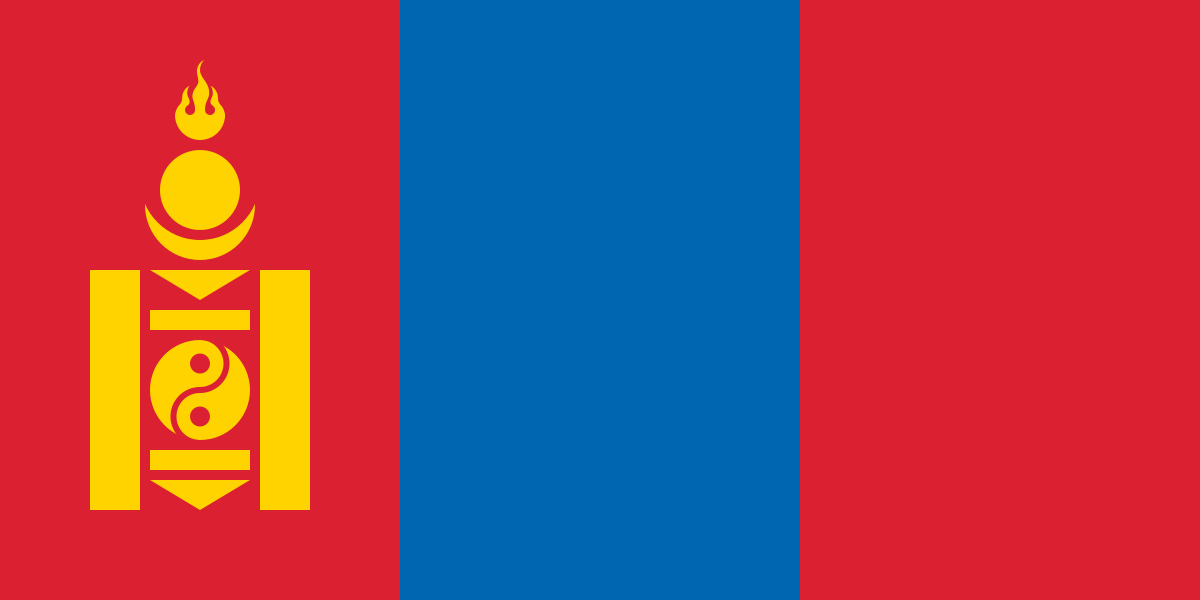
First prime minister of the Mongolian People's Republic, diplomat of the old regime
On 23 September 1924 a constitution-drafting commission chaired by Prime Minister Tserendorj was set up, and on 26 November 1924 the first Great Hural unanimously adopted its 6-chapter, 50-article constitution declaring Mongolia's first republican order.
Born in 1868 at Kherlen Bayan Ulaan as a subject of the Jebtsundamba Khutuktu's Great Shabi, he learned Mongolian, Manchu, Chinese and Russian and worked as a scribe and translator in the Manchu administration in Khüree from 1885 to 1911. After the 1911 independence he entered the Foreign Ministry, serving as deputy foreign minister in 1913-1915 and first-ranked minister in 1915-1919. He signed the 1919 renunciation document under Chinese occupation and became deputy foreign minister in the revolutionary government of 1921. Appointed prime minister in 1923, he headed the 1924 constitution-drafting commission and became the republic's first prime minister. After 1926, as Moscow tightened control, he resisted the abolition of private property and the persecution of the Buddhist Church, and he died of illness in office in 1928; sources give his death as 13 February or 13 November 1928.
Career timeline
1885–1890Scribe in the Manchu administration in Khüree
1890–1904Teacher at the Russian consulate's translator school
1904–1911Chinese-language translator in the Manchu ministry in Khüree (6th rank)
1913–1915Deputy foreign minister of Autonomous Mongolia
1915–1919First-ranked minister of foreign affairs
1923–1928Prime minister of Mongolia, from 1924 of the Mongolian People's Republic
Founder of Soviet Marxist historiography, posthumously repudiated
In December 1920 Lenin wrote to Pokrovsky: "I was extremely pleased with your new book. The presentation and approach are original. It reads with tremendous interest… it should become a textbook."
A student of Klyuchevsky who became the founder of Soviet Marxist historiography, rebuilding Russian history on class analysis and economic determinism. A Bolshevik from 1905, he participated in the October Revolution and from 1918 built the institutional skeleton of Soviet scholarship: the Communist Academy, Institute of Red Professors, Istpart, Institute of Lenin, and Central Archive. His thesis that tsarist autocracy was 'merchant capital in the cap of Monomakh' defined early Soviet history education, but under Stalin the 'school of Pokrovsky' became a pretext for purging scores of historians.
Career timeline
1887–1891Graduated Moscow University history; studied under Klyuchevsky and Vinogradov; retained to prepare for professorship
1896–1905Moved from 'legal Marxism' to revolutionary social democracy; joined RSDLP (Bolsheviks) 1905; first met Lenin in Geneva
1905–1907Moscow Bolshevik lecturer group and newspaper Borba editor; December uprising participant; delegate to 5th (London) RSDLP Congress, candidate CC member
1908–1917Exile: aligned with Vpered group then non-factional; returned to internationalist line in WWI; wrote five-volume Russian History (1910–1913)
1917–1918Chairman of Moscow Soviet (Nov 1917–Mar 1918); Brest-Litovsk peace delegation member
1918–1932Deputy People's Commissar for Enlightenment; directed higher education, science, archives; headed Communist Academy, Institute of Red Professors, Istpart, Institute of Lenin, Central Archive
1920–1923Published Russian History in the Most Concise Outline — the standard early Soviet history textbook
1929–1932First Marxist elected full member of USSR Academy of Sciences (1929); Presidium of Central Control Commission (1930–1932); died of cancer
"Man, that's the truth!" - The Lower Depths (1902)
Alexei Peshkov, son of the carpenter Maxim Peshkov, was born in Nizhny Novgorod and drifted through Russia's lower depths as a dockhand and a tramp before becoming Maxim Gorky with the short story "Makar Chudra" in 1892. Before 1917 he was the Bolsheviks' greatest patron, but in 1917 and 1918 he attacked Lenin's violence in "Untimely Thoughts", and that quarrel was not a final break. He left for Italy in 1921 because of tuberculosis and settled in Sorrento; the most widely repeated account dates his definitive return to October 1932, while Basinsky dates it 9 May 1933. After returning he glorified Stalin, endorsed collectivization and the labour-camp system, and died at Gorki on 18 June 1936 after a long illness; the rumours of poisoning were never confirmed.
Career timeline
1892–1917Rises from tramp-laborer to world fame; funds the Bolsheviks
1917–1921'Untimely Thoughts' in Novaya Zhizn — open criticism of revolutionary violence
1921–1933Lives abroad in Sorrento, nominally for his health
1932–1936Returns; first head of the Writers' Union, codifies socialist realism
Bolshevik agrarian policymaker: first Agriculture Commissar, later VP of Ukraine's Academy of Sciences
In October 1905 he led multi-thousand revolutionary meetings in Kyiv, and after the 17 October Manifesto the crowd wrecked the City Duma building. His 18 October 1905 balcony speech became a charge in his 1908–09 trial; he fled to Finland and was later exiled to Siberia.
Born 20 August (O.S.)/1 September 1868 in Lubny, Poltava Governorate; died 2 December 1940 in Kyiv. His grandfather emigrated from Württemberg in 1818; his father was a carpenter; his mother came from impoverished Polish landowner nobility. The family took Russian subjecthood in 1882, and he took it himself at university. He joined a Social-Democratic student circle in Bern in 1891 and was a delegate to the 5th RSDLP Congress (London, 1907). In November 1917 he became RSFSR People's Commissar for Agriculture, then People's Commissar for Food (December 1917 – February 1918), enforcing the grain monopoly and requisitioning. Removed as Tambov Governorate Executive Committee chairman in 1920–21 for failing against the Tambov rebels, he later served as People's Commissar for Land Affairs of the Ukrainian SSR (1927–29) and vice-president of Ukraine's Academy of Sciences (1931–38).
Career timeline
1891Joined Social-Democratic student circle at Kharkiv University
1898Joined RSDLP; exiled to Vologda for 5 years, moved to Samara for TB treatment
The Bolshevik elder removed by Stalin for trying to Sovietize Georgia gently
"The establishment of Soviet power in Georgia had the outward appearance of a foreign occupation, because in the country itself there was nobody ready to take part in a rebellion": report to the Central Committee, December 1921
Born in Guria to a priest's family, Makharadze studied at Tbilisi Theological Seminary and the Warsaw Veterinary Institute before joining the Social Democratic movement in 1891. He became one of the few Bolshevik leaders in Menshevik-dominated Georgia, and as chairman of the Georgian Revolutionary Committee in February 1921 proclaimed the Soviet republic, only to be removed by Stalin in July for his moderate treatment of the Menshevik opposition and insistence on Georgian sovereignty, replaced by Mdivani. This ousting was the direct prelude to the 1922 Georgian Affair; Makharadze later held the chairmanships of Gosplan, Sovnarkom, and the Supreme Soviet Presidium in Georgia, and was one of the few Old Bolsheviks to survive the Great Purge, dying a natural death in 1941.
Career timeline
1891Joined the Social Democratic movement
1903Member of the Caucasian Union Committee of the RSDLP; active in the 1905 Revolution
1907–1915Led Bolshevik underground groups in Transcaucasia
1917Editor of Kavkazsky Rabochy; member of the Caucasian Regional Committee of the RSDLP(b)
1918–1920Underground work in Menshevik-ruled Georgia
1921.02–07Chairman of the Georgian Revolutionary Committee; removed by Stalin for moderation
1922–1938Chairman of CEC Georgia, Sovnarkom Georgia, Gosplan ZSFSR, CEC ZSFSR
1938–1941Chairman of the Presidium of the Supreme Soviet of Georgia; Deputy Chairman of the USSR Supreme Soviet
Co-founder of Istpart, who laid the institutional foundations of Party historiography
Once I visited him at home. He was then living in the Government Building by the Stone Bridge, now Serafimovich Street. I remember that in his study, right by his desk, millet was scattered on the floor and little chicks were pecking at it. In reply to my startled look he said: 'It's pleasant to see young life.' — From the memoirs of Boris Urlanis
Born the son of a village priest, he studied at St. Petersburg University before joining the revolutionary movement. He shared Siberian exile with Lenin in 1897 and later served as an agent for Iskra. After October he led school reform at the People's Commissariat of Enlightenment, and in 1921 he became one of the founders of Istpart, the commission that institutionalised the study of Party history. In his later years he directed the Historical Museum and the Museum of the Revolution, and he is remembered for his vivid memoir At the Turning Point, which chronicles Lenin's years in exile.
Career timeline
1886–1891Studied at St. Petersburg University; organised underground student circles; expelled in 1890; completed degree externally at Kiev University
1895–1897Active in the League of Struggle for the Emancipation of the Working Class; arrested, imprisoned and exiled to Yenisei province alongside Lenin
1900–1905Iskra agent in Pskov; in emigration helped build the Party library and archive in Geneva
1918–1920Collegium member at the Commissariat of Enlightenment and head of school reform; co-drafted the Statute on the Unified Labour School; founded an experimental school-commune in Litvinovichi
1919–1920Deputy People's Commissar of Enlightenment for the Turkestan Republic; organised teacher training and the first republic-wide education congress in Tashkent
1921–1924Co-founder and deputy chairman of Istpart (Commission on Party History); built the institutional foundation for Party historiography
1925–1927Chairman of the Central Committee of MOPR (International Red Aid) in the USSR
Actress turned Bolshevik financial agent whom Lenin called 'Comrade Phenomenon'
In 1903, passing as the wife of a senior railway official, she hid a wanted underground activist in her first-class compartment while delivering a suitcase of May Day leaflets to Gorky.
Maria Andreyeva was a leading actress of the Moscow Art Theatre and stage partner of Konstantin Stanislavski who, after joining the Bolsheviks in 1904, became one of the party's most effective financial agents. Her fundraising prowess (channeling fortunes from industrialists like Savva Morozov into Lenin's coffers) earned her the party alias 'Comrade Phenomenon,' and during her eighteen years as Maxim Gorky's common-law wife she was the material and practical backbone of his literary work and propaganda tours abroad. After the October Revolution she served as Commissar of Theaters and Public Shows in Petrograd, co-founded the Bolshoi Drama Theatre, and later directed the Moscow House of Scientists for eighteen years, dedicating her final decades to building Soviet cultural institutions.
Career timeline
1894–1898Actress, Russian Society of Art and Literature
"Capitalism cannot reform itself": father of the modern Negro liberation movement who joined the Communist Party at 93
"Communism will triumph. I want to help bring that day." — from his 1961 application to join the Communist Party USA, submitted at age 93
American sociologist, historian, Pan-Africanist, and the single most important African American intellectual of the 20th century. A co-founder of the NAACP, he edited its magazine The Crisis for 24 years, shaping the direction of the black civil rights movement, while his books The Souls of Black Folk and Black Reconstruction in America transformed American sociology and historiography. He viewed capitalism as the root cause of racism and pursued a synthesis of Marxism and Pan-Africanism. In 1961, at age 93, he joined the Communist Party USA; invited by Kwame Nkrumah, he settled in Ghana to begin work on the Encyclopedia Africana, and died there in 1963.
Career timeline
1895–1897Wilberforce University; University of Pennsylvania researcher, published The Philadelphia Negro (1899)
1897–1910Atlanta University professor; published The Souls of Black Folk (1903); founded Niagara Movement (1905)
1910–1934NAACP co-founder, editor of The Crisis; organized Pan-African Congresses
1934–1944Atlanta University professor; published Black Reconstruction in America (1935)
1944–1948NAACP Director of Special Research; attended UN founding conference
1950–1951Peace Information Center chair; indicted under FARA, acquitted
1961–1963Joined CPUSA; emigrated to Ghana, began Encyclopedia Africana
She built the Soviet school and library system from the shadow of her husband
Trotsky described her Iskra room: it always smelled of burned paper, because she warmed the secret letters over a flame to read them, and she kept the aliases and addresses of hundreds of underground agents in her head.
Lenin's wife and closest comrade, but an organizer in her own right. Born in Saint Petersburg into an impoverished noble family, she joined Marxist circles and taught and propagandized among workers before marrying Lenin in Shushenskoye exile in 1898. As Iskra's secretary in emigration she ran the network of codes, aliases and addresses through which the party held together, and after 1917 she built Soviet education: the likbez literacy campaign, the unified labor school and a nationwide library network. In 1925 she briefly backed the New Opposition, then publicly recanted, and in 1928 her attack on Chukovsky's fairy tales effectively barred him from children's literature. She also ran the purging of 'harmful' library stock, yet intervened for intended victims of the terror. She died of peritonitis on 27 February 1939, the day after her 70th birthday; her ashes rest in the Kremlin Wall.
Career timeline
1887Graduated Obolenskaya Gymnasium with a gold medal
1889–1890Attended Bestuzhev Courses; joined a Marxist student circle
1891–1896Taught at an evening school for workers beyond the Neva Gate; propaganda work
1898Married Lenin in Shushenskoye exile; joined the RSDLP
1901–1905Exile in Munich and London; secretary of the newspaper Iskra
1905–1907Returned to Russia; secretary of the Bolshevik Central Committee
1911Taught at the Party school in Longjumeau; co-founded the women's journal Rabotnitsa
1917–1920Participated in the October Revolution; designed Komsomol and Pioneer movements; chair of Glavpolitprosvet
1924–1927Member of the Central Control Commission; briefly supported the New Opposition at the 14th Congress (1925), then recanted
1927–1939Member of the Central Committee of the VKP(b)
1929–1939Deputy People's Commissar for Enlightenment of the RSFSR; led Soviet education, library and censorship policy
1931Elected honorary member of the USSR Academy of Sciences; awarded doctorate in pedagogy
1937Elected deputy of the USSR Supreme Soviet (1st convocation); member of its Presidium
The Bolshevik physician who built the USSR Supreme Court and led it for fourteen years
On 30 August 1918, when Lenin was carried into the Kremlin bleeding from an assassin's bullets, it was Vinokurov — a trained physician — who gave him first aid. Nobody imagined that six years later the doctor would sit at the apex of Soviet justice.
A Bolshevik jurist trained as a physician, Vinokurov served as the first Chairman of the USSR Supreme Court (1924–1938) and built the institutional foundations of the Soviet judiciary. A revolutionary of the first generation, he co-founded the Moscow Social Democratic organisation in 1893, joined the Bolsheviks in 1903, and chaired the first Bolshevik Petrograd City Duma in October 1917. He treated Lenin's wounds after the 1918 assassination attempt and, as People's Commissar of Social Security (1918–1921), laid the groundwork for Soviet welfare administration. Throughout his Supreme Court tenure he rivalled Vyshinsky and Krylenko for control of the justice apparatus, holding a comparatively legalistic line while remaining institutionally implicated in the Great Terror. Dismissed in 1938 and relegated to a health-education post, he died of natural causes in 1944.
Career timeline
1893–1902Co-founded Moscow and Yekaterinoslav Social Democratic organisations; arrested, solitary confinement, exile
1903–1917Bolshevik party work in Yekaterinoslav and St. Petersburg; editor of 'Insurance Questions' journal
1917.10Chairman of the first Bolshevik Petrograd City Duma; collegium member, People's Commissariat of Labour
1918–1921People's Commissar of Social Security of the RSFSR
1921–1924Member of the Famine Relief Commission and Commission to Combat the Effects of Famine
1924–1938Chairman of the Supreme Court of the USSR
1938–1944Head of Health Education, People's Commissariat of Health; later at Medgiz
The botanist who led the Soviet Academy of Sciences through the Stalin years
At a 1939 Academy session, Komarov publicly backed Lysenko's assault on genetics; when the session ended, in a private conversation with Vavilov and Kostov, he subjected Lysenko's views to blistering criticism. Vavilov, disgusted by the duplicity, likened him to Vasily Shuisky.
Vladimir Komarov, botanist and plant geographer, served as President of the USSR Academy of Sciences (1936–1945). His expeditions across the Far East, Manchuria, Kamchatka, and Central Asia built vast collections; his Flora of Manchuria brought international recognition. He oversaw the 30-volume Flora of the USSR, cataloguing over 17,500 species: the landmark of Soviet taxonomy. He systematized the morpho-geographical method and established Academy branches across the Far East, Urals, Caucasus, and Central Asia. Leading the Academy through the Purge and war, he publicly endorsed Lysenko while privately disparaging him to Nikolai Vavilov: a double stance emblematic of scientists under Stalin. He chaired the wartime commission mobilizing Urals, Siberian, and Kazakh resources for defence; his name was given to the Komarov Botanical Institute.
Career timeline
1894Graduated St. Petersburg University with degree in botany
1895–1897Expedition to the Far East, Manchuria, and northern Korea
Leader who took the SFIO majority into the Comintern at Tours in 1920, founding the French Communist Party, and ran L’Humanité
At the 1920 Tours Congress, he backed SFIO affiliation with the Comintern, led the majority split, and helped found the French Communist Party. Arrested in 1923 for opposing France’s Ruhr occupation, he was cleared by the Senate sitting as a High Court.
Born in Paimpol in Brittany, he joined Guesde’s French Workers’ Party in 1891 and the unified SFIO in 1905, and from 1918 ran L’Humanité for the rest of his life. As his supporters swung towards the October Revolution after the war, he led the vote to join the Comintern at the Tours congress of 1920 and became a founder of the French Communist Party. He was jailed in 1923 for denouncing the French occupation of the Ruhr. A deputy and senator, he remained the party’s elder statesman until his death in 1958.
Career timeline
1892Joined the Gironde section of the French Workers’ Party, founded by Jules Guesde and Paul Lafargue.
1905Took part in the founding congress of the unified Socialist Party (SFIO) and became its propaganda delegate.
1918Elected director of L’Humanité, which he led until his death in 1958.
1920At the Tours Congress, supported SFIO affiliation with the Comintern and helped found the French Section of the Communist International (SFIC), predecessor of the French Communist Party.
1923Arrested for opposing France’s Ruhr occupation and brought before the Senate sitting as a High Court; it ruled there was no case to answer.
1936Elected senator for the Seine, becoming the first senator from the French Communist Party.
Night, 16 April 1917 (3 April O.S.), Finland Station, Petrograd. Returning from exile, Lenin spoke from an armoured car, condemning the Provisional Government and calling for a continent-wide European proletarian revolution; over the following days he set out the April Theses.
Lenin was a Russian revolutionary, politician and theorist, born Vladimir Ilyich Ulyanov in Simbirsk in the Russian Empire. He led the Bolshevik faction from the 1903 RSDLP split and directed the October Revolution of 1917. His government redistributed land, nationalised banks and large industry, withdrew from the First World War by the Treaty of Brest-Litovsk, and promoted world revolution through the Communist International. At the same time its state security services carried out the Red Terror, in which tens of thousands were killed or interned, and it defeated right- and left-wing anti-Bolshevik armies in the Civil War of 1917–1922. Facing wartime devastation, famine and popular uprisings, he proposed the New Economic Policy in 1921. He died at Gorki on 21 January 1924, and Stalin succeeded him as the pre-eminent figure in the Soviet government.
Career timeline
1895–1900Arrest; Siberian exile
1900–1905Iskra and What Is to Be Done?; the Bolshevik faction forms
1902Published What Is to Be Done?
1909Published Materialism and Empirio-criticism
1914–1917Zimmerwald Left: turn the imperialist war into civil war
1916Wrote and published Imperialism, the Highest Stage of Capitalism
1917.04Returns; the April Theses
1917.10Forces the insurrection; chairs Sovnarkom
1918–1921Brest peace, civil war, War Communism
1918Published The State and Revolution, written in 1917
1921The retreat into NEP
1922–1924Strokes; dictates the Letter to the Congress
From Azerbaijani Enlightener to a Head of the Soviet State
When oil magnate Taghiyev tried to silence him at the 1906 Teachers' Congress, Narimanov renounced his scholarship and declared: "I will not be silenced for despicable metal while comrades shed blood against the tsarist yoke."
A teacher, physician, and writer, Narimanov opened a public reading room in Baku and produced some of the earliest works of Azerbaijani realist literature. After joining Hummet in 1905, he entered revolutionary politics, led the government of Soviet Azerbaijan from 1920, and later became a co-chairman of the USSR Central Executive Committee. His attempt to join national emancipation to socialism brought him into tension with centralizing nationalities policy; after his death in 1925, he was interred in the Kremlin Wall.
Career timeline
1890Teacher in Kizil-Ajili village, Borchaly district
1891–1902Teacher at Baku private progymnasium; founded and ran the 'Narimanov Reading Room' (1894)
1895–1899Published plays and fiction incl. Bahadur and Sona (1896) and Nadir Shah (1899); translated and staged Gogol's The Government Inspector (1896)
1905Joined the Muslim Social Democratic organisation Hummet
1908Graduated from Novorossiysk University medical faculty, licensed physician
1909–1914Arrested and exiled to Astrakhan for 5 years; practised medicine, organised Muslim theatre, chaired the Council of People's Universities
1917Member of the Baku Bolshevik committee, editor of the newspaper Hummet
1918Commissar for Municipal Economy, Baku Council of People's Commissars
1919Head of the Near East Department, RSFSR People's Commissariat of Foreign Affairs
1920–1922Chairman of the Azerbaijani Revolutionary Committee and Council of People's Commissars; concurrently People's Commissar for Foreign Affairs (1920–1921)
1922Chairman of the Union Council, ZSFSR (Mar–Dec); member of the Soviet delegation to the Genoa Conference
1922–1925Chairman of the USSR Central Executive Committee — one of the formal heads of the Soviet state
1923–1925Candidate member, Central Committee of the Russian Communist Party (Bolsheviks)
From revolutionary engineer to Soviet diplomatic architect, the only Bolshevik who could do business with Western capital
In 1893, the young Krasin visited Tolstoy to argue that revolution was inevitable. The great apostle of non-violence "began to stamp with rage," as Krasin's wife Liubov, who was present, recorded.
From Siberian exile under the Tsar to general director of Siemens-Schuckert Russia, then to the Soviet state's first People's Commissar of Foreign Trade, Krasin's trajectory was unique among Bolsheviks. During the 1905 revolution he led the Combat Technical Group, handling arms and finance, and built the underground 'Nina' press in Baku to print Iskra. He quit politics in 1909, rose through Siemens to become its Russian head, then returned at Lenin's call in 1918. Architect of the state monopoly on foreign trade and the 1921 Anglo-Soviet Trade Agreement, he was the only senior Bolshevik at home in Western business circles; Lenin rated him the party's ablest practical organizer.
Career timeline
1903–1907Member, RSDLP Central Committee
1905Head, Combat Technical Group, CC RSDLP
1913–1917General Representative, Siemens-Schuckert in Russia
1918–1920People's Commissar of Trade and Industry, RSFSR
1919–1920People's Commissar of Railways, RSFSR
1920–1925People's Commissar of Foreign Trade, USSR
The Civil War food administrator who designed the grain dictatorship
A story tells that he fainted from hunger on a train while travelling to organize grain seizures, but the anecdote is unverified; it circulated in the 1939 film Lenin in 1918, and one chronicle calls it a tale from later Soviet propaganda. Lenin's June 1919 order doubling his salary is documented.
Born in 1870 at Alyoshki (now Oleshky, Ukraine) as the son of a minor official in a poor, many-child family, he organized a Marxist student circle in 1891. Arrested in 1893 and expelled from the Kherson agricultural school, he worked as a statistician; he joined the RSDLP in 1898 and served as an Iskra agent in Ufa and Kharkiv before a three-year Olonets exile in 1902. In 1917 he led the Ufa soviet and city duma and sent grain echelons to Petrograd; as People's Commissar for Food from February 1918 to December 1921 he proposed the food dictatorship at the 8 May 1918 Sovnarkom meeting and organized the food detachments and kombedy. He later served as Deputy Chairman of Sovnarkom, Rabkrin chief and Gosplan chairman. He died in the Crimea in May 1928 and was buried in the Kremlin Wall.
Career timeline
1893–1898Expelled from Kherson Agricultural Institute; worked as statistician and agronomist, social-democratic agitation
1898Joined RSDLP; served as Iskra agent in Ufa and Kharkiv
1902–1904Arrested and sentenced to three years' exile in Olonets Governorate; returned to Ufa in November 1904
1905–1917Bolshevik underground work under cover as manager of Prince Kugushev's estates in Ufa
1917Ufa RSDLP(b) committee member, City Duma chairman; organized grain trains to Petrograd
1917–1921Deputy People's Commissar for Food from November 1917, then RSFSR People's Commissar for Food from 25 February 1918 to 2 December 1921, directing the food dictatorship, prodrazvyorstka and armed food detachments
1921–1923Deputy Chairman of Sovnarkom RSFSR/USSR and People's Commissar of Rabkrin
1923–1925Chairman of Gosplan under the USSR Sovnarkom; his 1925–26 control figures launched regular annual planning
1925–1926People's Commissar for Foreign and Internal Trade of the USSR
Bolshevik intellectual who brought Capital into Russian and served as the first People's Commissar of Finance
"A passively starving and silently dying countryside — no, that is not a lever that could move social development" — recalling the impact of the 1891–1892 famine on his generation, from his 1919 memoirs
An early Bolshevik who joined the party in 1898. He led the Russian translation of Marx's Capital, producing the edition Lenin praised as the best. Appointed the first People's Commissar of Finance of the RSFSR in October 1917, he later served as editor-in-chief of Izvestia and Leningradskaya Pravda, and as director of the Lenin Institute. In the 1920s Soviet philosophical debates he led the 'mechanist' camp, and alongside Yaroslavsky he was a major theorist of the militant atheist movement. He served on the Central Committee from 1925 until his death.
Career timeline
1895Arrested on suspicion of plotting to assassinate the Tsar; turned social democrat in Tula exile
1901Arrested while organizing Moscow SD committee; exiled to Achinsk, Siberia
1907–1909Published Russian translation of Marx's Capital with Bogdanov and Bazarov
1917.10Appointed first People's Commissar of Finance of the RSFSR (did not take office); member of Moscow MRC
1920Soviet-Polish War; member of the Provisional Revolutionary Committee of Poland
1925–1928Editor-in-chief of Izvestia; later deputy editor of Pravda and director of the Lenin Institute
1926–1928Editor of Leningradskaya Pravda; led the mechanist camp in philosophical debates
French socialist and teachers’ union activist who led the Committee for the Third International
He organised internationalist socialists against the war and served as secretary of the Committee for the Third International during the founding of the French Communist Party.
A teacher, Loriot joined the Socialist Party in 1901 and became active in the teachers’ union. During the First World War he opposed support for the war and backed the Zimmerwald position, serving as secretary of the Committee for the Resumption of International Relations and later the Committee for the Third International. At the Tours Congress in 1920 he joined the leadership of the newly formed French Communist Party.
Career timeline
1901Joined the Socialist Party
1917Became secretary of the Committee for the Resumption of International Relations
1919Secretary of the Committee for the Third International
1920Elected to the Executive Committee of the newly formed Communist Party and as international secretary at the Tours Congress
1925Active in opposition to the party’s Bolshevisation
1926Left the party and joined the revolutionary syndicalist movement
Founder of the Marx-Engels Institute and independent Marxist who never stopped disagreeing
«Stop it, Koba, don't make a fool of yourself. Everybody knows theory is not exactly your field.» — to Stalin at a party meeting.
A Jewish-Russian Marxist from Odessa who joined the revolutionary movement at 17. In 1921 he founded the Marx-Engels Institute (IME), assembling the world's finest collection of Marxist documents and personally recovering, editing and first publishing Marx and Engels' unpublished manuscripts, including the first chapter of The German Ideology and Dialectics of Nature. A full member of the USSR Academy of Sciences (1929) and the foremost Marx scholar of his generation, his independence (public opposition to the dissolution of the Constituent Assembly, the Brest peace, and the suppression of dissent within the party) led to his arrest in 1931 and execution in Saratov in 1938.
Career timeline
1887–1889Organised workers' circles in Odessa as an early Marxist; first Paris sojourn, met Plekhanov and Lavrov
1891–1899Arrested, held 18 months then 4 years' hard labour; exiled to Kishinev; spent 5 years in Kresty Prison
1901–1905Led the Borba group and attended the 2nd RSDLP Congress; openly criticised Lenin's party centralism and factionalism
1905–1907Returned to Russia; helped organise the first trade unions in Petersburg; worked in the SD faction of the 2nd Duma
1907–1917Exile abroad; researched in the German SPD archives, served as Kautsky's academic secretary; recovered and published many unpublished Marx-Engels manuscripts
1917–1918Returned, joined the Mezhraiontsy and merged with Bolsheviks; elected to Constituent Assembly; opposed armed uprising, dissolution of the Assembly and press suppression
1918–1920Briefly left the party over Brest peace, then reinstated; headed Glavarkhiv (Main Archive Administration) and the Science Directorate
1921–1931Founded and directed the Marx-Engels Institute (IME); first published The German Ideology ch. 1 (1924) and Dialectics of Nature (1925)
1929Elected full member of the USSR Academy of Sciences (history, 27 of 30 votes); awarded Order of the Red Banner of Labour
1931–1938Arrested on charges of Menshevik ties, expelled from Academy and party, exiled to Saratov; re-arrested 1937, shot 21 January 1938
First Procurator General of the USSR and architect of revolutionary legality
At the 1922 Petrograd trial, Krasikov demanded the death penalty for Metropolitan Veniamin, arguing that "the church must kneel before the revolution" — and the court obliged.
A Bolshevik revolutionary who joined Plekhanov's Emancipation of Labour group in Geneva in 1892 and sat on the Bureau of the II RSDLP Congress in 1903 alongside Lenin and Plekhanov, he became the USSR's first Procurator General in 1924 and laid the institutional foundations of the Soviet judicial system. He founded the anti-religious journal Revolution and Church, helped draft the Soviet constitutions of 1918, 1924, and 1936, and died of illness in 1939 after being removed during the Great Purge.
Career timeline
1892Joined Emancipation of Labour group, Geneva
1903Bureau member, II RSDLP Congress (with Lenin and Plekhanov)
1905Head of agitation, Petersburg Party Committee
1917Helped organize Petrograd Soviet; chaired MRC military-investigative commission
1918–1924Deputy People's Commissar of Justice
1919–1924Founder and editor, Revolution and Church
1924–1933First Procurator General of the USSR
1933–1938Deputy Chairman, Supreme Court of the USSR
The first Imperial general to join the Bolsheviks: military director who led the founding of the Red Army
He later recalled: 'More by instinct than by reason, I was drawn to the Bolsheviks, seeing in them the only force capable of saving Russia from collapse and total annihilation.'
A major general of the Imperial Russian Army who became one of the first high-ranking officers to join the Bolsheviks after the October Revolution, serving as military director of the Supreme Military Council (1918) and chief of the Field Staff of the Revolutionary Military Council (1919), where he led the initial organisation of the Red Army. Summoned urgently by Lenin during the German offensive of February 1918, he rushed to Petrograd and established the Narva–Pskov defensive line, pioneering the large-scale recruitment of former tsarist officers as 'military specialists.' In the interwar period he founded the Soviet Union's first geodetic administration; arrested twice under Stalin, he survived and was promoted to lieutenant general in 1944.
Career timeline
1891–1898Graduated Konstantinovsky Survey Institute and Moscow Infantry Junker School; completed General Staff Academy
1898–1913Staff officer in Kiev and other military districts; revised the Army Tactics textbook and lectured on applied tactics
1914–1915Commanded 176th Perevolochensky Regiment at outbreak of WWI; Quartermaster-General of 3rd Army and Northwestern Front; promoted Major General
1915–1916Acting chief of staff, Northern Front; removed after Empress Alexandra's campaign against him
1917.03–09Pskov garrison commander; acting commander of the Northern Front during the Kornilov affair, detained General Krasnov
1917.11–1918.08Chief of staff to Supreme Commander Krylenko; military director of Supreme Military Council, created the 'screen' defence system against German advance
1919.06–07Chief of Field Staff, Revolutionary Military Council of the Republic
1919–1944First head of Supreme Geodetic Administration (1919–23); organised state aerial photography bureau (1925); arrested 1931 and released; promoted Komdiv (1937), then Lieutenant General (1944)
Russian revolutionary who organized the first Marxist circles in the Volga region
"Fedoseev enjoyed the extraordinary sympathy of all who knew him, as the model of an old-time revolutionary, wholly devoted to his cause" — Lenin, 1922
Nikolai Fedoseev was a pioneer of Russian Marxism who organized the first Marxist study circle in Kazan in 1888, introducing young Lenin and Maxim Gorky to Marxist theory. From prison, he corresponded with Lenin on questions of Marxist worldview, and wrote a major study analyzing the economic causes of the fall of serfdom in Russia, as well as a draft program for a proletarian party. His polemic against the Narodnik theorist Nikolai Mikhailovsky opened the early Marxist-Narodnik debate, and Lenin later called his party program draft 'the only correct one'. But in 1898, hounded by a fellow exile's slander in Siberia, he took his own life at 27.
Career timeline
1888Organized the first Marxist circles in Kazan
1889.07Arrested for organizing an illegal printing press
1890–1892Imprisoned in Kazan and St. Petersburg's 'Kresty' prison
1892.09Organized workers during the Morozov factory strike — arrested again
The lone vote against the war; the revolution's first martyr
“The main enemy is at home.” — anti-war pamphlet, 1915
German socialist revolutionary. The only Reichstag deputy to vote against war credits during the First World War. Co-founded the Spartacus League and the Communist Party of Germany (KPD) with Rosa Luxemburg. Murdered by Freikorps after the January 1919 uprising.
Career timeline
1907Published Militarism and Anti-Militarism and was sentenced to fortress imprisonment
1912–1916Reichstag deputy; the sole vote against war credits in December 1914
1916Arrested at a May Day anti-war rally; sentenced to prison
1918.11November Revolution — proclaims the 'Free Socialist Republic' from the Berlin palace
1918.12–1919.01Co-founds the Spartacus League and the KPD; the January uprising
1919.01Seized by the Freikorps and killed alongside Luxemburg
“Freedom is always the freedom of the one who thinks differently”
On 14 January 1919, the day after the Spartacist uprising fell, Luxemburg's final article appeared in Die Rote Fahne. To the victors' cry of 'Order prevails in Berlin!' she answered: 'I was, I am, I shall be!' Arrested that night, murdered the next day.
Polish-born German revolutionary, and the Bolsheviks' sharpest comradely critic. From prison she defended the Russian Revolution while warning against the dissolution of the Constituent Assembly and the suppression of the press. Murdered by Freikorps troops during the January 1919 Berlin rising.
Career timeline
1893Co-founds the Polish social democracy
1898–1914Theorist of the SPD left; the revisionism dispute
1899Published Reform or Revolution
1906The Mass Strike
1913Published The Accumulation of Capital
1915–1918Jailed for anti-war work; writes on the Russian Revolution from prison
1918.12Co-founds the German Communist Party
1919.01Murdered by Freikorps troops in the January rising