The Balkan Wars
How did the Balkan League, formed to partition the Ottoman Empire's European lands, drive the empire almost out of Europe in 1912, why did its members turn on each other over Macedonia eight months later, how did the two wars set the stage for the First World War, and how did the Second International at Basel and the Balkan socialists stand against them?
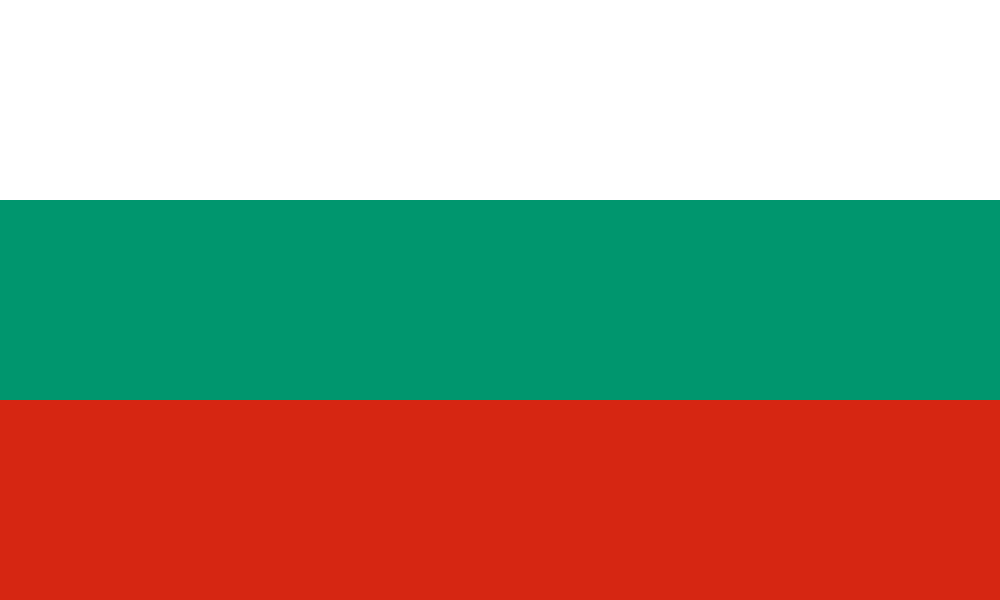
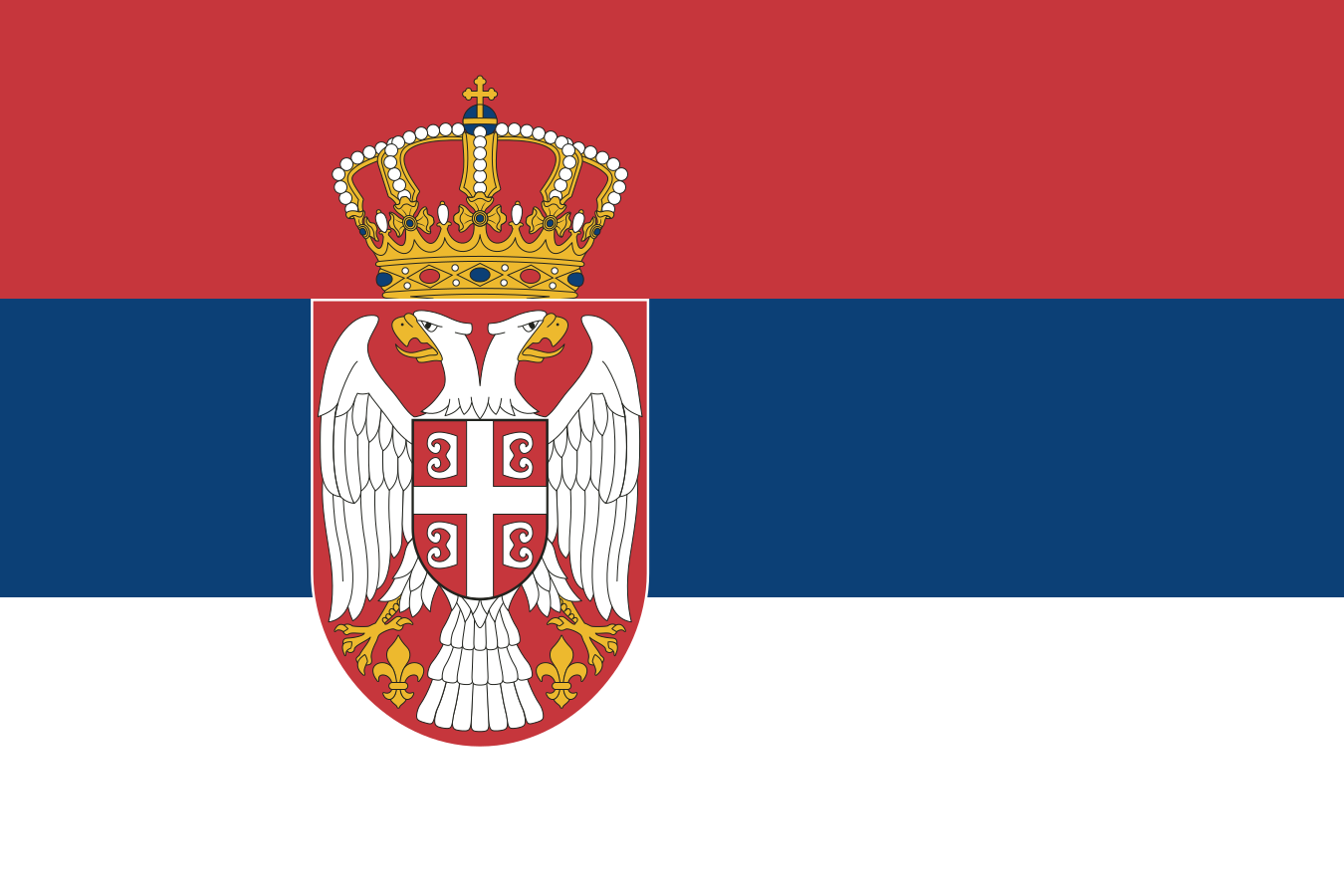
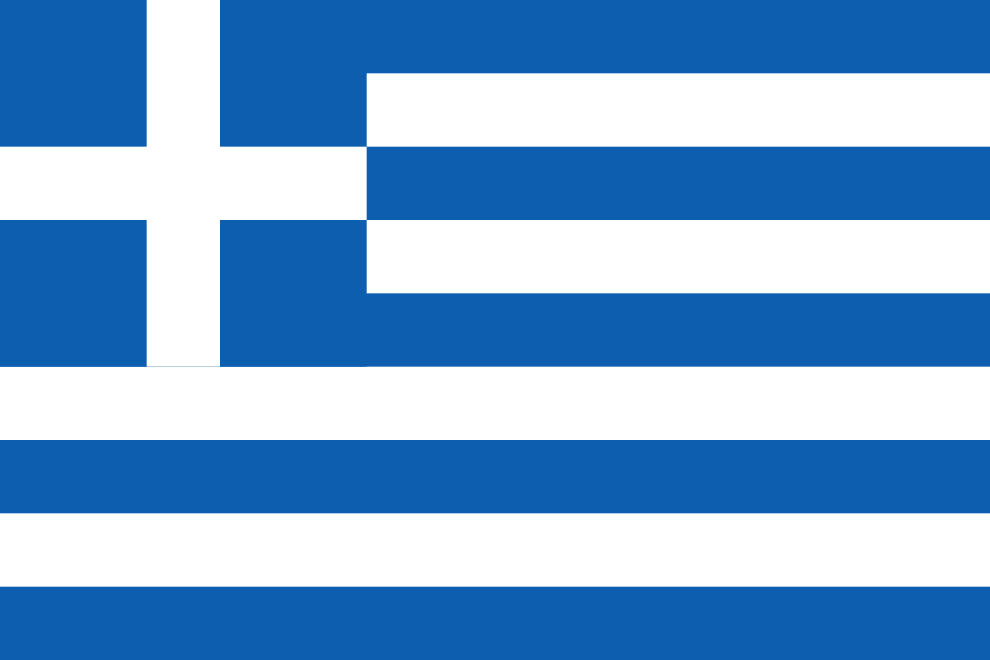
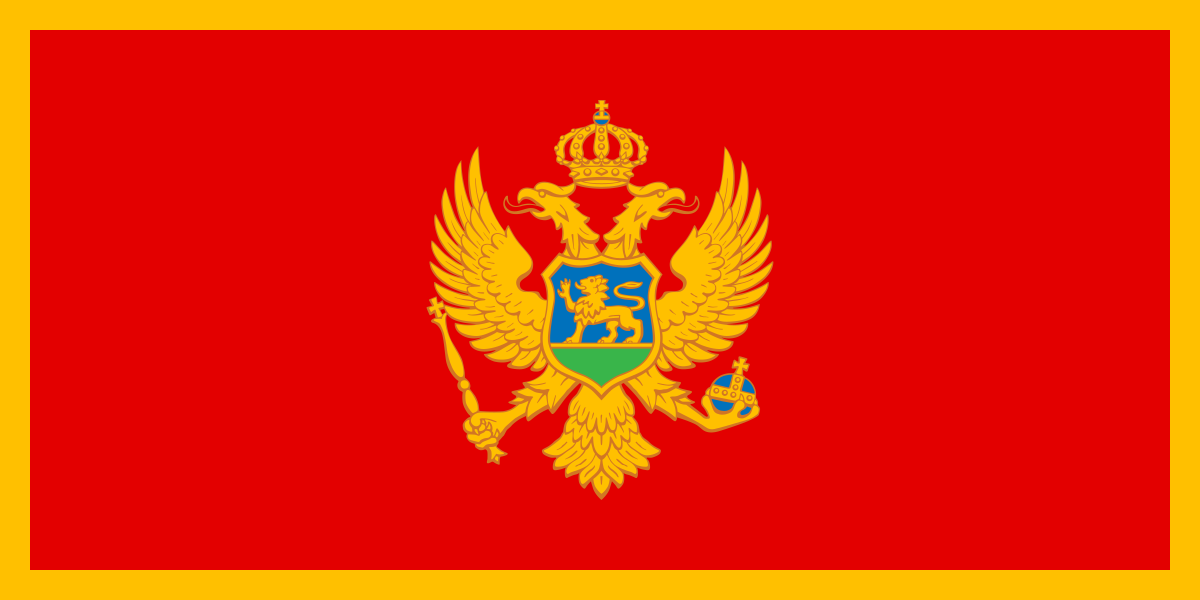
In 1912, under Russian patronage, Bulgaria, Serbia, Greece and Montenegro formed the Balkan League by secret treaties. Montenegro went to war with the Ottoman Empire on 8 October and the other three on the 17th; the Bulgarians won at Lule Burgas and reached the Çatalca Line before Constantinople, the Serbs won at Kumanovo and the Greeks took Thessaloniki. Albania declared independence on 28 November, and that same month the Second International met in extraordinary congress at Basel and adopted a manifesto against the war's spreading into a European war. A coup by the Committee of Union and Progress in January 1913 renewed the fighting, but Edirne, Ioannina and Shkodër fell in turn, and by the Treaty of London of 30 May the Ottomans lost their territory west of the Enos-Midia line. When Bulgaria attacked its former allies over the partition of Macedonia on 29 June, Serbia and Greece were joined by Romania and the Ottomans, and by the Treaty of Bucharest of 10 August Bulgaria lost most of Macedonia and Southern Dobruja.
 The Macedonian question and the Balkan League
In the late nineteenth century nation-states emerged on the Ottoman Empire's European territory, but the process was incomplete. Serbia gained land in the Russo-Turkish War of 1877–1878, Greece acquired Thessaly in 1881, and Bulgaria, an autonomous principality from 1878, absorbed Eastern Rumelia in 1885. All three, together with Montenegro, sought more of Ottoman Rumelia, that is Albania, Macedonia and Thrace, where many of their co-nationals still lived. Macedonia was at the centre. Between 1893 and 1912 rivalry between Greek and Bulgarian subjects over schools and churches turned into armed conflict, and from 1904 to 1908 Greek, Bulgarian and Serbian bands fought a guerrilla war over the Christian peasants of Macedonia, above all over the national allegiance of the Slavic-speaking population. The English Wikipedia article on the Macedonian Struggle notes that at the dawn of the twentieth century most of the local population had no clear national identity and took one only when forced by nationalist education, propaganda and terror. 1 2
The Bulgarian side of the movement was led by the Internal Macedonian Revolutionary Organization, founded in Salonica in 1893. It first sought autonomy for the Macedonia and Adrianople regions, but after the Ottomans crushed the Ilinden-Preobrazhenie Uprising of 1903 and destroyed some 100 villages, it split into a left-wing "federalist" faction that favoured autonomy and a future Balkan federation and a right-wing "centralist" faction that wanted union with Bulgaria. The Young Turk Revolution of 1908 restored the constitution of 1876 and the parliament and raised hopes of reform and autonomy among the Balkan peoples, but after the failed counter-coup of 1909 the nationalist element of the Young Turks became dominant. In October 1908 Austria-Hungary annexed Bosnia and Herzegovina and Bulgaria declared its independence. Blocked in the north, Pašić's Serbian government turned to "Old Serbia", the Sanjak of Novi Pazar and Kosovo, and when the Ottomans lost Libya in the Italo-Turkish War of 1911 and Albania rose in a series of revolts, the Balkan states judged that their moment had come. 3 1
The negotiations, begun in the latter part of 1911, were all conducted in secret. Under close Russian supervision Serbia and Bulgaria signed a treaty on 13 March 1912, ostensibly directed against Austria-Hungary but with a secret annex that redirected it against the Ottoman Empire and set out a partition. Macedonia was divided into an "Uncontested Zone" east of the Ohrid-Kriva Palanka line, recognised as Bulgarian, and a "Contested Zone" of some 11,000 km², whose fate was to be decided by the Russian Emperor as arbiter and guarantor of the alliance. The Greco-Bulgarian alliance of 29 May 1912 made no provision for the division of territory; Montenegro allied with Bulgaria and then Serbia, and Greece reached oral "gentlemen's agreements" with Serbia and Montenegro. Greece's value lay less in its army than in a navy that could dominate the Aegean and cut off Ottoman reinforcements. By the end of September the Balkan League was complete, but its members had not agreed, either among themselves or with the Great Powers, on how Ottoman territory would be divided. 1 4
The First Balkan War: from Thrace to Çatalca
When the Ottoman Empire mobilised in Thrace on 26 September, Serbia and Bulgaria ordered mobilisation, followed by Greece on the 30th. Montenegro, whose border negotiations had failed, declared war first on 8 October; Serbia, Bulgaria and Greece delivered a common ultimatum on 13 October and went to war on the 17th. The English Wikipedia article on the First Balkan War names as the principal reason for the Ottoman defeat the government's decision to declare war before the mobilisation ordered on 1 October was complete. At the outbreak 912,000 soldiers of the Balkan League faced 580,000 Ottoman troops, while many Turkish divisions were still fighting Italy in Libya. The empire had about 26 million people, but three-quarters lived in Asia and reinforcements had to come by sea; twice defeated by the Greek navy at Elli and Lemnos, the Ottoman fleet gave up the Aegean. 1 5
The Bulgarian army was the leading army of the coalition. At the outbreak Bulgaria mobilised 599,878 men in all, and Ferdinand I proclaimed the war "a just, great and sacred struggle of the Cross against the Crescent". Three Bulgarian armies of some 297,000 men in eastern Thrace wrecked the Ottoman offensive plan and took Kirk Kilisse without resistance and, from 28 October to 2 November, defeated an Ottoman army of 126,000 riflemen at Lule Burgas-Bunarhisar, in terms of forces engaged the largest battle fought in Europe between the Franco-Prussian War and the First World War. The fortress of Adrianople (Edirne), with some 61,250 men, was cut off and besieged. The Ottomans fell back to the Çatalca Line, 30 km from their capital. 5 6 7 8
On 17 November, despite clear warnings that Russia would attack the Bulgarians if they occupied Constantinople, 176,351 Bulgarian troops with 462 guns assaulted the Çatalca Line, but 140,571 Ottoman troops, stiffened by fresh reinforcements from Asia, threw them back. Cholera had spread among the Bulgarian soldiers after Lule Burgas. On 3 December the Ottomans and Bulgaria, representing Serbia and Montenegro as well, agreed to an armistice and peace negotiations moved to London. Greece did not sign the truce and continued operations in Epirus. Bulgaria's non-recoverable losses in the First Balkan War were 33,000 men, 14,000 killed and 19,000 dead of disease. 5 6 9
 The Macedonian and Albanian fronts and Albanian independence
Serbia's primary objective was Vardar Macedonia. Under Radomir Putnik the Serbian army beat the Ottoman Vardar Army at Kumanovo on 23–24 October and drove its remnants into central Albania after the battle of Monastir (Bitola). When Pašić then asked Putnik to join the race for Thessaloniki, Putnik declined, judging that a Greek-Bulgarian war over the city would help Serbia's plans for Vardar Macedonia, and turned his army west into Albania, reaching the Adriatic. The Greek army under Crown Prince Constantine forced the Sarantaporo pass and won at Giannitsa, and on 8 November (9 November in the English First Balkan War article) Hasan Tahsin Pasha surrendered Thessaloniki and its garrison of 26,000 men to the Greeks. The Bulgarian 7th Rila Division, hurrying from the north, arrived a day later. Prime Minister Venizelos had pressed the crown prince to take "Salonique à tout prix". 5 1 10
At the outbreak of the war most Albanians sided with the Ottomans to keep their lands from being partitioned, but the Ottoman army and administration failed to protect them. Serbia opposed the plan for an Albanian vilayet and preferred a partition of Ottoman Europe among the four allies. With Albanian lands facing partition, Ismail Qemali secured Austro-Hungarian backing in Vienna and went to Vlorë, where on 28 November 1912 an assembly of 40 delegates issued the Albanian Declaration of Independence; on 4 December a government under him was formed. Vlorë was the only town the delegates actually controlled, yet the declaration proved effective in the vacuum of power. The London Conference of Ambassadors recognised Albanian independence de facto on 17 December, and the international community recognised Albania as a neutral, sovereign and hereditary principality only on 29 July 1913, after the Second Balkan War. 5 11
Occupation on the western front brought massacres of civilians. Citing contemporary accounts, English Wikipedia states that some 20,000–25,000 Albanians in the Kosovo Vilayet were killed in the first two to four months of the conflict and that Albanian deaths exceeded 120,000 by the end of the Second Balkan War. Montenegro besieged Shkodër (Scutari) from 28 October 1912. Although the Great Powers blockaded the Montenegrin coast from 10 April 1913, Nikola I pressed the siege, and on 23 April Essad Pasha surrendered; but the Powers, set on an independent Albania, made Montenegro give the city up. Denied an Adriatic port, Serbia too withdrew from Albania after an Austro-Hungarian ultimatum. Dimitrije Tucović of the Serbian Social Democratic Party, mobilised for the campaign, sent letters from the front about war crimes against civilians to the party paper, the Workers' Newspaper. 5 12 1 13
The London Conference, the coup of 1913 and the Treaty of London
The ambassadors of Austria-Hungary, France, Britain, Germany, Italy and Russia met at St James's Palace in London in December 1912 under Sir Edward Grey, and from 16 December the peace conference of the belligerents sat there. The issues were the status of Albania, the Sanjak of Novi Pazar, and the fate of Kosovo, Macedonia and Thrace. Austria-Hungary and Italy, unwilling to let Serbia reach the Adriatic, strongly supported an independent Albania, while Russia backed Serbia and Montenegro. The sticking point was Edirne. With the Bulgarian demand for its cession looming and Grand Vizier Kâmil Pasha pursuing the peace talks, about fifty members of the Committee of Union and Progress led by Enver and Talât stormed the government buildings on 23 January 1913, in what became known as the Raid on the Sublime Porte. War Minister Nazım Pasha was killed and Kâmil Pasha resigned at gunpoint. The new government withdrew from the London conference and hostilities resumed on 3 February. 9 14 15 16
Officially the Great Powers agreed on the territorial integrity of the Ottoman Empire and sternly warned the Balkan states, but unofficially each sent different signals that cancelled the warning. Russia, a prime mover in the founding of the League, saw it as a tool for a future war against Austria-Hungary, yet was unaware of Bulgarian plans for Constantinople and the Straits, on which it had long-held ambitions. France, not feeling ready for war with Germany in 1912, firmly told its Russian ally that it would not join a Russo-Austrian conflict arising from the League's actions. Britain secretly encouraged Greek entry into the League to counteract Russian influence. Austria-Hungary was opposed to Serbian expansion as such. Wilhelm II at first told Archduke Franz Ferdinand that Germany would support Austria even at the risk of a world war, but the German Imperial War Council of 8 December 1912 concluded that Germany would not be ready for war until at least mid-1914 and passed that view on to Vienna. 1
The resumed war gave the Ottomans nothing back. In February they tried a combined landing at Bulair on the Gallipoli peninsula and at Şarköy on the Sea of Marmara, but it was bungled through poor communication between Enver, Ali Fethi and Mustafa Kemal. On 6 March the Greeks broke through at Bizani and took Ioannina. On 26 March 106,425 men of the Bulgarian Second Army and 47,275 men of two Serbian divisions captured Edirne; the final assault cost the Bulgarians 8,093 and the Serbs 1,462 casualties. Kâzım Karabekir, a major at Edirne, was taken prisoner and held until October 1913. The Bulgarian censor cut every reference to Serbian participation from foreign correspondents' telegrams, and Serbia protested that it had shed blood for Bulgarian territory never foreseen in their treaty. English Wikipedia judges that the battle planted the seeds of the two countries' confrontation. 5 16 17
The 1913 Treaty of London was signed on 30 May without the Ottoman delegation. All Ottoman territory in Europe west of the line from Enos on the Aegean to Midia on the Black Sea, except Albania, was ceded to the Balkan League, and Crete was ceded to the allied sovereigns. The borders of Albania and all other Albanian questions were left to the Great Powers. But the treaty did not decide how the ceded land was to be divided among the allies. Serbia refused to carry out the division agreed with Bulgaria in March 1912, and Greece and Serbia sought a common border in Macedonia. That same day the Bulgarian prime minister Ivan Geshov resigned, opposing the tsar's policy of making war on the allies. 14 1 18
 The break-up of the League and the Second Balkan War
Having lost its Adriatic port to an independent Albania, Serbia demanded not only the whole Contested Zone but also the part of the Uncontested Zone it had occupied. Bulgaria appealed to the Russian Emperor, citing the 1912 treaty and the difference in casualties (29,698 Serbian, 87,926 Bulgarian), but Foreign Minister Sergey Sazonov instead urged Bulgaria to accept the Serbian demands. In Thessaloniki the Greeks had agreed to admit a Bulgarian battalion, but an 18,000-strong division entered, raising suspicion of a bid for a condominium. Bulgaria demanded Thessaloniki and the land north of Pieria and refused to demobilise after the Treaty of London. Greece and Serbia signed a treaty on 1 June 1913 fixing a common border and promising mutual military support; Ioannis Metaxas negotiated its military terms as Greek plenipotentiary. On 8 June Nicholas II offered to arbitrate in identical messages to the kings of Bulgaria and Serbia, but Bulgaria made its acceptance conditional, in effect refusing, and Russia repudiated its alliance with Bulgaria. 1 19
On 29 June 1913 General Mihail Savov, under direct orders from Tsar Ferdinand and without consulting the government or declaring war, ordered attacks on the Serbian and Greek armies. During the night of 29–30 June the Serbs on the Bregalnica and the Greeks at Nigrita were struck (several English Wikipedia articles also give the Julian date, 16 June). The Serbs held, and the Greeks won the battle of Kilkis-Lachanas on 2–4 July. The mostly Bulgarian town of Kilkis was plundered and burned by the Greek army, while the retreating Bulgarians destroyed Nigrita, Serres and Doxato and massacred Greek inhabitants; in their advance the Greeks destroyed some 160 Bulgarian villages. On 10 July Romania, refused the fortress of Silistra, declared war and advanced almost unopposed to Vrazhdebna, 11 km from Sofia. The Romanian army counted almost no combat casualties but lost 1,600 men to cholera. 1 6 20
With the Bulgarian army tied down in the west and south, the Ottoman Empire moved as well. Ottoman troops under Enver reached the Enos-Midia line on 12 July and on 23 July retook Edirne, which the Bulgarians had abandoned; Mustafa Kemal took part in the recovery of Dimetoka and Edirne with this force, and Enver won fame as the "conqueror of Edirne". In Sofia Prime Minister Danev resigned on 13 July and on the 17th the pro-German Radoslavov formed a government. In the Kresna gorge a Bulgarian attempt to encircle the Greeks ended without a decision, and King Constantine accepted Venizelos's proposal to agree to an armistice. The delegations that met in Bucharest on 30 July, among them Pašić for Serbia, Venizelos for Greece and Maiorescu for Romania, agreed to an armistice from the 31st. The Treaty of Bucharest followed on 10 August (12 August in the English article on the Treaty of London). At Romania's insistence the Ottomans were kept out, and Bulgaria signed a separate Treaty of Constantinople with them on 29 September (30 September in the Balkan Wars article), returning Edirne and Kırklareli. 6 16 21 22 23 1
By the 1913 Treaty of Bucharest Serbia gained central Vardar Macedonia and the eastern half of the Sanjak of Novi Pazar, growing from 48,300 to 87,780 km² and adding more than 1.5 million people. Greece took southern Epirus and southern Macedonia including Thessaloniki and Kavala, growing from 64,790 to 108,610 km² and from 2,660,000 to 4,363,000 people. Montenegro took the western half of the Sanjak and Romania Southern Dobruja. Bulgaria kept the Strumica district and western Thrace with its Aegean coast, but lost eastern Thrace, where it had shed most blood, and most of the Macedonia it had wanted. Slightly over 100,000 Bulgarians migrated to Bulgaria, mainly from Southern Dobruja and eastern Thrace. Greece and the Ottomans concluded the Treaty of Athens on 14 November, but the status of the Aegean islands brought them close to war again in the spring of 1914. 22 1 6
 The socialist response: Balkan federation, votes against war credits, Basel
The Balkan socialist parties had their own answer before the war. Whereas Western European socialist parties saw the status quo as the condition of peace, Balkan socialists argued that the status quo itself was the source of conflict and called for the overthrow of the Ottoman and Austro-Hungarian empires and a democratic Balkan federation free of the Great Powers' intrigues. On 7–9 January 1910 the first conference of the Balkan social democratic parties, organised by Dimitrije Tucović, met in Belgrade, with a Narrow Socialist delegation led by Dimitar Blagoev; it condemned the interference of the Great Powers and the efforts of Balkan rulers to gain hegemony at their neighbours' expense. When war came the parties in the Bulgarian parliament backed it by voting war credits, with the exception, as the Russian Wikipedia article on Trotsky and the Balkan Wars notes, of the Serbian and Bulgarian socialists, who voted against. Dragiša Lapčević won international renown for voting against war budgets in the Serbian Skupština. 24 25 13 26 27
Blagoev condemned the First Balkan War as the result of Great Power imperialism and of the chauvinism and class aspirations of the Balkan bourgeoisies, and the Narrows opposed both wars and put forward a Balkan federative republic. Tucović came back to write Serbia and Albania: A Contribution to the Critique of the Conqueror Policy of the Serbian Bourgeoisie, declaring: "We have carried out the attempted premeditated murder of an entire nation." In "The Social Significance of the Serbo-Bulgarian Victories", published in Pravda on 7 November 1912, Lenin treated the conquest of Macedonia as a kind of bourgeois revolution undermining landlord rule, yet wrote that liberation by a revolution of Serbian, Bulgarian and Turkish peasants against the landlords of all nationalities would have cost a hundred times fewer lives, and named the Balkan federal republic demanded by the workers as the alternative. In Romania Christian Rakovsky criticised Romania's invasion of Bulgaria in the Second Balkan War and called on the authorities not to annex Southern Dobruja. 25 28 13 29 30
In September 1912 Leon Trotsky went to the Balkans as war correspondent of the Kiev liberal daily Kievskaya Mysl and covered both wars for a year under the pen name "Antid Oto". Arriving in Sofia on the day fighting began, he supported the slogan "The Balkans for the Balkan peoples" and argued for a federal state of the whole peninsula on the model of the United States or Switzerland, and he wrote about the atrocities soldiers and officers of both sides described to him. He also chronicled the ethnic cleansing carried out by the Serbian army against Albanian civilians. From late November 1912 he stayed mostly in Romania, where he grew close to Rakovsky, and he clashed with the Kadet leader Milyukov, who advocated pan-Slavism and control of the Straits, in a polemic over the war's "moral catastrophe". His articles were later collected in volume six of his Soviet collected works, The Balkans and the Balkan War (1926). 31 26
The extraordinary congress at Basel met in the middle of this war. Fearing that the Balkan War would grow into a European war, the executive of the Second International decided on 28 October 1912 to convene an extraordinary congress, and on 24–25 November 555 delegates from 23 countries gathered in Basel. Some 10,000 people marched with red flags to Basel Minster, where Jean Jaurès, Hugo Haase, August Bebel, Clara Zetkin, Keir Hardie, Victor Adler and others spoke in the cathedral and on the square. The manifesto adopted unanimously on the 25th reiterated the Stuttgart resolution of 1907: if war threatened, the working classes and their parliamentary representatives were to do everything to prevent its outbreak by the means they found most effective, and if it broke out nonetheless, to work for its speedy end and use the economic crisis it brought to rouse the people and so hasten the abolition of capitalist class rule. The contested question of the general strike was left out. The historian James Joll called the congress "the high point of the International's optimistic self-confidence". 32 33 24
Assessment
The human cost of the Balkan Wars is still uncertain. English Wikipedia's First Balkan War article says that all sides committed war crimes but that the shortage of impartial observers makes civilian casualties hard to establish. Military losses vary by source: the casualty figures Bulgaria cited in its appeal to the Russian Emperor were 29,698 Serbian and 87,926 Bulgarian, and Bulgaria's non-recoverable losses in the first war are given as 33,000. Contemporary estimates are cited of 20,000–25,000 Albanians killed in the first months and over 120,000 by the end of the second war, and by 1923 only 38 percent of the Muslim population of 1912 still lived in the Balkans; Paul Mojzes has called the wars an "unrecognized genocide". Turks remember them as the "Balkan disaster", Greeks as an epic achievement that doubled the kingdom. 5 1 6
The leading contemporary inquiry into the atrocities was the report of the International Commission of the Carnegie Endowment for International Peace, which toured the region in August and September 1913 and was published in Washington in the early summer of 1914. Mark Levene rates it as thoroughly documented, while Enika Abazi and Albert Doja question its credibility, noting that the commission was expelled from Serbia, received no help in Greece and relied on documents prepared by the Bulgarian government; of the four members on the ground, Milyukov and Brailsford were considered pro-Bulgarian even by contemporaries. The report was overshadowed by the outbreak of the First World War, and its uncritical reissue in 1993, during the Yugoslav wars, was criticised for reinforcing the stereotype of "Balkan violence". Trotsky's articles were republished in 1993 for the same reason. 34 26
The Balkan Wars were the immediate prelude to the First World War. A much enlarged Serbia pushed for the union of the South Slavs, and Austria-Hungary and Germany came to see it as a Russian satellite. Bulgaria turned towards the Central Powers, and Russia, having lost the Balkan League, could no longer afford to abandon Serbia, its last ally in the region. English Wikipedia concludes that this configuration let the July Crisis of 1914 escalate quickly into a world war. In the Ottoman Empire the Committee of Union and Progress established a dictatorship in June 1913, and the flood of refugees and news of massacres deepened hatred of minorities, a factor that exacerbated the Ottoman genocides of the First World War two years later. 1 5
For the socialist movement the war was both a test and an illusion. Because the conflict stayed confined to the Balkans, a wave of optimism spread through the International that the danger had passed, and Kautsky and others advanced the theory of "ultra-imperialism", according to which the economic interdependence of the great powers made war between them irrational. That optimism collapsed in July 1914, when the major parties rallied to their governments' war efforts. The Basel Manifesto then became the touchstone of the opposition: in 1915 Lenin called it "the fullest, most precise, and solemn expression of socialist views on war and on the tactics of socialists in regard to war" and used it to indict the leaders' betrayal, while Zinoviev stressed that it had explicitly rejected "defending the fatherland". The Bulgarian Narrows and the Serbian Social Democrats, by contrast, voted against war credits again in 1914, and the anti-war line of Balkan socialism passed into the Zimmerwald Left and the communist movement. 24 33 25 28 27
Consequences
The Ottoman Empire lost all its European territory except eastern Thrace, Serbia and Greece nearly doubled in size, and Albania became an independent state. Macedonia was partitioned among Serbia, Greece and Bulgaria, and both wars brought massacres of civilians and mass expulsions. Austria-Hungary and Germany, alarmed at an enlarged Serbia, a defeated Bulgaria turning to the Central Powers, and a Russia that could no longer abandon Serbia formed the configuration that let the July Crisis of 1914 grow into a world war. The International mistook the containment of the conflict for a lasting peace, but the Basel Manifesto became the touchstone of anti-war socialists after 1914, and the Balkan socialists who voted against war credits passed into the Zimmerwald Left and the communist movement.
Timeline & Map
- 11908-10Annexation of Bosnia and Bulgarian independence
Exploiting the upheaval of the Young Turk Revolution, Austria-Hungary annexed Bosnia and Herzegovina and Bulgaria declared independence.
- 21910-01-07First conference of the Balkan social democrats
The Belgrade conference organised by Tucović, attended by Blagoev's Narrow Socialist delegation, condemned Great Power interference and the Balkan states' quest for hegemony.
- 31912-03-13Serbo-Bulgarian treaty of alliance
The secret annex of the treaty, concluded under Russian supervision, divided Macedonia into Uncontested and Contested Zones subject to the Russian Emperor's arbitration.
- 41912-05-29Greco-Bulgarian alliance
A treaty without any provision for the division of territory brought Greece into the Balkan League.
- 51912-10-08Montenegro declares war
After border negotiations failed, Montenegro was the first of the allies to declare war on the Ottoman Empire.
- 61912-10-17General war begins
After their common ultimatum of the 13th was rejected, Serbia, Bulgaria and Greece went to war with the Ottoman Empire.
- 71912-10-23Battle of Kumanovo
On 23–24 October the Serbian army defeated the Ottoman Vardar Army and advanced into northern Macedonia.
- 81912-10-28Battle of Lule Burgas
In a battle lasting until 2 November the Bulgarians drove the Ottomans back to the Çatalca Line.
- 91912-11-08Surrender of Thessaloniki
Hasan Tahsin Pasha surrendered the city and its 26,000-man garrison to the Greeks (9 November in some sources).
- 101912-11-17Assault on the Çatalca Line fails
The cholera-stricken Bulgarian assault was stopped at the defences before Constantinople.
- 1912-11-24Extraordinary congress at Basel
The extraordinary congress of the Second International, with 555 delegates from 23 countries, unanimously adopted its anti-war manifesto on the 25th.
- 111912-11-28Albanian Declaration of Independence
The assembly at Vlorë led by Ismail Qemali proclaimed Albanian independence.
- 121912-12-03Armistice
The Ottomans and Bulgaria, also representing Serbia and Montenegro, agreed an armistice; Greece did not sign.
- 1912-12-16
 London peace conference
Alongside the ambassadors' conference of the Great Powers, the belligerents' peace conference opened in London.
- 131913-01-23Raid on the Sublime Porte
The Committee of Union and Progress under Enver and Talât overthrew the government and withdrew from the London conference.
- 141913-03-06Fall of Ioannina
The Greeks broke through at Bizani and took Ioannina.
- 151913-03-26Fall of Edirne
The Bulgarian Second Army and two Serbian divisions took the fortress after a five-month siege.
- 161913-04-23Surrender of Shkodër
Under a Great Power blockade Essad Pasha surrendered to the Montenegrins, who were later made to give the city up.
- 1913-05-30Treaty of London
Ottoman territory west of the Enos-Midia line passed to the Balkan League; Geshov resigned the same day.
- 171913-06-01Serbo-Greek alliance
The two countries agreed a common border and mutual support against Bulgaria.
- 181913-06-29Bulgarian surprise attack
On the tsar's orders General Savov launched attacks on the Serbian and Greek armies without a declaration of war (16 June O.S.).
- 191913-07-02Battle of Kilkis-Lachanas
In fighting until 4 July the Greeks defeated the Bulgarians, and Kilkis was burned.
- 201913-07-10Romania enters the war
Refused Silistra, Romania declared war and advanced to within 11 km of Sofia.
- 211913-07-23Ottoman recapture of Edirne
Ottoman forces under Enver reoccupied Edirne, which the Bulgarians had abandoned.
- 221913-07-31Armistice at Bucharest
The delegations that met in Bucharest on the 30th agreed an armistice from the 31st.
- 231913-08-10Treaty of Bucharest
Macedonia was partitioned and Southern Dobruja passed to Romania (12 August in some sources).
- 241913-09-29Treaty of Constantinople
Bulgaria returned Edirne and Kırklareli to the Ottomans (30 September in some sources).
- 251913-11-14Treaty of Athens
Greece and the Ottomans made peace, leaving the status of the Aegean islands unresolved.
Related people 39
Bulgaria (main force of the Balkan League in 1912, isolated in 1913)5
Leadership3
Proclaimed the war of 1912 a struggle "of the Cross against the Crescent", and in June 1913, without consulting the government, ordered through General Savov the attack on his former allies that began the second war.
Prime minister of BulgariaIvan Geshov1849–1924Pursued the Balkan League policy and led Bulgaria through the first war, but resigned on 30 May 1913, the day the Treaty of London was signed, in opposition to war on the allies.
Prime Minister of Bulgaria (1913)Stoyan Danev1858–1949Signed the Treaty of London and succeeded Geshov as prime minister, but resigned on 13 July 1913 when Russia stayed inactive in the second war.
Serbia, Greece and Montenegro (Balkan League in 1912, anti-Bulgarian coalition in 1913)6
Leadership5
A major architect of the Balkan League, he demanded revision of the Macedonian partition after Serbia lost Albania, and led the Serbian delegation at Bucharest in 1913.
Prime minister of GreeceEleftherios Venizelos1864–1936Brought Greece into the Balkan League and pressed for the capture of Thessaloniki; in 1913 concluded the alliance with Serbia and led the Greek delegation at Bucharest.
King of MontenegroNikola I1841–1921Declared war first on 8 October 1912 and, defying a Great Power blockade, took Shkodër in April 1913, only to give it up under pressure from the Powers.
Commander-in-chief of the Greek army; King of Greece from March 1913Constantine I of Greece1868–1923As crown prince he forced the Sarantaporo pass and won at Giannitsa to take Thessaloniki; king from March 1913, he commanded at Kilkis-Lahanas and the Kresna Gorge in the second war and agreed to an armistice on Venizelos's proposal.
Chief of the Serbian General StaffRadomir Putnik1847–1917Drove the Ottoman Vardar Army out at Kumanovo and Monastir (Bitola), and declined Pašić's request to join the race for Thessaloniki, turning the army west through Albania towards the Adriatic.
The Ottoman Empire7
Leadership4
Overthrew the government in the Raid on the Sublime Porte of 23 January 1913 and resumed the war; in the second war he recovered Edirne and was hailed as its "conqueror".
Leader of the Committee of Union and Progress; Ottoman interior ministerTalat Pasha1874–1921To prevent the surrender of Adrianople he and Enver stormed the government offices on 23 January 1913 and brought down Kâmil Pasha's cabinet. In the second war he pressed for the recapture of Adrianople and negotiated the peace with Bulgaria at the Constantinople conference.
Ottoman Grand VizierKâmil Pasha1833–1913Pursued the peace talks as the demand for the cession of Edirne loomed, and resigned at gunpoint in the Raid on the Sublime Porte on 23 January 1913.
Ottoman Chief of Staff and Minister of WarNazım Pashac. 1848–1913After his two-front offensive plan failed, he was killed by a Unionist during the Raid on the Sublime Porte on 23 January 1913.
Implementers & commanders1
Participants2
Fought the Bulgarians at Edirne as a major, was taken prisoner and remained in captivity until the armistice of October 1913.
Commander of the Shkodër garrisonEssad Pasha Toptani1863–1920Surrendered Shkodër to the Montenegrins on 23 April 1913 under a Great Power blockade of the coast; the Powers then forced Montenegro to give the city up.
Balkan and international anti-war socialists12
Participants11
Won international renown by voting against war budgets in the Serbian Skupština on the eve of the Balkan Wars, and advocated a Balkan federation.
Leader of the Bulgarian Narrow SocialistsDimitar Blagoev1856–1924Condemned the First Balkan War as the product of Great Power imperialism and Balkan bourgeois chauvinism; his Narrow Socialists opposed both wars and called for a Balkan federative republic.
Romanian Social DemocratChristian Rakovsky1873–1941Called for peace during the wars and opposed Romania's invasion of Bulgaria and annexation of Southern Dobruja; Trotsky stayed at his estate in 1913.
Writer in PravdaVladimir Lenin1870–1924In "The Social Significance of the Serbo-Bulgarian Victories" (November 1912) likened the conquest of Macedonia to a bourgeois revolution while naming a Balkan federal republic as the alternative; in 1915 used the Basel Manifesto to indict social-chauvinism.
Speaker at the Basel congressJean Jaurès1859–1914Spoke at Basel Minster, declaring the International strong enough to speak in a tone of command to those in power and, if necessary, to follow words with deeds.
Speaker at the Basel congressAugust Bebel1840–1913Spoke for the German Social Democrats at the rally in and around Basel Minster.
Speaker at the Basel congressHugo Haase1863–1919Spoke at Basel, and reaffirmed the Basel resolutions at the International Socialist Bureau meeting of July 1914.
Speaker at the Basel congressClara Zetkin1857–1933One of the speakers at the Basel Minster rally.
Speaker at the Basel congressKeir Hardie1856–1915Spoke at the Basel rally for British Labour.
Speaker at the Basel congressVictor Adler1852–1918Spoke at Basel for the Austrian Social Democrats; in July 1914 he confessed the Austrian party's powerlessness against war fever.
Leader of the Serbian Social Democratic PartyDimitrije Tucović1881–1914Organised the first Balkan Socialist Conference in 1910; mobilised in 1912, he reported the massacres of civilians in the Albanian campaign to the Workers' Newspaper and afterwards wrote Serbia and Albania.
Outside the camps
Participants5
Named arbiter in the Serbo-Bulgarian treaty of 1912, he offered on 8 June 1913 to arbitrate between the two kings, an offer Bulgaria's conditional reply effectively rejected.
German EmperorWilhelm II1859–1941At first promised to back Austria even at the risk of a world war, but the war council of 8 December 1912 concluded that Germany would not be ready for war before mid-1914.
Romanian prime minister and delegate at the Bucharest peace conferenceTitu Maiorescu1840–1917Among the delegates who met in Bucharest on 30 July 1913 and agreed an armistice from the 31st, he concluded the Treaty of Bucharest of 10 August, which gave Southern Dobruja to Romania.
British Foreign Secretary; chairman of the London ambassadors' conferenceEdward Grey1862–1933Chaired the conference of the six Great Powers' ambassadors at St James's Palace from December 1912, which dealt with the status of Albania and the conquered territories.
Russian Foreign MinisterSergey Sazonov1860–1927When Serbia appealed to the tsar citing the 1912 treaty and the casualty figures, he instead urged Bulgaria to accept the Serbian demands.
Historians & interpreters2
When the Balkan Wars did not spread, advanced the theory of ultra-imperialism, that the economic interdependence of the powers made war irrational, feeding the optimism of 1913.
Interpreter of the Basel ManifestoGrigory Zinoviev1883–1936Stressed that the Basel Manifesto explicitly rejected "defensive war" and "defending the fatherland", calling it "better than Stuttgart".
Related terms
Sources: reference 1reference 2reference 3reference 4reference 5reference 6reference 7reference 8reference 9reference 10reference 11reference 12reference 13reference 14reference 15reference 16reference 17reference 18reference 19reference 20reference 21reference 22reference 23reference 24reference 25reference 26reference 27reference 28reference 29reference 30reference 31reference 32reference 33reference 34
← Historical events