Hungary on the Axis side: from the Vienna Awards to the Don
Why was Hungary, which regained lost lands thanks to Germany, drawn deep into a war it had not wanted — and why did its attempt to get out end in German occupation?
Between 1938 and 1941 Hungary regained part of the lands lost at Trianon through the two Vienna Awards and the occupation of Ruthenia and Yugoslav territory, paying for it by joining the Tripartite Pact and passing three Jewish laws. After Teleki’s suicide in protest at the invasion of Yugoslavia in 1941, Bárdossy’s government declared war on the Soviet Union on the pretext of the Kassa bombing, and the Kamianets-Podilskyi deportations, the Novi Sad raid and Jewish labour service followed. When the Second Army was destroyed on the Don in January 1943, Kállay’s government sought a secret armistice with the Western Allies. Hitler, who learned of it, decided in March 1944 to occupy Hungary.
The turn to the right and the First and Second Jewish Laws (1938–1939)
Amid the Depression and the wound of Trianon, Hungarian politics moved steadily to the right in the 1930s. A 1934 trade agreement tied the economy to Germany, and the far-right party Ferenc Szálasi founded in 1935 grew into the Arrow Cross. In 1938 Hungary openly repudiated Trianon’s limits on its armed forces. Gömbös’s successor as prime minister, Kálmán Darányi, tried to appease both the Nazis and Hungarian antisemites with the First Jewish Law, passed in May 1938, which capped the share of Jews in the white-collar professions and in business and industry at 20 per cent. 1 2
When Darányi stepped down in May 1938, Horthy appointed Béla Imrédy, a former president of the National Bank, as prime minister. Imrédy had at first valued relations with Britain, but after the German annexation of Austria in March he turned his foreign policy towards Germany and Italy from the autumn of 1938. Proclaiming a “miraculous revolution”, he pressed for a dictatorial reorganisation free of parliament, and in December 1938 he introduced a harsher Second Jewish Law. In February 1939 opponents including István Bethlen uncovered Jewish ancestry on his mother’s side, and Imrédy, caught by his own Jewish policy, resigned. 3 4 1
Imrédy’s successor, Pál Teleki, carried the Second Jewish Law through in May 1939. For the first time it defined Jews by race — anyone with two or more grandparents born Jewish counted as a Jew — and so changed the status of converts to Christianity. Jews were limited to 6 per cent in the professions and among actors and to 12 per cent of private company staff, and barred from public employment and from editing newspapers. Some 250,000 Hungarian Jews lost their livelihood, and many lost the vote. 1 5 2
The Vienna Awards and territorial expansion (1938–1940)
When the Munich Agreement of September 1938 weakened Czechoslovakia, Hungary claimed the Magyar-populated south of Slovakia and of Ruthenia. In early October irregulars of the “Ragged Guard” crossed the border, and talks deadlocked. On 2 November the German and Italian foreign ministers, Ribbentrop and Ciano, delivered the First Vienna Award at the Belvedere Palace in Vienna, transferring to Hungary about 11,900 km² with some 870,000 inhabitants, 86.5 per cent of them Hungarians; Hungarian troops marched in between 5 and 10 November. Košice — Kassa to Hungarians — became Hungarian with them. 1 6 4 7
When Czechoslovakia broke up in March 1939, Carpatho-Ukraine declared independence on 15 March under President Avgustyn Voloshyn, but Hungarian troops, with Hitler’s permission, occupied the rest of Ruthenia between 14 and 18 March, crushed resistance and restored the old common border with Poland. Hungary recognised Tiso’s Slovakia, a German protégé, yet on 23 March attacked eastern Slovakia over a border dispute; the “Little War”, which lasted until the 31st, gained Hungary a further strip of 1,697 km² at the eastern end. 8 6 7 1
When Romania yielded Bessarabia and northern Bukovina to a Soviet ultimatum in June 1940, Hungary pressed its claim to Transylvania. After talks broke down in August and both armies massed on the border, Germany and Italy again arbitrated: on 30 August Ribbentrop and Ciano’s Second Vienna Award gave Hungary the 43,492 km² of Northern Transylvania. Its ethnic make-up was disputed — the Romanian census of 1930 counted 38 per cent Hungarians and 49 per cent Romanians, the Hungarian census of 1941 53.5 and 39.1 per cent. As they marched in during September, Hungarian troops massacred Romanian villagers at Ip and Treznea. 9 1
The Tripartite Pact, “eternal friendship” and Teleki’s suicide (1940–1941)
When Germany, Italy and Japan signed the Tripartite Pact in September 1940, the minister in Berlin, Döme Sztójay, urged that Hungary join before Romania did, and Horthy wanted Hungary to be the first new member. On 20 November 1940, under German pressure, Prime Minister Teleki signed Hungary’s accession. In December Teleki also concluded a treaty of “eternal friendship” with Prince Paul’s Yugoslavia. Teleki sought to regain territory in co-operation with Germany while staying out of the war; in 1939 he had written to Hitler that Hungary could not on moral grounds take armed action against Poland. 10 1 11
When a coup in Belgrade on 27 March 1941 reversed Yugoslavia’s accession to the pact, Hitler demanded Hungarian participation in an invasion of Yugoslavia in return for territory, and Horthy accepted at once; Defence Minister Károly Bartha and Chief of Staff Henrik Werth urged him not to miss the chance. On 3 April the minister in London reported that Britain would break off relations if German troops were allowed through and declare war if Hungary attacked Yugoslavia. That night, after a call thought to have told him that the German army had begun its march into Hungary, Teleki shot himself. His note read: “We broke our word, – out of cowardice … We have allied ourselves to scoundrels … I did not hold you back. I am guilty.” 11 1
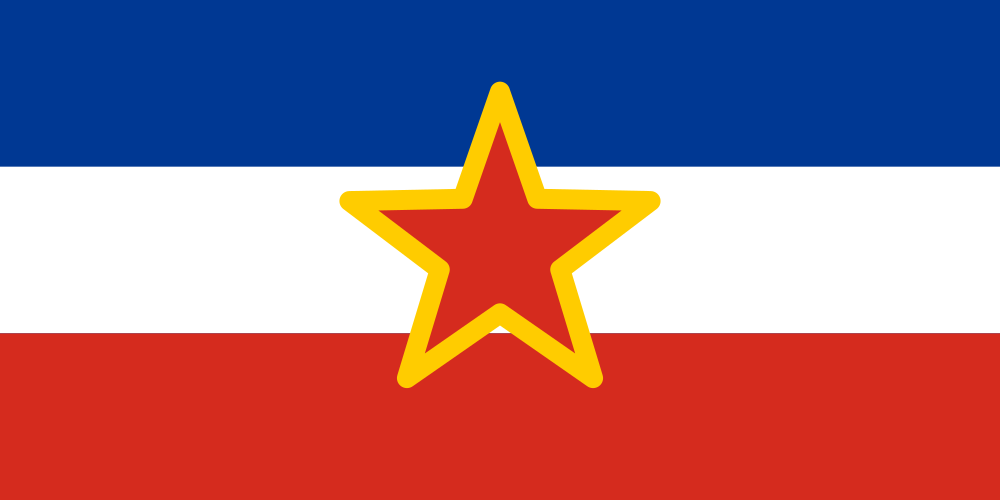
The new prime minister was the foreign minister, László Bárdossy. After Germany invaded Yugoslavia on 6 April and the Independent State of Croatia was proclaimed on the 10th, the Hungarian government crossed the frontier on the 11th on the pretext that Yugoslavia had ceased to exist. Hungarian troops took Bačka, Baranja, Međimurje and Prekmurje, and these 11,417 km² of “Recovered Southern Territories” were formally annexed in December 1941. The British foreign secretary, Eden, said it would remain an “everlasting shame” on Hungary’s reputation that it had attacked Yugoslavia months after a pact of friendship. 12 1 13
The bombing of Kassa and war on the Soviet Union (1941)
When Germany invaded the Soviet Union on 22 June 1941, Hitler did not ask Hungary to take part. Werth and Bartha, however, argued that Hitler would reward participation by restoring all the lands lost at Trianon and that the war would be over in six weeks. On 23 June Molotov told the Hungarian minister in Moscow that the Soviet Union would not object to Hungarian claims against Romania if Hungary stayed neutral, but Bárdossy did not pass the telegram on to the cabinet. On 26 June unidentified aircraft bombed Kassa (Košice). 14 1
The Hungarian military, citing an unexploded bomb of Soviet make, blamed the Soviet Union. Horthy ordered retaliation, and on 27 June Bárdossy told parliament that a state of war existed between Hungary and the Soviet Union — without the parliamentary consent the constitution required for a declaration of war. Responsibility has never been settled: Horthy’s memoirs called it a German provocation, and Czechoslovak, Slovak and Romanian aircraft have all been suggested. The historian Ignác Romsics thought a Soviet bomber aiming at Prešov the likeliest culprit, and wrote that Hungary’s leaders saw the raid as a threat “because they wanted to view it as such”. 12 14
On 1 July the Hungarian Carpathian Group advanced into Soviet Ukraine under the German Seventeenth Army, and its mechanised corps fought in the encirclement at Uman in August. In late 1941 Britain warned that it would declare war unless Hungarian forces left the Soviet Union, and a state of war began on 6 December. After Pearl Harbor Bárdossy broke off relations with the United States and on 15 December announced a state of war with it too. Within half a year Hungary was at war with Yugoslavia, the Soviet Union, Britain and the United States. 1 12
Kamianets-Podilskyi, Novi Sad and labour service (1941–1942)
Soon after Hungary entered the war, the agency in charge of foreign nationals decided to deport “unsuitable alien” Jews — mostly Polish and Russian Jews and refugees from western Europe, but also Hungarian Jews who could not document their citizenship, and in the Carpathian region whole communities. Bárdossy signed the deportation order on 12 July. Taken by freight train to Kőrösmező, the Jews were handed over to the Germans beyond the old frontier: about 14,000 by 10 August and 4,000 more later that month. The United States Holocaust Memorial Museum puts the number deported at more than 20,000. 15 16 2 12
They were marched from Kolomyia to Kamianets-Podilskyi, where on 27–28 August (26–28 August according to the US Holocaust Memorial Museum) SS and police units under Friedrich Jeckeln and local Ukrainian collaborators shot the deportees together with the local Jews. Jeckeln reported 23,600 victims, some 16,000 of them deported from Hungary (the Museum puts the deportees taken to Kamianets-Podilskyi at 14,000–16,000) — one of the first large-scale massacres of the “Final Solution”. The American minister in Budapest, Herbert Pell, protested repeatedly, but Bárdossy lied that there had been no massacre. In August 1941 his government enacted the Third Jewish Law, which banned marriage and sexual relations between Jews and non-Jews. 15 16 2 12
In annexed Bačka small-scale armed resistance broke out in the second half of 1941. In early January 1942, taking a clash with Partisans as pretext, Chief of Staff Ferenc Szombathelyi ordered punitive raids. Keitel was then in Budapest to demand the whole Hungarian army for the Eastern Front, and Bárdossy wanted to show that troops were needed in the occupied lands. Beginning at Čurug on 6 January, the raids culminated in Novi Sad (Újvidék) on 20–23 January, where Ferenc Feketehalmy-Czeydner’s troops marched residents to the Danube bank in −29 °C, machine-gunned them and broke the ice to throw in the bodies. Estimates of the dead run from about 3,300 to 4,116, mostly Serbs and Jews. 13 17) 2
Jewish men were conscripted not into the army but into labour service (munkaszolgálat). Created by the Teleki government under the 1939 defence act, it began as unarmed labour for the “unreliable”, but from spring 1941 Jews were segregated, denied uniforms and made to wear identifying armbands. From summer 1941 tens of thousands were sent near the front in Ukraine to clear mines and do heavy labour, and many died of hunger and abuse by their guards. The US Holocaust Memorial Museum estimates that about 100,000 men were conscripted and that 25,000–42,000 died before March 1944. 18 19 2
The Second Army on the Don (1942–1943)
Having failed before Moscow, Germany demanded more troops from its allies at the end of 1941: Hitler wrote to Horthy, Mussolini and Antonescu in late December, and Keitel came to Budapest in January 1942. The result was the despatch of the Second Army under Gusztáv Jány. The 209,000-strong army was assigned to Army Group South on 11 April and moved east from 17 April to 27 June in 822 trains. Although it received nearly all the country’s “modern” equipment, it lacked motor transport and anti-tank weapons, and the equipment Germany promised never came. 20 21) 22
In the summer offensive of 1942 the Second Army advanced to the Don near Voronezh. Repeated attacks failed to eliminate the Soviet bridgeheads left on the west bank at Uriv, Korotoyak and Shchuchye, and the army’s losses in 1942 came to 33,763 dead, wounded and missing. With winter, supply collapsed — winter clothing, food and fuel ran out — and as German units were drawn off to Stalingrad, the front the army had to hold grew ever longer. On 27 December 1942, at Hitler’s demand, the General Staff ordered the Don positions held at all costs. 21) 20 22
On 12 January 1943 Filipp Golikov’s Voronezh Front launched the Ostrogozhsk–Rossosh offensive from the Uriv bridgehead. In temperatures below −30 °C the front was broken in several places, and Weichs, commanding Army Group B, refused to commit his reserve. The Germans forbade retreat, and Jány held to the order until he allowed withdrawal only on 17 January. Encircled units were destroyed or froze to death. One estimate puts the losses of the roughly 190,000 soldiers and 17,000 Jewish labour servicemen at about 100,000 dead, 35,000 wounded and 60,000 captured; Hungarian accounts put the loss at 100,000–120,000 men. 20 21) 23 22
On 24 January Jány issued an order of the day beginning “The Hungarian Second Army has lost its honour…”, accusing his men of cowardice and ordering drastic discipline. It caused general outrage, and on Horthy’s instruction it was withdrawn in March. The survivors were brought home by the end of May, and Jány was relieved in August. The German Sixth Army at Stalingrad had surrendered in February 1943. The Second Army ceased to exist as an effective fighting force, and the Germans pulled what was left of it from the front. 20 22 21) 1
The underground Communists and the anti-German opposition (1940–1943)
Illegal since 1919, the Hungarian Communist Party (KMP) was so weakened after the execution of Imre Sallai and Sándor Fürst in 1932 that the Comintern dissolved it in 1936. Mátyás Rákosi, imprisoned since 1924, was paroled in October 1940 and allowed to leave for the Soviet Union in exchange for Hungarian revolutionary banners captured by Russian troops in 1849. After Germany attacked the Soviet Union the Communists sought an anti-German front with non-Communists. The Independence Committee led by Zoltán Schönherz staged demonstrations at the Batthyány eternal flame on 6 October 1941 and at the graves of Kossuth and Táncsics on 1 November, and in the Christmas 1941 issue of the Social Democratic Népszava Endre Bajcsy-Zsilinszky called for an “Independence Front” to take Hungary out of the war and bring land reform and universal suffrage. 24 25 26 27
The underground paper Szabad Nép appeared on 1 February 1942, edited by Ferenc Rózsa. Mass arrests in May–June and July 1942 destroyed the Communist leadership. Rózsa, arrested on 1 June, died in unclear circumstances in police custody two weeks later; Schönherz, arrested on 6 July, was sentenced to death by the special court of the Chief of the General Staff and executed on 9 October. After a further wave of arrests in January 1943 János Kádár took over the leadership. When the Comintern was dissolved that year, Kádár staged a sham dissolution to throw off the police and refounded the party as the Peace Party, a step Rákosi and the Moscow émigrés condemned. The Peace Party demanded Kállay’s removal, a separate peace and the dissolution of the Arrow Cross. 28) 26 29 30) 24
Opposition in parliament was a small minority. Bajcsy-Zsilinszky warned Bárdossy before the Novi Sad raid and afterwards called it “a state-organized pogrom” in parliament, demanding that those responsible be tried. When he tried to raise it again on its first anniversary in January 1943, Arrow Cross and Party of Hungarian Renewal deputies shouted him down with cries of “Treason!”; throughout 1942 the Defence Ministry had warned that he would be prosecuted for impugning the army’s honour. The Social Democrats found activity ever harder during the war, and with the German occupation in 1944 the party was outlawed. 27 31
Kállay’s “see-saw” and the decision for Operation Margarethe (1942–1944)
In March 1942 Horthy forced Bárdossy out and installed Miklós Kállay, a conservative of the Bethlen school, as prime minister. In his first speech Kállay called the war against the Soviet Union “our war” and cracked down on the Social Democrats, sending hundreds of Jewish members to labour service, but behind the scenes he sought contact with the Allies. When Germany repeatedly demanded the deportation of Hungary’s Jews, Kállay and Horthy refused, calling it a domestic matter that would wreck the economy; hundreds of thousands of Jews thus survived until March 1944, though discrimination and labour service went on. His back-and-forth policy became known as the “Kállay two-step” or “Kállay see-saw”. 32 2 1
After the Don disaster, at the end of January 1943, Bethlen, the Prince Primate Cardinal Serédi and the chief justice advised Horthy to withdraw the troops from the Eastern Front and punish those responsible for Novi Sad. In February the journalist András Frey opened contacts with the British in Istanbul, and in April Kállay proposed to Mussolini in Rome an “axis within the Axis” of Hungary, Italy and Finland, which Mussolini rejected. At the Klessheim meeting in April Hitler warned Horthy and Kállay that he knew of their peace feelers. In parliament Kállay was attacked by Imrédy’s Party of Hungarian Renewal and the Arrow Cross, and in May 1943 Horthy prorogued parliament. 32 33)
When the Allies landed in Sicily in July 1943 and Mussolini fell, the talks accelerated. On 9 September, on a yacht in the Sea of Marmara off Istanbul, the British ambassador Sir Hughe Knatchbull-Hugessen and the Hungarian diplomat László Veress signed a secret preliminary armistice under which Hungarian forces would surrender once Allied troops reached Hungary. Kállay objected to its unconditional-surrender formula, but the Hungarian consul in Istanbul and the minister in Lisbon signalled acceptance. Kállay put those responsible for Novi Sad before a court martial in December 1943, but Feketehalmy-Czeydner and the other convicted officers fled to Germany in January 1944. 32 33) 13
After Italy’s armistice with the Allies in September 1943, Hitler had the Wehrmacht high command plan the occupation of Hungary (Margarethe I) and of Romania (Margarethe II); Keitel reported on 30 September that both plans were ready. From November documents stolen by Elyesa Bazna, the British ambassador’s valet, also told Berlin of Veress’s secret armistice. As the Red Army neared the foothills of the Carpathians in early 1944, Hitler feared that Hungary, through which Romanian oil reached the Reich, would leave the alliance. On 4 March Goebbels wrote in his diary that “treason had to be punished”, quoting Hitler as saying that he would not let Hungary’s 700,000 Jews slip through his fingers. 33) 32
On 7 March Hitler decided to activate Margarethe I. His first idea was a military solution that would partition Hungary among Romania, Croatia and Slovakia, but the SS officer Wilhelm Höttl argued that keeping Horthy as regent would secure the co-operation of the whole Hungarian state without sabotage of the railways, and Hitler decided to try this political solution first. On 12 March German troops were ordered to seize key Hungarian facilities, and Himmler instructed Eichmann to prepare the deportation of Hungary’s Jews to Auschwitz. Horthy was summoned to Klessheim, and on 19 March German troops entered Hungary. 33) 2
Consequences
All the regained lands were returned after the war, and before the German occupation the Kamianets-Podilskyi massacre, the Novi Sad raid and labour service had already killed tens of thousands of Jews, and about 100,000 soldiers had died on the Don. The German occupation of 19 March 1944 opened the mass deportation and murder of Hungary’s Jews.
Timeline & Map
- 1938.05.29
 First Jewish Law
It capped the share of Jews in the professions and business at 20 per cent.
- 11938.11.02

 First Vienna Award
Germany and Italy awarded southern Slovakia and southern Ruthenia to Hungary.
- 1939.02Imrédy resigns
He resigned when opponents exposed his Jewish ancestry.
- 21939.03.14Occupation of Carpatho-Ukraine
Hungarian troops occupied the rest of Ruthenia by the 18th.
- 1939.03.23
 The “Little War” with Slovakia
Fighting until the 31st won a strip of eastern Slovakia.
- 1939.05.05Second Jewish Law
It defined Jews racially and cut the quotas to 6 per cent.
- 1940.08.30
 Second Vienna Award
Northern Transylvania passed from Romania to Hungary.
- 1940.10.30
 Rákosi released
He left for the Soviet Union in exchange for the 1849 banners.
- 1940.11.20Accession to the Tripartite Pact
Hungary became the first state to join after the founders.
- 31941.04.03Teleki’s suicide
He took his life in protest at joining the invasion of Yugoslavia.
- 1941.04.11
 Invasion of Yugoslavia
Hungarian troops took Bačka and other areas, annexed in December.
- 41941.06.26Bombing of Kassa
Unidentified aircraft bombed Kassa; next day Hungary declared war on the USSR.
- 51941.08.27Kamianets-Podilskyi massacre
23,600 Jews, including deportees from Hungary, were shot.
- 1941.12.06

 War with Britain
Britain’s deadline expired; on the 15th war with the US was announced too.
- 61942.01.20Novi Sad raid
Hungarian troops killed thousands of Serbs and Jews by the 23rd.
- 1942.03.09Kállay government
Horthy replaced Bárdossy with Kállay.
- 1942.10.09Schönherz executed
The underground Communist leader was executed after a special military trial.
- 71943.01.12Don front collapses
The Soviet Ostrogozhsk–Rossosh offensive destroyed the Second Army.
- 81943.09.09
 Secret armistice off Istanbul
Veress signed a preliminary armistice with the British ambassador.
- 1944.03.07Margarethe ordered
Hitler decided to activate the occupation of Hungary.
Related people 23
Leadership5
Approved joining the Tripartite Pact and the wars on Yugoslavia and the USSR, then installed Kállay in 1942 to seek a way out.
Prime minister 1938–1939Béla Imrédy1891–1946Turned foreign policy towards Germany and introduced the Second Jewish Law, then fell when his Jewish ancestry came out.
Prime minister 1939–1941Pál Teleki1879–1941Introduced the Second Jewish Law and labour service and signed the Tripartite Pact, but killed himself over the invasion of Yugoslavia.
Prime minister 1941–1942László Bárdossy1890–1946Declared war on the USSR after the Kassa bombing and pushed through the deportations and the Third Jewish Law.
Prime minister 1942–1944Miklós Kállay1887–1967Refused German deportation demands and pursued a secret armistice with the Western Allies.
Implementers & commanders1
Participants10
Drew Hungary into the war with territorial rewards and in March 1944 decided to occupy it.
German foreign ministerJoachim von Ribbentrop1893–1946Delivered both Vienna Awards together with Ciano.
Italian foreign ministerGaleazzo Ciano1903–1944Delivered both Vienna Awards together with Ribbentrop.
Italian prime ministerBenito Mussolini1883–1945Rejected the “axis within the Axis” Kállay proposed in April 1943.
Romanian leaderIon Antonescu1882–1946Received Hitler’s letter of late 1941, like Horthy and Mussolini, demanding more troops for the Eastern Front.
Chief of the Wehrmacht high commandWilhelm Keitel1882–1946Came to Budapest in January 1942 to demand Hungarian troops for the Eastern Front and prepared the Margarethe plans.
Commander, Army Group BMaximilian von Weichs1881–1954Refused to commit his reserve to support the Hungarians at the start of the Soviet offensive in January 1943.
Soviet foreign commissarVyacheslav Molotov1890–1986On 23 June 1941 offered to back Hungarian claims on Romania if Hungary stayed neutral.
British foreign secretaryAnthony Eden1897–1977Warned of a break and war over Yugoslavia and called the attack an “everlasting shame” for Hungary.
Former prime minister, conservative elderIstván Bethlen1874–1946Helped expose Imrédy’s Jewish ancestry and in January 1943 urged Horthy to withdraw from the Eastern Front.
Opposition & resistance5
Destroyed the Hungarian Second Army in the Ostrogozhsk–Rossosh offensive.
Underground Communist leaderZoltán Schönherz1905–1942Led the Independence Committee, organised anti-war demonstrations and was executed in 1942.
Editor of Szabad NépFerenc Rózsa1906–1942Founded and edited the underground party paper and died in custody after his arrest in 1942.
Underground Communist leaderJános Kádár1912–1989Took over the leadership in 1943 and turned the Communist Party into the Peace Party.
Underground Communist leaderGábor Péter1906–1993Formed the new leadership with Kádár after the mass arrests of 1943.
Targets & victims1
Related terms
Sources: reference 1reference 2reference 3reference 4reference 5reference 6reference 7reference 8reference 9reference 10reference 11reference 12reference 13reference 14reference 15reference 16reference 17reference 18reference 19reference 20reference 21reference 22reference 23reference 24reference 25reference 26reference 27reference 28reference 29reference 30reference 31reference 32reference 33
← Historical events