The Revolutions of 1848
How did the revolution that began in Palermo and Paris in 1848 spread within weeks to some fifty countries, why did the temporary coalitions of liberal bourgeoisie, workers, peasants and rival national movements all fall to the counter-revolution of monarchs and armies by the end of 1849, and what did the defeat leave to the socialist movement?
Amid the failed harvests and industrial recession of 1845–1847, risings in Palermo in January 1848 and Paris in February opened the "springtime of the peoples". In March the governments in Vienna, Buda-Pest, Berlin, Milan and Venice gave way and promised parliaments, constitutions, press freedom and universal suffrage. But nations collided in Posen, Schleswig, Bohemia and Hungary, and the crushing of the Paris workers in June and of the Prague rising began the counter-revolution. The second wave of 1849, the Roman Republic, Hungarian independence and the German Imperial Constitution campaign, was broken by French, Austrian, Prussian and Russian armies. This event gathers four national sub-events and covers Poland, Denmark, Switzerland, the Danubian principalities, Britain and the Communist League, which have none of their own.

 On the eve: the crisis of 1845–1847 and the "social question"
The revolutions of 1848 grew out of the short- and long-term socioeconomic changes of industrialisation together with the political legacy of the French Revolution. In the countryside the privatisation and enclosure of common land stripped peasants of their customary right to take wood from the forests. France abolished that right in law with the Forest Code of 1827, and in the Bavarian Palatinate the number convicted of wood theft rose from 37,500 in 1821–1822 to 185,000 in 1846–1847, a third of the population. Where feudalism survived in Central and Eastern Europe, risings against the lords were common; the largest peasant revolt before 1848 broke out in Austrian Galicia in 1846 and put an end to the Kraków Uprising of the Polish nobility. 1
In the towns, migrants from the countryside flooded the labour market and real wages fell. Most workers in 1848 were artisans rather than factory hands, and as the guilds weakened, masters clashed with journeymen and, in the putting-out system, merchants with outworkers; the risings of the Lyon silk weavers in 1831 and 1834 and of the Silesian weavers in 1844 expressed that grievance. The educated middle class could not find posts either. In Germany the sociologist Riehl described an "intellectual proletariat" of underpaid junior officials, journalists and schoolteachers, and professionals without careers turned to journalism and became leaders of the revolutions of 1848. 1
Politically, liberalism, radicalism and nationalism were the main currents opposed to the governments. Liberals wanted equality before the law, civil liberties and constitutional monarchy, but sought to confine the vote to men of property. Radicals demanded universal manhood suffrage and gave greater weight to the "social question", what to do about the growing working poor of the capitalist economy; among them democrats looked to regulation and state intervention, socialists to the abolition of capitalism and redistribution. The franchise was very narrow: in France only 241,000 people out of 26 million, 0.5 per cent, could vote. Where parties were banned, newspaper editors and secret societies led the opposition, Mazzini's Young Italy the most famous of them. 1
The immediate trigger was the economic crisis of 1845–1847. In 1845 the potato blight ruined harvests across Northern Europe, and in Ireland the Great Famine killed more than a million of eight million people. The drought of 1846 damaged the grain harvest and sent food prices soaring; there were more than 400 food riots in France in 1846–1847 and 164 in the German states in 1847. Dear food and a poor cotton crop in the American South brought an industrial recession in 1847, and the economic historians Berger and Spoerer found a strong correlation between the countries hit hardest by the industrial shock of 1847 and those that had a revolution in 1848. 1
 The "springtime of the peoples": from Palermo to Paris, Vienna and Berlin
The revolutionary wave began at Palermo in Sicily on 12 January 1848. Before that the Greater Poland rising of 1846 and the Sonderbund War in Switzerland in November 1847 had already been violent struggles over reform. But what counted for contemporaries was the rising in Paris on 22–24 February: protests against the ban on the reform banquets grew into a revolution, Louis Philippe abdicated and the Second Republic was proclaimed. The news spread across the continent within a week, and Metternich is said to have exclaimed, "it's all over". The French sub-event tells this in detail. 1 2
Within weeks there were risings in Munich, Vienna, Buda and Pest, Venice, Kraków, Milan and Berlin. The demands were much the same everywhere: a representative parliament, freedom of the press and of association, universal manhood suffrage, and the arming of the people in a national guard. In Vienna, after clashes from 13 to 15 March, Metternich resigned and went into exile and Emperor Ferdinand I promised a constitution; the Hungarian Diet then won Hungarian sovereignty within the Habsburg monarchy. When the news from Vienna reached northern Italy, revolutionary governments were proclaimed in Milan and Venice and Piedmont–Sardinia declared war on Austria, opening the First Italian War of Independence. In Berlin, after brief but deadly barricade fighting on 18 March, Frederick William IV withdrew the army and appointed a liberal ministry. 1
Over the spring new parliaments were elected on a broad franchise: the French Constituent Assembly, the Austrian Reichstag, the Hungarian Diet and five other parliaments in the Habsburg lands, and the Frankfurt National Assembly, the first parliament to represent all Germany, which met in St Paul's Church on 18 May. With censorship relaxed, political clubs and newspapers multiplied, and workers' associations spread for the first time, though less organised than the clubs. In what contemporaries felt as a "revolutionary psychosis", French priests blessed trees of liberty and in Transylvania Romanians and Hungarians embraced. Yet in the towns machines were broken and tax collectors attacked, and in the countryside peasants occupied common land and attacked their lords. 1 3

 Nations in collision: Posen, Schleswig and Bohemia
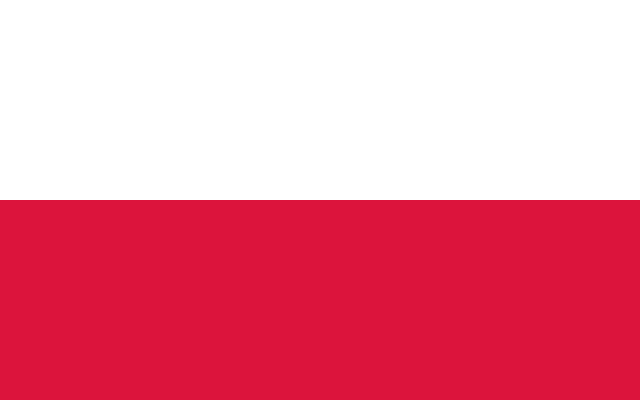
From late spring, national conflict began to divide the revolution. In the Prussian Grand Duchy of Posen, Ludwik Mierosławski and others sentenced to death for preparing the 1846 rising were amnestied in the Berlin revolution on 19–20 March and formed a "Polish Legion"; there was talk, under the black-red-gold flag of the German revolution, of a common fight against Russia. On 20 March a Polish National Committee was set up in Poznań as well. But when the Poles demanded "national reorganisation", the local Germans came to see them as enemies, and the king promised the Polish delegation autonomy while secretly ordering preparations to crush the movement. 4 5
Under the Jarosławiec agreement of 11 April the Poles received a promise of autonomy and disbanded most of their volunteers, but the Prussian army did not keep it. The remaining units won at Miłosław on 30 April, yet a capitulation was signed on 8 May and Mierosławski's main force laid down its arms at Bardo on 9 May. Some 1,500 Poles, mostly peasants, were imprisoned and abused in the Poznań citadel. In the "Poland debate" of the Frankfurt National Assembly in July, deputies who had once been friendly to the Poles called the restoration of Poland "insanity". The Neue Rheinische Zeitung of Marx and Engels treated that betrayal as a touchstone of the German revolution. 4 6
In the north, Schleswig became the meeting point of Danish and German nationalism. In Copenhagen a march to Christiansborg on 21 March led Frederick VII to appoint a National Liberal cabinet, and Denmark gained a parliamentary constitution the next year, a rare case that reaction did not reverse. But when that government moved to incorporate Schleswig into Denmark, the German-speaking population of Schleswig and Holstein rose in the same March and set up a provisional government and army, and the German Confederation and Prussia sent troops. This First Schleswig War was broken off by the armistice of Malmö on 26 August, in which Prussia, under pressure from the great powers, gave way to practically all the Danish demands; the armistice exposed the impotence of the Frankfurt parliament and provoked the September risings. The war resumed in 1849, but the Battle of Idstedt in 1850 and the London Protocol of 1852 confirmed the Danish king's sovereignty. 1 7
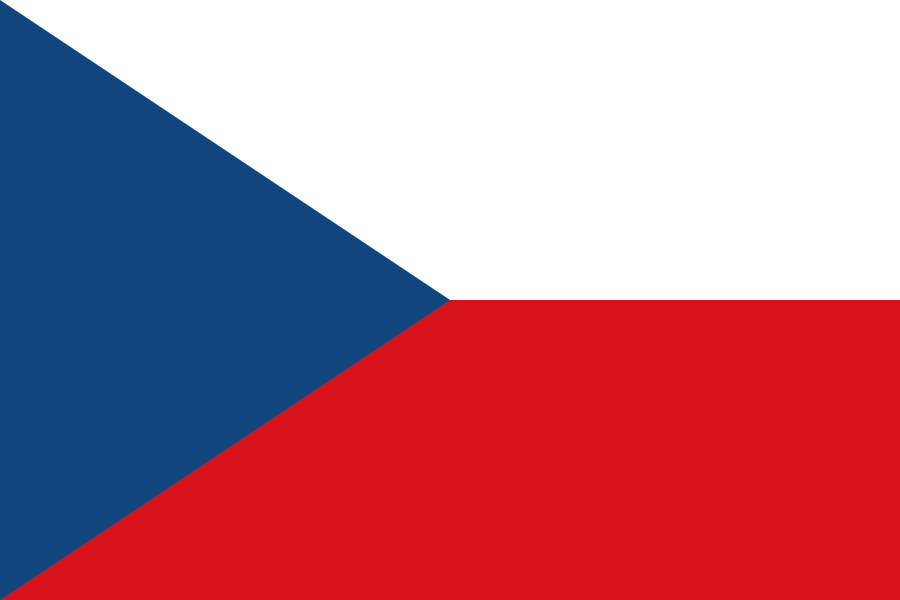
In the multinational Habsburg Empire, Germans, Hungarians, Czechs, Poles, Croats, Ukrainians, Romanians, Slovaks, Slovenes, Serbs and Italians each sought autonomy, independence or even hegemony over others. In Bohemia the German population, which wanted to join a greater Germany through the Frankfurt parliament, faced Palacký's Austroslavism, which sought Czech autonomy within the Habsburg monarchy. The Czechs held a Slavic congress in Prague from 2 to 12 June. In Galicia the Supreme Ruthenian Council, founded on 2 May 1848, demanded the division of Galicia into a Polish west and a Ukrainian east. In Hungary, Croats, Serbs and Romanians resisted a Magyar nation-state, a conflict the Hungarian sub-event follows. 1 8
 At the edges: Switzerland, the Danubian principalities, Britain and Ireland
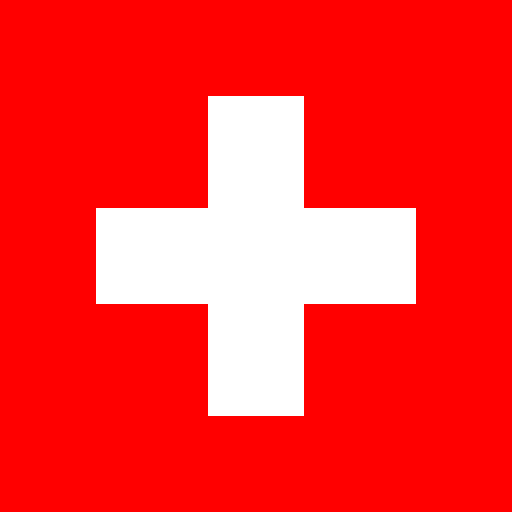
Switzerland was where the revolution won first. When seven Catholic cantons formed the Sonderbund against centralisation in 1845, the Federal Diet declared it unconstitutional in October 1847 and ordered it dissolved by force. General Dufour's federal army of 100,000 defeated the Sonderbund within a few weeks from 3 November, with about 100 dead, and the constitution of 1848 turned Switzerland from a loose confederation of cantons into a federal state. Belgium and the Netherlands escaped revolution by granting reforms in advance; Belgium stopped the "Belgian Legion" of some 6,000 émigrés from Paris at Risquons-Tout in March and expelled Marx from Brussels in early March. 9 1
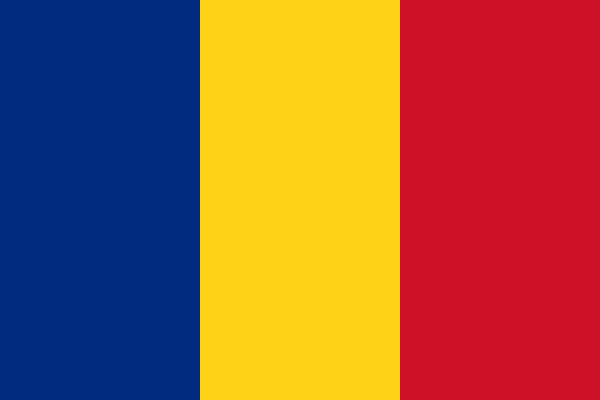
Revolution reached the Danubian principalities too, governed under the Russian-imposed Regulamentul Organic. After the failed revolt in Moldavia, young intellectuals and officers in Wallachia around the secret society Frăția, Nicolae Bălcescu among them, proclaimed at Islaz on 21 June the abolition of boyar privilege, the freeing of the peasants and autonomy. Prince Gheorghe Bibescu stepped down and a provisional government took over, but radicals and conservatives split over land reform. On 18 September crowds burned the Regulamentul and the register of boyar ranks. Under Russian pressure, Ottoman troops entered Bucharest on 25 September and ended the revolution, and the Russian and Ottoman occupation lasted until 1851. 10 11 1
In Britain, Chartism, the working-class movement for political reform under the People's Charter of 1838, reached its third peak in 1848. After the news from Paris there were protests and bread riots in Manchester, Glasgow and Dublin in March, and a meeting was called on Kennington Common for 10 April, after which a procession was to carry a third petition to Parliament. Parliament made seditious acts felonies punishable by death or transportation on 7 April and recruited 100,000 special constables. Feargus O'Connor addressed up to 50,000 people and called off the procession, and the petition went to Parliament in three cabs. Those who planned armed action from June were prosecuted, and the meeting's organiser William Cuffay was transported to Australia. Chartism declined rapidly after 1848. 12 13
In famine-stricken Ireland, Young Ireland rose in July in response to the Prevention of Crime (Ireland) Act 1848, but failed in a gunfight with some fifty police at Ballingarry in South Tipperary and collapsed when its leaders were arrested. The Russian and Ottoman empires saw no major revolution. Nicholas I intervened instead in Hungary and the Danubian principalities, and at home expanded the secret police and tightened censorship. The wave also reached beyond Europe, influencing reform in New Granada, the Chilean revolution of 1851 and the Praieira revolt in Pernambuco in Brazil. 1
The counter-revolution of summer and autumn (June–December 1848)
By summer the revolutionary coalitions broke apart. In Paris the elections of 23 April returned a conservative majority, and after the radical attempt on the Assembly on 15 May the government jailed left-wing leaders, closed clubs and newspapers and dissolved the Luxembourg Commission. The closing of the national workshops on 21 June provoked the June Days, in which 40,000 to 50,000 insurgents fought on barricades across Paris; General Cavaignac, given dictatorial powers by the Constituent Assembly, crushed them with great bloodshed. In the same June the rising in Prague provoked by Windisch-Grätz was put down by bombardment, the first victory of the Habsburg counter-revolution. 1 8
In northern Italy Radetzky defeated the Piedmontese at Custoza on 24 July, leaving Austria almost in full control of its Italian provinces. The strengthened conservatives in Vienna sent Jelačić, the Ban of Croatia, into Hungary. When the Hungarian War of Independence began on 11 September, a second rising broke out in Vienna on 6 October and radicals held the city for three weeks until the forces of Jelačić and Windisch-Grätz crushed them on 31 October. In Germany anger at the Malmö armistice led to risings in western Germany in September, and the Frankfurt parliament's Central Power backed the princes' troops that put them down. The execution by Austrian troops of Robert Blum, a Frankfurt deputy who had joined the Vienna rising, further discredited the parliament. 1 2 14
By the end of 1848 the springtime of the peoples was effectively over. In Prussia Frederick William IV, backed by the army, moved the National Assembly to Brandenburg on 9 November, then dissolved it and imposed a constitution. In Austria Ferdinand I abdicated on 2 December in favour of his nephew Franz Joseph I, a monarch who would not be bound by the concessions of the revolution. In France on 10 December Louis Napoléon Bonaparte, Napoleon's nephew, was elected president with 75 per cent of the vote, backed by conservatives who wanted order, peasants angry at the tax increases, and urban workers who hated Cavaignac for June. 1 3
The second wave and the end (1849)
At the end of 1848 the revolution had subsided where it began, in Paris, Vienna, Berlin and Milan. But the political activity opened up in 1848 let radicals organise outside the big cities. In France and Germany the left turned to the provinces and gained support among rural workers in the elections of 1849. In central Italy radicals took power in Tuscany and the Papal States and proclaimed the Tuscan Republic and the Roman Republic in February. Piedmont–Sardinia, where radicals won the elections, resumed the war with Austria but was decisively defeated at Novara in March, and Charles Albert abdicated. 1
In the Habsburg Empire the army dissolved the Kremsier Reichstag on 7 March and the government imposed the "March Constitution". Applying to the whole empire, it ended Hungary's autonomy, and on 14 April at Debrecen Hungary dethroned the Habsburgs and declared full independence. When the spring campaign recovered most of the country, Austria appealed for Russian intervention in "the holy struggle against anarchy". 200,000 Russian troops joined 175,000 Habsburg troops against 170,000 Hungarians; Austria offered no concessions for this and Russia demanded none. 1 14
In Germany the Frankfurt National Assembly completed in March the constitution for a German Empire, a federal constitutional monarchy with universal manhood suffrage under the King of Prussia as hereditary emperor, and elected Frederick William IV. He refused the crown on the ground that the Assembly had no authority to confer it, and from May to July the Imperial Constitution campaign brought risings in Dresden, the Palatinate, Baden and elsewhere; the May Uprising in Dresden lasted from 3 to 9 May. The insurgents of Baden and the Palatinate, commanded by Mierosławski, held out longest, but Rastatt capitulated on 23 July and the German revolution was over. 1 3 5
By the summer of 1849 the only revolutionary regimes left were in Rome, Venice and Hungary. The Roman Republic fell in July to a French expeditionary force, the Second Republic of the country that had started the revolution overthrowing the republic of another. Venice surrendered to Austria in August after more than a year of siege. Hungary, on the defensive once Russia entered the war, suffered defeat after defeat from late June until Görgei surrendered to the Russians at Világos on 13 August, and the last holdouts in the fortress of Komárom surrendered on 2–5 October, ending the revolutions of 1848. On 6 October thirteen Hungarian generals were executed at Arad and the former prime minister Batthyány in Pest. 1 14
The Communist League and the workers' movement
One of the smallest organisations of 1848 left the deepest mark on the later socialist movement. The Communist League was founded in London on 1 June 1847 by the merger of the League of the Just, a secret society of émigré German artisans led by Karl Schapper, with the Communist Correspondence Committee of Brussels led by Marx and Engels; the League of the Just had joined the Paris rising of May 1839 and then moved its centre to London. Commissioned by the League, Marx and Engels wrote the Communist Manifesto at the end of 1847, and it appeared anonymously in London in late February 1848 as a 23-page German pamphlet. Marx was expelled from Belgium on 4 March, and around 20 March a thousand copies reached Paris, and Germany in early April. 15 16
During the revolution the League dropped its clandestine character for a time but could not work effectively. The Manifesto's influence was confined to Germany, and in practice to the League in Cologne and the Neue Rheinische Zeitung edited by Marx. The Workers' Brotherhood founded by League members became the most significant revolutionary workers' organisation in Germany. Engels fought the Prussians in the Baden campaign of June and July 1849 as aide-de-camp to August Willich. When the paper was suppressed in May 1849 and Marx expelled from Germany, the leadership moved to London. A French translation appeared just before the June Days were crushed. 15 16
Re-formed in London at the end of 1849, the League published the Neue Rheinische Zeitung Revue in 1850. In the 1850 "Address of the Central Committee to the Communist League" Marx set out a theory of permanent revolution: the proletariat should push the bourgeois-democratic revolutionary forces forward while keeping its own organisation until it was ready to seize power itself. But by the end of the year the League split between the Willich–Schapper group, which wanted to restart the revolution at once, and Marx and Engels, who wanted to build an international workers' movement over time. In 1850 the Prussian spy Stieber obtained the register of members; in 1851 members of the central board were arrested, and at the Cologne Communist Trial of November 1852 they received three to six years. The League dissolved immediately afterwards. 15 1 16
Assessment
The revolutions of 1848 were the most widespread revolutionary wave in European history. More than fifty countries were affected, but there was no significant coordination or cooperation among the revolutionaries. Tens of thousands were killed and more driven into exile, and most of the revolutions were quickly suppressed. Yet the abolition of serfdom in Austria and Hungary, the end of absolute monarchy in Denmark, representative democracy in the Netherlands, the Swiss federal state and universal manhood suffrage in France endured. The reaction was deep as well: the Prussian Junkers recovered their manorial police powers in 1852–1855, and arrests in the Habsburg lands rose from 70,000 in 1850 to a million by 1854. 1
Interpretations diverged from the start. Liberal democrats looked back on 1848 as a democratic revolution that in the long run secured liberty, equality and fraternity; nationalists remembered it as a "springtime of hope" in which new nations rejected the old multinational empires. Communists denounced it as a betrayal of working-class ideals by a bourgeoisie indifferent to the legitimate demands of the proletariat. The view of 1848 as a bourgeois revolution is also common in non-Marxist scholarship, and many accounts agree that tension between moderate bourgeois revolutionaries and radicals played a major role in the failure. Christopher Clark has called the period after 1848 a "revolution in government" in which states learned to manage the public sphere, and Priscilla Robertson judged that many of the revolutionaries' aims were achieved by the 1870s, largely by their enemies; Andrássy and Deák, who led the Austro-Hungarian Compromise of 1867, had been revolutionaries in 1848. 1
In the Marxist tradition 1848 was a laboratory of theory. Marx was disappointed by the bourgeois character of the revolutions; he analysed the June Days in France as the first great battle between bourgeoisie and proletariat, and Louis Bonaparte's coup as state power resting on a balance of classes (see the French sub-event). Engels argued that the German liberal bourgeoisie, afraid of the workers, compromised with the princes (see the German sub-event). The permanent revolution of the 1850 Address passed half a century later into the debates of Russian revolutionaries, above all Trotsky's theory. At the same time Engels's support for the Hungarian revolution, in which he called the South Slavs and others "non-historic peoples", became a long-running dispute over Marxism and the national question (see the Hungarian sub-event). 1 16
After the defeat, many exiles known as the Forty-Eighters scattered to Australia, Brazil, Canada, Britain and the United States. Of the roughly 4,000 who went to America many were anti-slavery, and Willich, Hecker, Struve and others fought for the Union in the Civil War. London became the centre not only for Marx and Engels but for exiles from many countries, Mazzini, Kossuth and Herzen among them, and those encounters prepared the ground for the International Workingmen's Association of 1864. The Communist Manifesto was nearly forgotten in the 1850s and 1860s and was widely read again only in the early 1870s, after the Paris Commune and the First International. The barricades and defeat of 1848 returned in the Paris Commune of 1871. 17 1 16
Consequences
The revolutions ended with the surrender of the fortress of Komárom in October 1849. Tens of thousands had died and more had gone into exile, and the monarchs restored order with imposed constitutions and martial law. Yet the abolition of serfdom in Austria and Hungary, the end of Danish absolutism, the Swiss federal state and French universal manhood suffrage remained. German and Italian unification came not from the revolution but from Bismarck and Cavour in the 1860s and 1870s. Marx and Engels drew the lessons of bourgeois betrayal and permanent revolution, an analysis that passed to the Paris Commune of 1871 and the debates of the Russian revolutionaries.
Timeline & Map
- 11847.11Sonderbund War
Dufour's federal army of 100,000 defeated the Sonderbund of seven Catholic cantons within weeks from 3 November; the constitution of 1848 made Switzerland a federal state.
- 21848.01.12Rising in Palermo
A rising against the Bourbons in Sicily set up a provisional government that lasted until May 1849, the first spark of 1848.
- 1848.02The Communist Manifesto published
Commissioned by the Communist League, the Manifesto of Marx and Engels appeared anonymously in London in late February as a German pamphlet.
- 31848.02.22The February Revolution in Paris
Protests against the ban on the reform banquets grew into revolution by the 24th; Louis Philippe abdicated and the Second Republic was proclaimed.
- 41848.03.13Rising in Vienna; Metternich resigns
After clashes on 13–15 March Metternich resigned and fled, and Ferdinand I promised a constitution.
- 51848.03.15The Twelve Points in Pest
Mass demonstrations in Pest and Buda forced acceptance of the Twelve Points, including press freedom and a responsible ministry.
- 61848.03.18Barricade fighting in Berlin
After brief, deadly street fighting Frederick William IV withdrew the army and appointed a liberal ministry; the Five Days of Milan began the same day.
- 71848.03.20Polish National Committee in Poznań
Polish prisoners amnestied in the Berlin revolution formed a "Polish Legion", and a National Committee was founded in Poznań.
- 81848.03.21March on Christiansborg
After a march on Christiansborg Frederick VII appointed a National Liberal cabinet, ending absolute monarchy.
- 91848.04.10Chartist meeting on Kennington Common
With 100,000 special constables mustered, O'Connor addressed up to 50,000 people and called off the march on Parliament.
- 101848.05.09Capitulation at Bardo
Mierosławski's main force, victorious at Miłosław on 30 April, laid down its arms at Bardo, ending the Greater Poland Uprising.
- 111848.05.18Frankfurt National Assembly opens
The first parliament representing all Germany met in St Paul's Church.
- 121848.06.02Slavic Congress and rising in Prague
The Slavic Congress met from 2 to 12 June; the rising provoked by Windisch-Grätz was put down by bombardment.
- 131848.06.21Proclamation of Islaz
Wallachian revolutionaries proclaimed a programme of abolishing boyar privilege and autonomy and formed a provisional government.
- 141848.06.22The June Days in Paris
40,000–50,000 insurgents fought the closure of the national workshops until the 26th and were crushed by Cavaignac.
- 151848.07.24Battle of Custoza
Radetzky defeated the Piedmontese, and Austria recovered almost all its Italian provinces.
- 1848.08.26Armistice of Malmö
Prussia conceded almost all the Danish demands and halted the Schleswig war; anger at the "betrayal" provoked the September risings in Germany.
- 161848.09.25Ottoman troops enter Bucharest
Under Russian pressure Ottoman troops ended the Wallachian revolution; the Russian and Ottoman occupation lasted until 1851.
- 171848.10.06The October rising in Vienna
A second rising broke out in Vienna as the Hungarian war began; Jelačić and Windisch-Grätz crushed it on 31 October.
- 1848.12.02Accession of Franz Joseph
Ferdinand I abdicated in favour of his nephew Franz Joseph I, who would not be bound by the concessions of the revolution.
- 1848.12.10Louis Napoléon elected president
Napoleon's nephew won France's first presidential election with 75 per cent of the vote.
- 181849.02
 The Roman Republic proclaimed
After the pope fled to Gaeta, radicals proclaimed the Roman Republic and the Tuscan Republic.
- 191849.03.07Kremsier Reichstag dissolved
The Austrian army dissolved the Reichstag and the government imposed the March Constitution, ending Hungary's autonomy.
- 201849.03.23Defeat at Novara
Piedmont–Sardinia was decisively defeated by Austria and Charles Albert abdicated.
- 211849.04.14Hungarian declaration of independence
At Debrecen Hungary dethroned the Habsburgs and declared full independence.
- 221849.05.03May Uprising in Dresden
The Imperial Constitution campaign against the king's rejection fought in Dresden until the 9th.
- 1849.07Fall of the Roman Republic
A French expeditionary force overthrew the Roman Republic.
- 231849.07.23Capitulation of Rastatt
The Baden insurgents, who held out longest, capitulated, ending the German revolution.
- 241849.08.13Surrender at Világos
Görgei surrendered to the Russians, effectively ending the Hungarian War of Independence.
- 251849.08Venice surrenders
After more than a year of siege the Republic of San Marco surrendered to Austria.
- 261849.10.06Executions at Arad
Thirteen Hungarian generals were executed at Arad and the former prime minister Batthyány in Pest; the last holdouts at Komárom had surrendered on 2–5 October.
- 271852.11Cologne Communist Trial
Members of the Communist League's central board received three to six years, and the League dissolved soon after.
Related people 37
Revolution and national movements20
Leadership12
Commanded the Greater Poland Uprising of 1848, served as chief of staff in Sicily and led the Baden and Palatinate insurgents in 1849.
Radical leader of the Wallachian revolutionNicolae Bălcescu1819–1852As minister in the provisional government he argued for land reform and universal suffrage, and in 1849 tried to mediate between Kossuth and the Romanians.
Member of the French provisional government, chairman of the Luxembourg CommissionLouis Blanc1811–1882Socialist of the right to work and the "organisation of labour" who led the Luxembourg Commission of workers' delegates.
Foreign minister of the French provisional governmentAlphonse de Lamartine1790–1869Became the face of the provisional government after February and ruled out exporting the revolution.
Leader of the Hungarian revolutionLajos Kossuth1802–1894Led the National Defence Committee, declared independence at Debrecen in April 1849 and went into exile after the defeat.
Hungarian commanderArtúr Görgei1818–1916Led the spring campaign of 1849 and surrendered to the Russians at Világos on 13 August.
Leader of the Baden republican risingFriedrich Hecker1811–1881Led the republican Hecker uprising with Struve in April 1848 and after exile fought in the American Civil War.
Commander of Baden volunteersAugust Willich1810–1878Fought in Baden in 1849 with Engels as his aide-de-camp and led the faction for immediate revolt in the League split of 1850.
Founder of Young Italy, triumvir of the Roman RepublicGiuseppe Mazzini1805–1872Model for the pre-revolutionary secret societies, he led the Roman Republic in 1849.
Commander in the defence of the Roman RepublicGiuseppe Garibaldi1807–1882Defended Rome against the French expedition in 1849.
President of the Republic of San MarcoDaniele Manin1804–1857Founded the Venetian republic in 1848 and held out under siege until the surrender of August 1849.
Chartist leaderFeargus O'Connor1796–1855At the Kennington Common meeting of 10 April 1848 he carried a petition said to bear six million signatures, but when the procession was banned he asked the crowd to disperse, and Britain's 1848 ended without bloodshed. A Commons committee counted fewer than two million genuine signatures.
Participants6
Wrote the Communist Manifesto with Engels and edited the Neue Rheinische Zeitung in Cologne; set out permanent revolution in the 1850 Address.
Co-author of the Manifesto, fought in the Baden campaignFriedrich Engels1820–1895Fought the Prussians in the Baden campaign of June–July 1849 as Willich's aide-de-camp.
Paris revolutionaryLouis Auguste Blanqui1805–1881Imprisoned after the demonstration of 15 May 1848.
Poet of Hungary's 15 MarchSándor Petőfi1823–1849Recited the "National Song" in Pest on 15 March 1848 and was killed in battle in 1849.
Participant in the Dresden May UprisingMikhail Bakunin1814–1876Attended the Prague Slavic Congress and joined the Dresden rising of 1849, after which he was arrested.
Leader of the League of the Just, founder of the Communist LeagueKarl Schapper1812–1870He led the League of the Just of exiled German artisans and was foremost in turning it into the Communist League in London in June 1847. In 1850 he led, with Willich, the faction that wanted a new rising at once.
Targets & victims2
Monarchs, armies and counter-revolution10
Leadership3
Enthroned as a monarch not bound by the revolution's concessions, he imposed the March Constitution and called in Russia.
Russian emperor, patron of counter-revolutionNicholas I1796–1855Sent 200,000 troops to end the Hungarian war and pressed for the suppression of the Danubian revolution.
King of PrussiaFrederick William IV1795–1861Yielded in March 1848, dissolved the National Assembly in November and refused the Frankfurt imperial crown in 1849.
Implementers & commanders5
Given dictatorial powers by the Constituent Assembly, crushed the June Days in Paris.
Commander who crushed Prague and ViennaAlfred Windisch-Grätz1787–1862Bombarded Prague in June 1848 and crushed the Vienna rising in October.
Ban of CroatiaJosip Jelačić1801–1859Invaded Hungary in September 1848 and joined in crushing the Vienna rising in October.
Austrian commander in northern ItalyJoseph Radetzky von Radetz1766–1858Defeated the Piedmontese at Custoza in 1848 and Novara in 1849.
Prussian police spyWilhelm Stieber1818–1882Obtained the Communist League's register of members in 1850, which led to the arrests of 1851 and the Cologne Communist Trial of 1852
Targets & victims2
Symbol of the conservative order since 1815, he resigned and fled after the Vienna rising of March 1848.
Austrian emperor who abdicated in December 1848Ferdinand I (Emperor of Austria)1793–1875After the Vienna rising of March he gave way repeatedly, then abdicated to his nephew under the counter-revolutionary government's plan
Outside the camps
Leadership2
Participants4
Refused to join the Frankfurt parliament, argued for Czech autonomy within the Habsburg monarchy and led the Prague Slavic Congress.
PopePius IX1792–1878Hailed as a reforming pope, he withdrew from the war in 1848, fled to Gaeta and returned on French arms.
Hungarian minister of justice, architect of the Compromise of 1867Ferenc Deák1803–1876A minister of the revolutionary government of 1848 who went on to lead the Compromise of 1867
Sardinian prime minister who steered Italian unificationCamillo Benso di Cavour1810–1861After the revolution failed, Italian unification came in the 1860s through Cavour's diplomacy and wars
Related terms
Sources: reference 1reference 2reference 3reference 4reference 5reference 6reference 7reference 8reference 9reference 10reference 11reference 12reference 13reference 14reference 15reference 16reference 17