RSFSR formal head of state who once sat on an NKVD execution troika
In 1937, as acting second secretary of the Yaroslavl Oblast Party Committee, Organov's name went onto an NKVD special troika — three signatures, no courtroom, no defence, no appeal, and the sentence was death.
Nikolai Organov was a Soviet party and state functionary who served as Chairman of the Presidium of the Supreme Soviet of the RSFSR from 1959 to 1962, the formal head of state of the Russian republic. Born into a working-class family, he joined the Bolshevik Party in 1925 and rose through the party apparatus, serving as First Secretary of the Primorsky and Krasnoyarsk Krai Committees. During the Great Purge in 1937, he was appointed to an NKVD special troika under Order No. 00447, participating in the summary sentencing that sent thousands to execution, a grim contradiction in the record of a man who would later become the RSFSR's ceremonial head of state. In the late Khrushchev period he was moved to the post of Soviet Ambassador to Bulgaria, and he ended his career as chairman of the CPSU Central Committee's Commission for Travel Abroad.
"For the old Communists," he told Teresa Torańska, "serving the party was not merely a goal, but an inner need in life."
Jakub Berman was a communist leader who supervised ideology, culture, and the security apparatus in postwar Poland. Together with Bolesław Bierut and Hilary Minc, he formed the regime’s ruling Stalinist triumvirate after 1948, combining socialist construction with political repression. After Bierut’s death, Berman was forced out of power in 1956 and expelled from the party the following year, becoming a symbol of de-Stalinization. He acknowledged partial responsibility for abuses while maintaining his commitment to the communist cause.
Career timeline
1928Joined the Communist Party of Poland; worked among intellectuals
1939–1941Edited Polish-language communist press in Soviet-occupied territory
1941–1944Instructor at the Comintern International Lenin School
1944–1948PPR Politburo member; oversaw security and political affairs
1948–1956PZPR Politburo member; responsible for ideology, culture, and security
1956Resigned from the Politburo and Central Committee
1957Expelled from the Polish United Workers’ Party
1958–1969Editor at Książka i Wiedza publishing house
Neutralist leader and the last royal prime minister of Laos
In November 1975 the monarchy's last prime minister, with his half-brother Souphanouvong, went to King Savang Vatthana to ask for his abdication.
A Lao royal and politician who led the neutralist faction and repeatedly headed coalition governments between the right and the Pathet Lao. As the monarchy's last prime minister he led the third coalition government from 1974. In November 1975 he flew with Souphanouvong to Luang Prabang and persuaded King Savang Vatthana to abdicate, then resigned as the National Congress of People's Representatives opened. He remained an adviser to the new government and died in Vientiane in 1984.
Career timeline
1945Minister of Public Works, Lao Issara provisional government
1951–1954Prime Minister
1956–1958Prime Minister (national-reconciliation coalition)
1960National Assembly president and prime minister
1962Prime minister of the national-union government (Three Princes accord)
1974–1975Prime minister of the third coalition government
Khrushchev's chief investigator who traced Stalin's crimes to the end
"Nikita Sergeyevich, you know that I am not an enemy of the people." — a single line sent from exile to Khrushchev, 1954
An Old Bolshevik who joined the party at 15 in 1916. As chief investigator of the Shvernik Commission under Khrushchev, she proved in 64 volumes that the Kirov murder, Moscow show trials, and Katyn massacre were Stalin's fabrications. She survived eight years in Kolyma and was rehabilitated.
Career timeline
1916Joins the RSDLP(b) at age 15
1918Shaumyan's secretary in the Baku Commune; Turkish death sentence commuted
1918–1920Transcaucasian underground; courier of a secret letter to Lenin
1920–1937Party cadre in Baku, Bryansk, Moscow; Moscow City Committee org-dept head; CCC member
1937–1946Arrested; 8-year sentence in Kolyma Gulag
1949–1954Re-arrested; indefinite exile in Krasnoyarsk
Marshal who commanded the Fourth Front Army through Zhang Guotao’s split and as defence minister directed the 1979 war with Vietnam
Hospitalized after a tuberculosis relapse in June 1990, he died on 21 September 1990 at eighty-nine, asking that there be no memorial or farewell and that his ashes be scattered over the Dabie, Daba and Taihang Mountains and the Hexi Corridor, where they were divided and scattered after cremation.
A Shanxi native in Whampoa’s first class, he became commander of the Fourth Front Army in the Eyuwan Soviet after the Guangzhou Uprising, followed Zhang Guotao’s southward decision on the Long March and in 1936 saw the Western Route Army destroyed in the Hexi Corridor. Deputy commander of the 129th Division in the war with Japan and of the North China Military Region in the civil war, he took Taiyuan in 1949. A marshal in 1955, he was sidelined after the “February Countercurrent” of 1967, returned in 1978 and as minister of defence directed the 1979 war with Vietnam.
In 1939, summoned by Stalin, his truck blew two tires and he arrived an hour and a half late. 'Did you come via Tver?' Stalin asked. 'Technology betrays when you don't master it,' replied the 37-year-old factory director. When he tried to decline the commissar post, Voroshilov grabbed his arm: 'Where's the bottle for the anvil?'
A key technocrat of Stalin-era Soviet armaments industry, Malyshev directed the mass-production system for the T-34 tank as People's Commissar of the Tank Industry during World War II, and after the war became the first Minister of Medium Machine-Building, overseeing the entire Soviet nuclear industry. Starting as a locomotive designer and rising through tanks, shipbuilding, nuclear weapons, and missiles, he epitomized the 'Stalin's commissars' generation that built Soviet military-technical power.
Career timeline
1930sRises through machine-building and tank-industry administration
1941–1945Tank Industry commissar, overseeing wartime tank production including the T-34 system
1945–1953Transport and medium machine-building leader at the junction of armaments and atomic administration
1953–1957Minister of Medium Machine-Building, involved in atomic and missile-industry administration
1957Dies as a key figure of the wartime production-administrator generation
Kazakh SSR figure who chaired the Soviet of Nationalities
At the 1946 summer air parade in Tushino, Stalin introduced him to the assembled officials: "Comrades, this is Zhumabay Shayakhmetov — the first national secretary of Kazakhstan," and took to calling him "Eagle of the East."
Rising from the Kazakh party leadership, he chaired the Soviet of Nationalities. His career shows the republic-representation line from late Stalinism into early Khrushchev.
Career timeline
1930sRises through Kazakh republic NKVD and party administration
1946–1954First Secretary of the Kazakh Communist Party, a late-Stalin republic leader
1950–1954Chairman of the Soviet of Nationalities, entering the formal federal line as a Kazakh representative
1954Removed amid the Virgin Lands campaign and Khrushchev’s policy shift
“I sincerely repent and ask you to give me the opportunity to atone,” he said in his final statement.
Filipp Mikheyev was a Soviet Communist Party functionary who, as administrative director of the Leningrad city and oblast committees, kept the party apparatus running through the war and after. Arrested in the Leningrad Affair in 1949, he was sentenced to ten years in 1950 and rehabilitated with his party status restored in 1954.
Career timeline
1902Born in Chernoyarovo, Tver Governorate
1923Studied at the Pskov Soviet Party school
1924–1926Served in the Red Army
1926Joined the Communist Party
1936–1940Deputy secretary and first secretary of the Detskoye Selo district party committee
1940–1949Administrative director of the Leningrad city and oblast party committees
1941–1944Participated in the defense of Leningrad
1950–1954Sentenced to ten years in the Leningrad Affair and rehabilitated in 1954
Whenever Suslov was away, Kirilenko chaired the Secretariat in his place. On returning, Suslov would cancel wholesale all the decisions taken without him. (Alexander Yakovlev)
Russian and Soviet party and state figure who rose from a poor peasant family in Shakhovskoye, Saratov province, and joined the party in 1921, already influential under Stalin. He served as a Central Committee secretary from May 1947 until his death, edited Pravda in 1949-1950, and from 1965 was Second Secretary of the CPSU, the party's second-ranking figure under General Secretary Brezhnev. Overseeing ideology, propaganda, culture, censorship and education, he was known as the 'grey cardinal' and took part in the decisions to intervene in Hungary in 1956, Czechoslovakia in 1968 and Afghanistan in 1979. He died in Moscow in 1982 and was buried at the Kremlin Wall Necropolis.
Career timeline
1920s–1930sRises through party schools and economic administration, serving in North Caucasus and Stavropol posts
1944–1946Works in Lithuania during postwar Sovietization and anti-nationalist control
1947–1982CC secretary and long-term manager of ideology, propaganda and orthodoxy
1956After de-Stalinization, helps recast the language of party orthodoxy and control
1964–1982Conservative ideological arbiter of the Brezhnev system
East German jurist who succeeded Fechner as justice minister after the 1953 uprising and led its harsh political trials
Born into a liberal middle-class family in Bernburg, Anhalt, she was among the first women to study law in Germany. A Social Democrat, she married the physician Georg Benjamin, brother of Walter Benjamin, in 1926 and joined the KPD in 1927. Barred from practising law under the Nazis, she lost her husband in Mauthausen in 1942. After the war she worked in the justice administration of the Soviet zone, and as vice-president of the GDR Supreme Court presided over show trials of political undesirables and Jehovah’s Witnesses. On 15 July 1953 she succeeded Max Fechner, who had opposed prosecuting the striking workers, as minister of justice, and her heavy sentences against those arrested in June earned her the names “Red Hilde” and “the Red Freisler”. Ulbricht forced her to resign in 1967. She died in East Berlin in 1989.
Beijing mayor purged as the Cultural Revolution's first major target, then the architect of post-Mao China's legal-institutional foundations
"Chairman Mao was not without any mistakes either. … Even if Chairman Mao's prestige is not as high as Mount Everest, it's still as high as Mount Tai. Even if you shovel off a few tons of dirt, it's still just as high" — at the 1962 Seven Thousand Cadres Conference, publicly criticizing Mao
A founding CCP member in Shanxi (1923) who rose through the anti-Japanese war and civil war to the Politburo in 1945. As Beijing mayor and first party secretary (1951–66), he governed the capital for 15 years as a loyal party stronghold. In February 1966, his 'February Outline' tried to contain the Cultural Revolution within academic debate; Mao annulled it and had Peng purged as a 'counter-revolutionary revisionist,' subjected to over 53 public struggle sessions, the Cultural Revolution's opening act. Rehabilitated under Deng Xiaoping in 1979, he chaired the Central Political and Legal Affairs Commission, pushed seven foundational laws through the NPC in three months, and as NPC Standing Committee chairman (1983–88) laid the institutional foundations of China's post-Mao legal system.
Career timeline
1923Joined CCP in Taiyuan; founding member in Shanxi province
1929–1935Imprisoned in Beijing and Tianjin; continued underground work from prison
1937–1941Organization director, North China Bureau; secretary, Shanxi-Chahar-Hebei Border Region
1941–1944Deputy director, Central Party School; led the Yan'an Rectification purge at the school
1945Elected to Politburo; sent to lead Northeast Bureau — removed 1946 after military defeats
1951–1966Mayor of Beijing and First Secretary of Beijing Municipal Committee
1966Head of Five Man Group, drafted February Outline; purged at May 1966 conference, opening the Cultural Revolution
1979–1988Chair of NPC Legal Affairs Commission, secretary of Central Political and Legal Affairs Commission; Chairman of 6th NPC Standing Committee (1983–88)
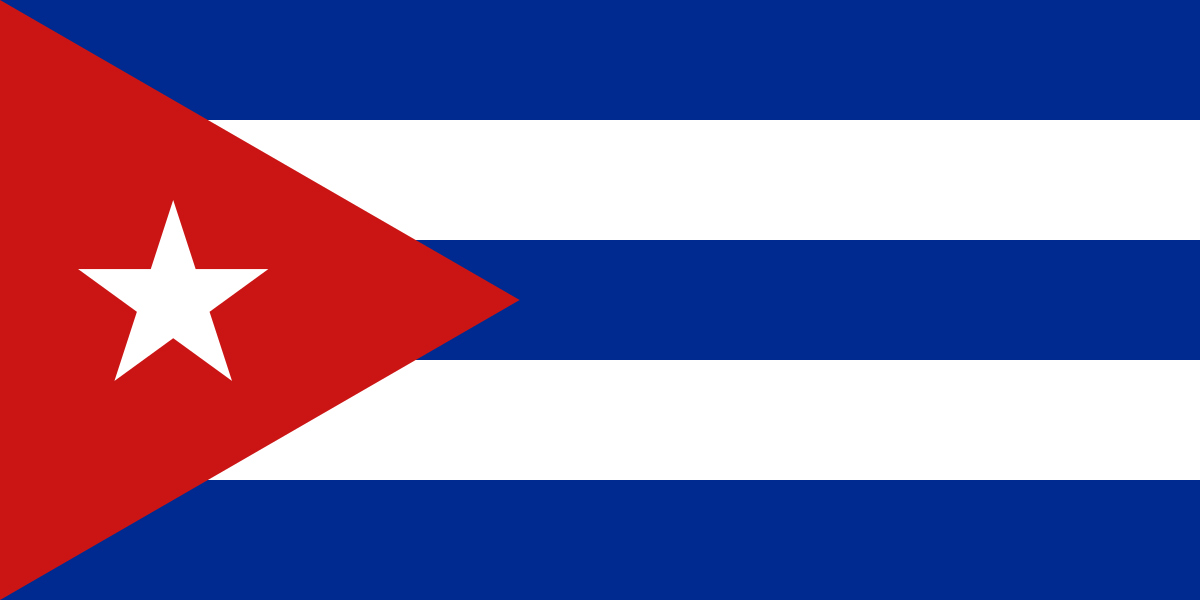
The student founder of the Cuban Communist Party martyred at 25: a face of Latin American anti-imperialism
December 1928, at a tense party meeting in Mexico City, Vittorio Vidali shouted at Mella: "Never forget — there are only two ways out of the International: expelled or dead!" A month later, Mella was assassinated on the street.
Student leader who co-founded the Communist Party of Cuba, organizing anti-imperialist student struggles at the University of Havana and establishing Cuba's first Marxist-Leninist party with Carlos Baliño in 1925. Exiled in Mexico for resisting the Machado dictatorship, he was assassinated at 25 in 1929 and became a foundational martyr of the Cuban revolutionary left, later claimed as a precursor by the Castro movement.
Career timeline
1922Enters University of Havana law school — co-founds FEU, serves as secretary
1923Becomes FEU president — convenes First National Student Congress, founds José Martí Popular University
1924Joins Havana Communist Group, creates Cuban section of the Anti-Imperialist League
1925Co-founds the Communist Party of Cuba with Carlos Baliño — Central Committee member; arrested, conducts 18-day hunger strike
1926Expelled from university and party — flees via Honduras and Guatemala to Mexico City
1926–1927Founds ANERC — writes for Cuba Libre and other revolutionary papers
1927Attends World Congress Against Colonial Oppression in Brussels — Moscow for RILU Fourth Congress
1929Shot dead on 10 January walking home in Mexico City — aged 25
A Fascist diplomat who became a witness to the regime's internal collapse
On 25 July 1943, Ciano voted for Grandi's motion, the act that helped bring down his father-in-law Mussolini.
Galeazzo Ciano was Mussolini's son-in-law and a leading diplomat of Fascist Italy who helped drive the regime's expansion and dependence on Germany before turning against a war he saw ending in catastrophe. He supported the Ethiopian war, the invasion of Albania, and the attack on Greece, while keeping diaries and diplomatic papers during his years as foreign minister. In July 1943 he voted for Dino Grandi's motion at the Fascist Grand Council, helping remove Mussolini, but miscalculated that his privileged position would survive the regime's change. After fleeing to Germany and being handed to the Italian Social Republic, he was executed after the Verona trial; his diaries remain a major record of Fascist responsibility and internal collapse.
Career timeline
1925After earning a law degree, entered the diplomatic service
1935–1936Minister of Press and Propaganda; served as a bomber pilot in the Ethiopian War
1936–1943Foreign Minister of the Kingdom of Italy
1939Participated in signing the Pact of Steel with Germany
1943.02–07Ambassador to the Holy See
1943.07Voted for Grandi's motion at the Fascist Grand Council
1944.01Executed by firing squad after the Verona trial
Wartime planning prodigy killed in the Leningrad Affair
At GKO meetings Voznesensky would openly disagree with Stalin, citing exact industrial capacity figures. Marshal Vasilevsky recalled: "His word was decisive. He was almost never wrong."
Soviet economist and Politburo member. At 35 he became chairman of Gosplan, overseeing the USSR's wartime economic planning during the Great Patriotic War and directing industrial evacuation and the conversion to military production as a member of the State Defense Committee. His 1947 work The Economy of the USSR during World War II won the Stalin Prize, and he emerged as a postwar leader favored by Stalin to shape economic reconstruction. After Zhdanov's death he lost the power struggle with Malenkov and Beria, was destroyed in the Leningrad Affair, and executed in 1950.
Career timeline
1930sYoung economic official rising rapidly through Leningrad party and planning bodies
1938–1941Chairman of Gosplan
1942–1949Chairman of Gosplan and state planning bodies, coordinating wartime production planning
1941–1945Key operator in wartime economic administration and the State Defense Committee system
1946–1949Emerges as a major postwar economic leader and writes on the wartime Soviet economy
1949–1950Arrested and executed in the Leningrad Affair
Korean revolutionary military leader who fought alongside Kim Il Sung in the Manchurian anti-Japanese guerrillas
Kim Il Sung kept a small safe in his office throughout his life. When Kim Jong Il opened it after his father's death in 1994, he found only one photograph inside — a faded picture of Kim Il Sung with Kim Chaek.
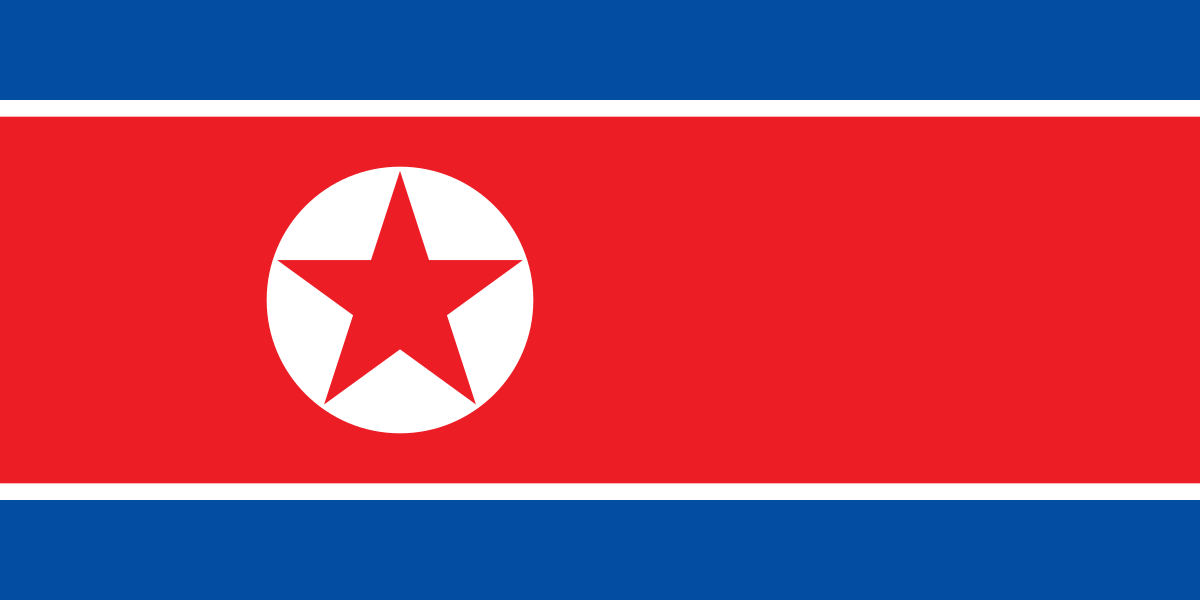
Beginning with the Korean Communist Party and Chinese Communist Party in 1920s Manchuria, he committed himself to armed anti-Japanese struggle and rose to command guerrilla operations in the Northeast Anti-Japanese United Army alongside Kim Il Sung and Choe Yong-gon, the three known as the 'Manchurian partisan troika.' After returning to Korea in 1945, he became Kim Il Sung's closest comrade, leading the creation of the North Korean branch of the Communist Party and orchestrating the campaign to install Kim as paramount leader. When the DPRK was founded in 1948, he became its first Deputy Premier and Minister of Industry, directing postwar industrial reconstruction. He commanded Korean People's Army forces at the front during the Korean War and died of exhaustion in January 1951; the DPRK posthumously named a city, a university, and a steel complex after him.
Career timeline
1927Joined the Korean Communist Party; arrested and imprisoned in the Kando Communist Party incident
1930Joined the Chinese Communist Party; Secretary of the Dongjing District Committee
1933–1940Political commissar of the 3rd Route Army, Northeast Anti-Japanese United Army; Secretary of the North Manchuria Provincial Committee
1942–1945Political commissar, 3rd Battalion, 88th Special Brigade, Soviet Far East
1945–1946Led creation of the North Korean Branch of the Communist Party; first president of Pyongyang Academy
1946–1948Vice-chairman of the North Korean People's Committee; Political Committee member of the Workers' Party of North Korea
1948–1951Deputy Premier and Minister of Industry, concurrently Deputy Minister of National Defence
1950–1951Frontline commander of the Korean People's Army during the Korean War
Editor of Neues Deutschland who helped draft the 1953 New Course, moved against Ulbricht and was purged as a “faction”
Born into a wealthy Jewish family in Gleiwitz, he became a correspondent for the Berliner Tageblatt and an agent of Soviet military intelligence (GRU). Exiled in the Soviet Union from 1939, he edited the newspaper of the National Committee for a Free Germany. Back in Berlin in 1945 he ran the Berliner Zeitung and helped found Neues Deutschland, whose editor always followed Moscow’s line. In June 1953 he and Zaisser set themselves against Ulbricht, and he helped formulate the New Course approved by the Central Committee. After the uprising he proposed a collective leadership, but in July he was removed from the Central Committee for “anti-party factionalism” and in January 1954 expelled from the SED. He worked at the Central Archives in Merseburg, died in 1966 and was rehabilitated only in 1989.
Career timeline
1930Recruited as a GRU agent
1943Editor-in-chief of Freies Deutschland
1945Editor-in-chief of the Berliner Zeitung
1950–1953SED Central Committee member and Politburo candidate
1953Removed from the Central Committee for “anti-party factionalism”
The communist who ruled Soviet Lithuania for 34 years
In 1949–50, when Moscow moved to purge the old generation of Lithuanian communists, Sniečkus confronted Stalin directly. Lithuania became the only republic where not a single pre-Soviet communist was arrested.
The longest-serving Soviet republican leader, heading the Lithuanian Communist Party for 34 years (1940–1974). An underground communist who drove Sovietization, he later buffered Moscow's interference and preserved space for the Lithuanian language and culture.
Career timeline
1920–1921Head, Alytus underground committee, CP of Lithuania
1921–1925Worked at CP of Lithuania publishing house, Smolensk
1925–1926Staff, CP of Lithuania representation at Comintern Executive Committee
1933–1936Staff, CP of Lithuania representation at Comintern Executive Committee
1927–1930Secretary, CC of CP of Lithuania (underground), responsible for agitation and organization
1936–1939First Secretary, CP of Lithuania (illegal, Kaunas)
1940.06–08Director, Department of State Security of Lithuania
1940–1974First Secretary, CP of Lithuania (34 years)
1942–1944Chief, Lithuanian Partisan Movement Staff
The East China leader purged with Gao Gang in the “Gao–Rao anti-party alliance”, the People’s Republic’s first high-level purge
Ran East China with Chen Yi, then moved to Beijing in 1953 to head the Central Organisation Department. Purged with Gao Gang in 1954, stripped of party membership in 1955; died in custody in 1975, never rehabilitated.
From Jiangxi, he became political commissar of the New Fourth Army after the 1941 incident and, as secretary of the East China Bureau in the civil war, ran the region with Chen Yi. After 1949 he chaired the East China military-administrative committee and headed the Central Organisation Department. Accused in 1953–1954 of plotting with Gao Gang to displace Liu Shaoqi and Zhou Enlai, he was condemned as the “Gao–Rao anti-party alliance” and arrested in 1955. Held without trial, he died in prison in 1975 and, unlike Gao Gang, was never formally rehabilitated.
Career timeline
1949–1952Chairman of the East China Military and Administrative Committee
1953–1954Head of the Central Organisation Department
Economist and the SED’s chief ideologue until 1958, when he was expelled from the Politburo in the Schirdewan affair
Born in Leipzig, he joined the USPD in 1919 and the KPD in 1920 and worked as an editor on party papers. From 1926 he studied in Moscow at the International Lenin School and the Institute of Red Professors. In exile from 1933 he was Ulbricht’s secretary in Paris; in Moscow he lost his teaching posts in 1936 for alleged deviations, and in the war became chief editor of Moscow Radio’s German service. Returning with the Ackermann Group in 1945, he ran the party’s propaganda and education work, joined the Politburo in 1950 and was Central Committee secretary for propaganda from 1950 to 1955, effectively the party’s chief ideologue. In June 1953 he set up the command in Halle that put down the uprising. After 1956 he opposed the complete collectivisation of agriculture, and in 1958 he was expelled from the Politburo. He then directed the Institute of Economics of the Academy of Sciences.
Career timeline
1920Joined the KPD
1926–1932International Lenin School and Institute of Red Professors, Moscow
1941–1944Chief editor of Moscow Radio’s German service
1950–1958SED Politburo member
1950–1955Central Committee secretary for propaganda
1958–1969Director of the Institute of Economics, Academy of Sciences
Smallholder premier of Hungary's second republic, forced out by Soviet-backed communists
At the Swiss border he signed his resignation on the hood of a car, the price of getting his son back.
A smallholder politician who became the first prime minister of Hungary's second republic under Soviet occupation (1946-47). He co-founded the Smallholders' Party with Zoltán Tildy in 1930, serving as its first general secretary, and after the party's 57 per cent landslide in 1945 rose from speaker of the assembly to premier, where he tamed the pengő hyperinflation with the forint. But as Rákosi's communists used salami tactics to strip away Smallholder deputies, he was blackmailed into resigning while on holiday in Switzerland in 1947, his son held as a hostage, and went into exile in the United States. His memoir The Struggle Behind the Iron Curtain (1948) became the founding Western account of the people's democracies of Eastern Europe.
Career timeline
1930–1945Co-founded the Smallholders' Party and became its first general secretary
1944.04–10Imprisoned by the Gestapo; went underground after the Arrow Cross coup
1945–1946Minister of reconstruction, speaker of the assembly, High National Council
1946–1947First premier of the second republic: the forint, the Paris peace treaty
1947.06Forced to resign in Switzerland; exiled to the United States
1947–1970Émigré politics; International Peasant Union and memoir
In a 1965 Baku speech he attacked the heavy-industry bias and called gas exports to the West a sell-off of Siberia, but it was a counterattack after a newspaper criticized the Kharkiv party organization he had led; Suslov called his views revisionist.
Of Ukrainian origin and born in Karlovka, Poltava province, to a foundry worker's family; Soviet sources give his birth as 18 February 1906, while his passport year of 1903 came from adding three years during the Civil War. A sugar-industry engineer and party member from 1930, he became USSR Deputy People's Commissar for the Food Industry in 1940, but Mikoyan had him dismissed in 1942 for falsely reporting that he had personally supervised a front-line sugar plant's evacuation. First Secretary of the Kharkiv obkom from 1950, Ukrainian party First Secretary from 1957 and a CPSU Secretary from 1963, he was one of the main organizers of Khrushchev's removal. Head of state from 1965 and one pillar of the collective leadership, he was removed from the Politburo in 1977 and resigned the presidency that June; sources differ on the day and place of his January 1983 death.
Career timeline
1965–1977Chairman of the Presidium of the Supreme Soviet
The organiser among Yan’an’s five secretaries, dead a year after the People’s Republic was founded
Back in Yan'an from 1940, he worked in the Secretariat and Organisation Department; the 1945 Seventh Congress made him a Politburo Standing Committee member behind Mao Zedong, Liu Shaoqi, Zhou Enlai and Zhu De. He died of a stroke in Beijing on 27 October 1950.
From Hunan, he studied at the Communist University of the Toilers of the East in Moscow and led the Communist Youth League. On the Long March he commanded the Second Front Army with He Long, and as the party’s delegate to the Comintern in 1938 he helped win recognition of Mao’s leadership. From 1943 he ran party organisation and finance as a Secretariat member, one of the “five secretaries” with Mao, Liu Shaoqi, Zhou Enlai and Zhu De. His health failed after 1949 and he died of a cerebral haemorrhage in 1950 at 46.
Amid Hungary's 1953 leadership change, Soviet leaders criticized him and he was dropped from the new Political Committee. Expelled from the party and convicted in 1956, he remained imprisoned until 1961.
Born to Jewish parents in Abaújszántó, he became a communist in the 1920s, fought in the Spanish Civil War and lived in the Soviet Union before returning in late 1944; from 1945 he sat on the Hungarian Communist Party's Political Committee and Secretariat. As defence minister in 1948–53 he formed the ruling "four" with Rákosi, Gerő and Révai. In June 1953 the Soviet leaders did not invite him to Moscow, and Bulganin criticized him for trying to make himself out to be a great army commander. Dropped from the new Political Committee, he was expelled from the party and convicted in 1956, released in 1961, and worked as an editor and publisher.
Career timeline
1945Joined the Hungarian Communist Party's Central Committee, Political Committee and Secretariat.
1948–1953Served as Minister of National Defence of the Hungarian People's Republic.
1956Was expelled from the party and convicted.
1961Released from prison and worked as an editor and publisher in Budapest.
From Ulmanis's favorite novelist to the architect of Latvia's Sovietization
On 21 July 1940, the motion to join the USSR was moved in the Latvian Saeima by none other than the country's most beloved novelist, Vilis Lācis.
Born the son of a port worker, Lācis became Latvia's most widely read novelist with Fisherman's Son (1933). Enjoying the patronage of Kārlis Ulmanis's nationalist regime while maintaining underground Communist ties, he became Chairman of the Council of People's Commissars (later Council of Ministers) of the Latvian SSR in 1940, serving 19 years and overseeing agricultural collectivization and the mass deportations of 1949. As a writer, he reached the pinnacle of Soviet letters with the Stalin Prize-winning novels Storm and To the New Shore. He also served as Chairman of the Soviet of Nationalities (1954–1958). His works, translated into over 50 languages, remain the most widely read body of Latvian literature.
Career timeline
1933–1935Librarian, Riga City Library
1935–1940Journalist, Jaunākās Ziņas newspaper
1940.06–08Minister of Internal Affairs, Latvian SSR
1940–1959Chairman, Council of People's Commissars/Council of Ministers, Latvian SSR
1952–1961Candidate Member, CPSU Central Committee
1954–1958Chairman, Soviet of Nationalities, USSR Supreme Soviet
1959–1966Deputy Chairman and Board Member, Latvian Writers' Union