Commander-in-chief of Estonia's war of independence
Launching the counteroffensive on 3 January 1919, he drove the 1st Division 200 kilometres east within eleven days, retaking Tartu and Narva.
Commander-in-chief of the Estonian army from December 1918, he led the counteroffensive of January 1919 and the battle of Cēsis in June. He propped up Päts's emergency regime in 1934 and, deported by the Soviets in 1940, died in Vladimir prison in 1953.
Career timeline
1901Joined the Imperial Russian Army
1917–1918Commander of the 1st Estonian Division
1918Appointed commander-in-chief of the Estonian Armed Forces
Musavat leader who headed the Azerbaijani National Council that declared the Azerbaijan Democratic Republic in 1918
Born near Baku in 1884, he founded Hummet, a Muslim social-democratic organization, in 1904. He took part in the Iranian Constitutional Revolution in 1909, and after returning to Baku in 1913 he became the chief of Musavat. As head of the Azerbaijani National Council he declared the independence of the Azerbaijan Republic on 28 May 1918. After the republic fell in 1920 he directed resistance until his arrest, but because he had once hidden Joseph Stalin from the police he was released and taken to Moscow. He escaped to Finland in 1922, lived in exile in Turkey, Poland and Romania, and died in Ankara in 1955.
Career timeline
1904Founded Hummet
1909–1911Iranian Constitutional Revolution; co-founded the Democrat Party of Persia
1913Joined Musavat and became its chief
1918Head of the Azerbaijani National Council; declaration of independence
1920Arrested, released and sent to the Commissariat on Nations in Moscow
Defence minister who pressed for joining the invasion of Yugoslavia and the war on the Soviet Union, and harshened labour service
Born in Budapest, he graduated from the military technical academy at Mödling in 1904. After the fall of the Soviet Republic he joined Horthy’s National Army. Appointed defence minister by Imrédy in 1938, he kept the post until 1942; with Chief of Staff Werth he pressed for full participation in the invasion of Yugoslavia and for fighting on the Eastern Front, and after the Kassa bombing demanded an immediate declaration of war on the Soviets. In 1942 he removed the age limit for conscription into labour service battalions and in June announced in parliament that Jewishness would be defined in racial terms. Horthy forced him to resign in September 1942 over his excessive pro-German stance. After the war a military court stripped him of his rank; he emigrated to Venezuela and died in 1964 while visiting Linz, Austria.
Career timeline
1904Graduated from the military technical academy at Mödling
1914–1918Senior commands in Budapest and Trieste
1919Fought the Czechoslovak and Romanian armies; joined the National Army
1938–1942Defence minister
1945Stripped of rank by a military court
1950s–1964Emigrated to Venezuela; railway engineer
The Radicals' 'Bull of Vaucluse', who helped build the Popular Front and dismantled it with his own hands
'Ah! les cons! s'ils savaient...', the words attributed to him on seeing the crowds cheering at Le Bourget airfield on his return from Munich on 30 September 1938. Whether he said them, and where and to whom, is disputed.
A baker's son and history teacher who rose to lead the Radical Party. He quit as premier after the 6 February 1934 riot, then as defence minister from June 1936 helped sustain the Popular Front, but after returning as premier in April 1938 he ended the 40-hour week by decree in November and broke the general strike. He signed the Munich accords in September 1938, declared war on Germany on 3 September 1939 and banned the Communist Party after the Nazi-Soviet pact. He fell over the failure to aid Finland in March 1940, stood trial at Riom and was interned near Buchenwald and at Itter Castle until 5 May 1945. Back in the Chamber after the war, he opposed de Gaulle's full powers in 1958 and died in Paris on 10 October 1970.
Career timeline
1884–1914Baker's son from Carpentras; history teacher
1914–1918Fights the First World War, rising from private to lieutenant
1919–1933Radical deputy; rises to lead the party
1934.01–02Premier; resigns the day after the riot of 6 February
1936–1940Defence minister, also premier from 1938
1938.04–09Returns as premier; signs the Munich agreement
1938.11Dismantles the 40-hour week by decree and breaks the general strike
1939.09Declares war on Germany; bans the Communist Party after the Nazi-Soviet pact
1940.03Falls over the failure to aid Finland
1940–1945Defendant at the Riom trial; interned near Buchenwald and at Itter Castle
1946–1958Returns to the Chamber; elder of the Radical Party
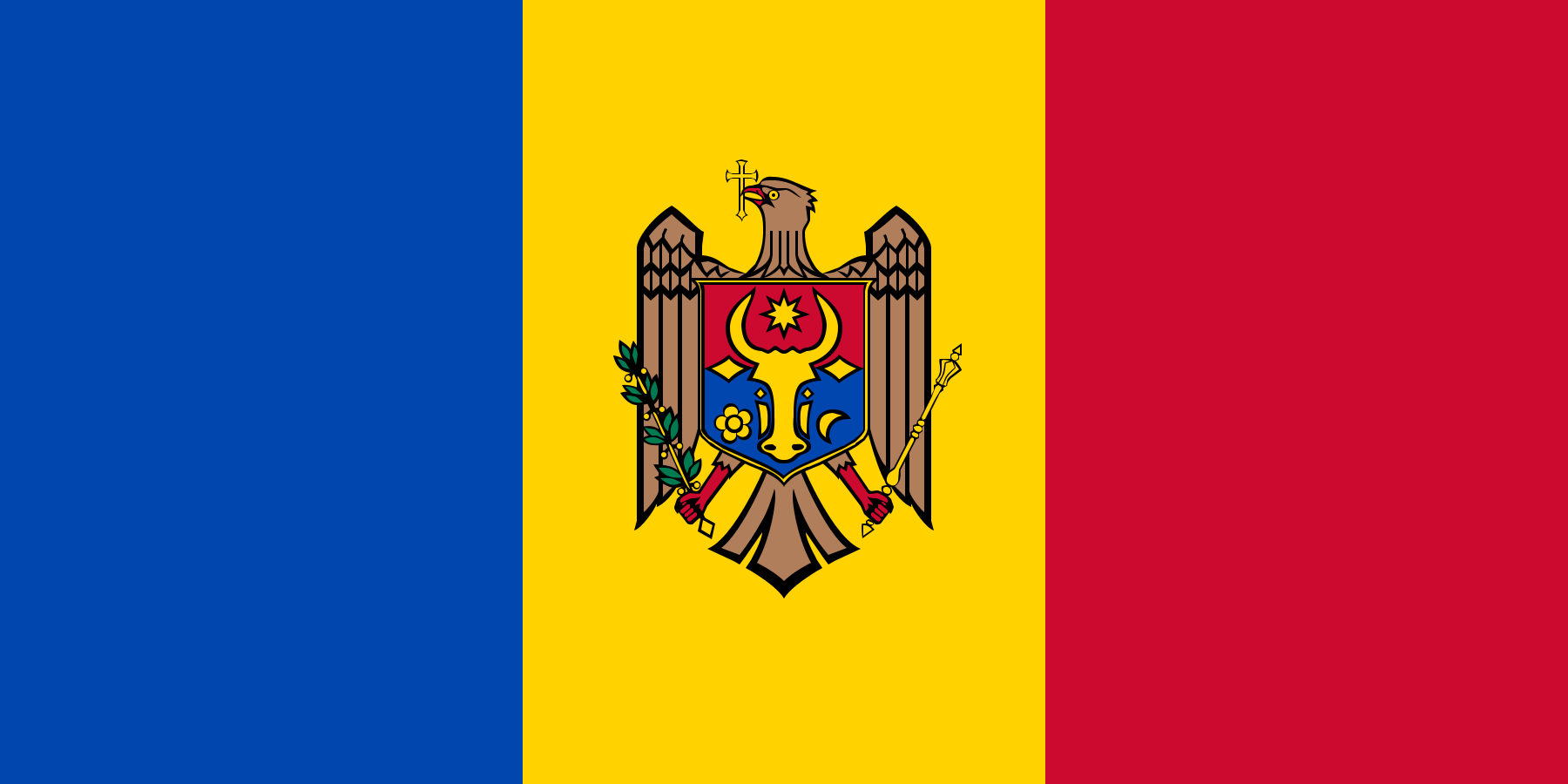
Bessarabian Socialist Revolutionary who headed the first government of the Moldavian Democratic Republic and put land reform first
Born in Tănătari, Bessarabia, in 1884, he graduated from the Chișinău seminary and the Faculty of Letters in Saint Petersburg and taught. A Socialist Revolutionary, he returned to Bessarabia in 1917 with Inculeț at Kerensky’s urging and was elected chairman of the governorate peasants’ soviet and to the Russian Constituent Assembly. In December 1917 he became President of the Council of Directors General, the Moldavian Democratic Republic’s first government, and Director General for Agriculture, putting land reform first. His view that the republic should bear the majority people’s name prevailed; he put the entry of Romanian troops to a vote, yet protested their presence, fearing they would be used to block land reform. He voted for union but resigned amid charges of a pro-Russian stance, and later sat in the Romanian Senate. He fled to Bucharest in 1940 and died there in 1971.
Career timeline
1917Chairman of the Bessarabian Governorate Soviet of Peasants’ Deputies
1917Member of the Russian Constituent Assembly
1917–1918President of the Council of Directors General and Director General for Agriculture
Chief of the German Army General Staff who planned Barbarossa and later forged the myth of the "clean Wehrmacht"
On 11 August 1941, his early optimism shattered, Halder wrote in his diary: 'The Russian colossus...has been underestimated by us...whenever a dozen divisions are destroyed the Russians replace them with another dozen.'
Franz Halder served as Chief of the German Army General Staff from 1938 to 1942, directing operational planning for the invasions of Poland, France, and, most consequentially, the Soviet Union. His diary entry of 31 July 1940 records Hitler's decision, delivered at the Berghof, to destroy the USSR; Halder's staff subsequently drafted the Commissar Order mandating summary execution of Red Army political officers, and the Barbarossa Decree granting German soldiers judicial immunity for atrocities in the East. After the war he served as lead consultant to the U.S. Army Historical Division, supervising over 700 former German officers in a systematic effort to suppress evidence of Wehrmacht crimes and fabricate the myth of the 'clean Wehrmacht,' a narrative that shaped Western historiography for decades.
Career timeline
1914–1918Served as staff officer in World War I; awarded Iron Cross 1st and 2nd Class
1938–1942Chief of the Army General Staff (OKH); directed planning for invasions of Poland, France, the Balkans and the USSR
1940.07Berghof conference of 31 July: recorded Hitler's decision to destroy the USSR in his diary; Barbarossa planning commenced
1941Drafted Commissar Order and Barbarossa Decree, radicalising warfare on the Eastern Front
1942.09Dismissed as Chief of Staff after strategic failures on the Eastern Front and conflict with Hitler
1944–1945Arrested for connection to the 20 July plot; imprisoned at Dachau and Flossenbürg concentration camps
1947–1961Lead consultant to U.S. Army Historical Division; supervised 700+ former officers, constructing the 'clean Wehrmacht' myth
1961Awarded U.S. Meritorious Civilian Service Award, the only German decorated by both Hitler and an American president
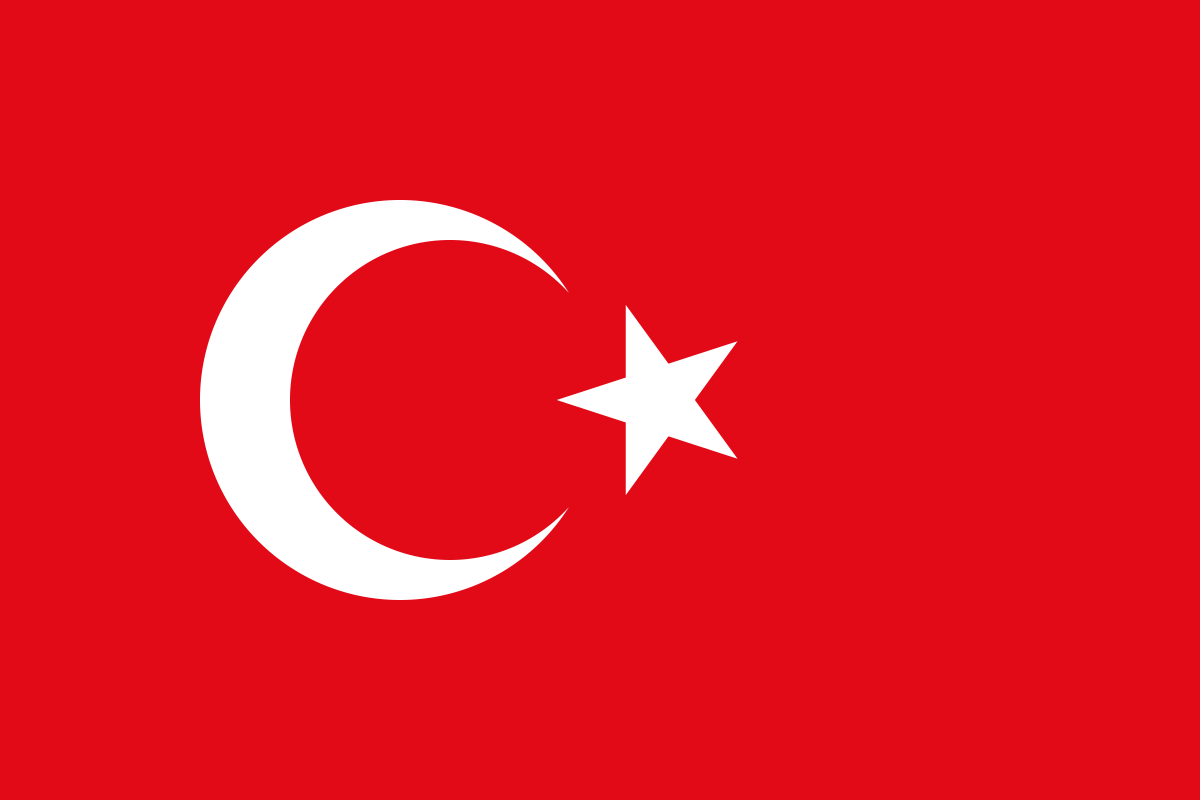
Officer who negotiated the Treaty of Lausanne and succeeded Atatürk as Turkey’s second president
Born in Smyrna, an Ottoman officer, he won the First and Second Battles of İnönü in the War of Independence as chief of the General Staff and commander of the Western Front. As Turkey’s chief negotiator at Lausanne in 1922–1923 he faced down Curzon and replaced the Treaty of Sèvres with the Treaty of Lausanne. As prime minister for most of Atatürk’s presidency he carried out the secularising reforms; after the Sheikh Said revolt he pushed the Turkification of the Kurds, and he is considered one of those responsible for the Dersim massacre. Elected second president in 1938, he took the title “National Chief” and kept Turkey in armed neutrality in the Second World War. After defeat in the 1950 election he handed over power peacefully. He died in 1973.
The first Korean communist, who gave her life bridging the Russian Revolution and Korean liberation
On September 16, 1918, dragged before Ataman Kalmykov's White Cossacks to be shot, her final cry: 'Freedom and independence for Korea!'
Born to Korean migrants in Siberia, she joined the Bolsheviks in 1916, becoming the first Korean communist. Dispatched to the Far East on Lenin's orders, she served as Commissar of Foreign Affairs for the Khabarovsk Soviet, co-founded the Korean Socialist Party with Yi Tong-hwi, and organized Korean Red Guard units against White and Japanese forces before her execution in 1918 at 33, a symbolic figure bridging the Russian Revolution and the Korean independence struggle.
Career timeline
1916Joined the RSDLP(B)
1917Secretary, Khabarovsk Bolshevik branch & Commissar of Foreign Affairs, Far Eastern Council of People's Commissars
1918.04Co-founded the Korean Socialist Party in Khabarovsk
1918.06–08Organized Korean and international Red Guard units against White and Japanese forces
1918.09.04Captured by White and Japanese forces
1918.09.16Executed by White Cossacks in Khabarovsk
First head of the Crimean People’s Republic, the first elected mufti of Crimea and the poet of the Crimean Tatar anthem
Born in 1885 in the village of Büyük Sonaq near Dzhankoy, the son of an imam, he went to Istanbul in 1908 to study law and theology, founded the Young Tatar Writers’ Association and the secret organisation Vatan (Homeland), and returned to Crimea in 1912. In March 1917 he became chairman of the Crimean Muslim Executive Committee and the first mufti of Crimea elected by delegates rather than appointed by the Minister of the Interior. Arrested in June for anti-government agitation, he was freed after a protest bearing 5,000 signatures. He prepared the Qurultay and in December became chairman and director of justice of the Directory of the Crimean People’s Republic, but was arrested by the Bolsheviks in January 1918 and killed without trial by sailors in Sevastopol on 23 February. His poem “Ant etkenmen” became the Crimean Tatar national anthem.
Career timeline
1908–1912Studied law and theology in Istanbul; co-founded Vatan
1913Law faculty of the Psychoneurological Institute, St Petersburg
1917Chairman of the Crimean Muslim Executive Committee; mufti of Crimea
1917–1918Chairman and director of justice of the Directory of the Crimean People’s Republic
Founding member and first party chairman, shot as a 'bourgeois'
Arrested at the third party congress in August 1924, he was tried, sentenced and shot within twenty-four hours while the congress went on meeting.
A founding member of the Mongolian People's Party in 1919, he led the party's first Central Committee after the 1921 revolution and served as finance minister in the early people's government. He directed the purge and execution of Prime Minister Bodoo in 1922, an early sign of the revolution's inner violence. Wanting less Soviet control and limited capitalism, he clashed with Comintern leftists and was denounced as a 'bourgeois' at the third party congress in August 1924, then arrested and shot within a day. The purge sealed the party's turn toward the non-capitalist path and the republic.
Career timeline
1919Founded the East Khüree group and helped found the Mongolian People's Party
1920Member of the party delegation to Moscow that met Lenin
1921Elected Central Committee chairman at the 1st congress in Kiakhta (March–September)
1921–1922Minister of finance
1922Directed the purge and execution of Prime Minister Bodoo
1923Member of the Central Committee Presidium
1924Denounced as a 'bourgeois' and executed at the 3rd party congress
Appealing for return in 1921, he declared: “Soviet power is the only power representing Russia and its people.”
Yakov Slashchov was a Russian imperial officer who became a White general and a central commander in the defence of Crimea during the Civil War. Taking the Perekop Isthmus at the end of 1919, he repelled repeated Red Army attacks in early 1920 and kept Wrangel's Crimean base alive with limited forces. Reports of harsh repression and looting under his command stand alongside his battlefield reputation, exposing the violence of White rule. After exile, he returned to Soviet Russia and taught tactics, embodying the uneasy absorption of defeated military expertise into the new state.
Career timeline
1905Graduated from the Pavlovsk Military School; ensign in the Life Guards Finland Regiment
1911–1917Studied at the Nicholas Military Academy; taught tactics at the Page Corps
1917Commander of the Moscow Guards Regiment
1918Joined the Volunteer Army; chief of staff to Shkuro and commander in Kuban formations
1919Commander of the 4th Infantry Division and the 3rd Army Corps of the Armed Forces of South Russia
1919–1920Commander of the Crimean defence; operated the Perekop Isthmus fortifications
1922–1929Tactics instructor at the Soviet Vystrel higher officers' courses
Petrograd Finnish Bolshevik who helped Lenin escape to Finland in 1917 and sat on the Red Guards’ three-man command in 1918
Born in Kronstadt in 1885 to a Petersburg Finnish working family, he worked in St Petersburg as a turner among other jobs and joined the Russian Social Democratic Labour Party in 1903, siding with the Bolsheviks. He organised Lenin’s escape to Finland in the summer of 1917 and guarded him around the October Revolution. Over the winter of 1917–1918 he and his brother Jukka procured arms for the Finnish Red Guards; when Haapalainen was dismissed on 20 March 1918 he formed a three-man command with Evert Eloranta and Adolf Taimi, then took over the Lempäälä front. After the defeat he rose to corps commander in the Red Army and quarrelled with Kuusinen and Manner in the Communist Party of Finland, which dropped him from its Central Committee in 1927. Expelled from the army for alcoholism in 1935 and sentenced to death, he died of tuberculosis in 1936 before the sentence was carried out.
Career timeline
1903Joined the RSDLP (Bolshevik)
1917Organised Lenin’s escape to Finland; Lenin’s bodyguard
1918Three-man command of the Red Guards; commander of the Lempäälä front
1919–1922Commissar and inspector of the Red Army’s Finnish units
1918–1927Leadership of the Communist Party of Finland
Imperial Japanese general defeated at Khalkhin Gol
On August 22, 1939, as his division collapsed under Zhukov's assault, Komatsubara wrote in his diary: "Even when we made point-blank attacks with cider bottles, they were ineffective, and our troops were left in despair."
Michitarō Komatsubara was an Imperial Japanese Army officer whose Russian expertise shaped a career in intelligence, staff work, and command. At Khalkhin Gol in 1939 he led the 23rd Division as Japan’s border conflict became a major campaign, but Zhukov’s encircling offensive left the division effectively destroyed. The defeat ended his active career, and he died later in 1940 after retiring from the army.
Career timeline
1905Graduated from Army Academy
1909–1910Assistant military attaché in Russia
1919–1929Soviet intelligence officer, then military attaché in Moscow
1932–1934Chief of the Harbin Special Agency in Manchukuo
1934–1937Commander of the 8th Infantry Brigade and 1st Imperial Guards Brigade
1937–1939Lieutenant general and commander of the Kwantung Army’s 23rd Division
1939–1940Kwantung Army staff officer, then retired after Khalkhin Gol
The Greek prime minister who accepted British aid under invasion
When Germany invaded on 6 April 1941, he rejected the German demand that British forces leave Greece.
Alexandros Koryzis was a lawyer, economist, and banker who helped organize state finance and agricultural credit in Greece. He served as an official and minister under Ioannis Metaxas's authoritarian regime, but became prime minister as an administrator rather than a party politician. After Metaxas's death in January 1941, he led the government in accepting British military assistance and resisting the German invasion, binding Greece's war effort to the Allied coalition. He died by suicide on 18 April, as German forces advanced.
Career timeline
1903Joined the National Bank of Greece
1915Helped organize the bank's agricultural-credit branch
1919–1920Economic adviser in Smyrna and founder of a National Bank branch
1925–1928First president of the Autonomous Currant Organization
1928–1933Deputy governor of the National Bank of Greece
1936–1939Minister of State Hygiene and Welfare
1939–1941Governor of the National Bank of Greece
1941Prime minister of Greece, also holding foreign affairs and defence portfolios
An aggressive commander of mobile warfare and military deception
In Fortitude South in 1944, Patton became the public face of a nonexistent First U.S. Army Group, staging a threat toward Calais.
George S. Patton was a U.S. Army general who emphasized armored mobility and aggressive offensive operations. He demonstrated strong battlefield leadership in North Africa and Sicily, yet repeated controversy over striking soldiers and inflammatory statements damaged his command standing. In Fortitude South in 1944, he was presented as commander of the fictitious First U.S. Army Group, helping persuade Germany that Calais was the real invasion target and keeping reserves away from Normandy after D-Day. He later led the Third Army across France and into Germany, but after the war was removed as military governor of Bavaria for anti-Soviet statements and criticism of denazification.
Career timeline
1909Second lieutenant, U.S. Army Cavalry
1916Served in the Pancho Villa Expedition and as Pershing's aide
1917–1918Organized and commanded the tank school in France; commanded the 304th Tank Brigade
1942Commanded the Western Task Force in Operation Torch, landing in North Africa
1943Commanded the U.S. Seventh Army in the Sicily campaign
1944Presented as commander of the fictitious First U.S. Army Group in Fortitude South
1944–1945Commanded the U.S. Third Army in the advance through France and Germany
1945Military governor of Bavaria; later commanded the U.S. Fifteenth Army
The colonel of the Croix-de-Feu who turned his columns away from the Chamber
That night his columns reached the rear of the Chamber and he ordered them to disperse rather than storm it. The left saw a dress rehearsal for fascism in the same night; the far right called him a traitor. Both verdicts followed him for the rest of his life
The son of a general, trained at Saint-Cyr, who served in Morocco and the First World War and retired as a lieutenant-colonel. From 1931 he led the veterans' association Croix-de-Feu and built it into a mass movement of several hundred thousand, whose discipline and motorised rallies looked to the French left like the face of fascism. On the night of 6 February 1934 his columns reached the rear of the Chamber and he ordered them to disperse rather than storm it, a caution for which the far right called him a traitor. When the Popular Front government dissolved the leagues in 1936 he founded the Parti Social Français and turned toward electoral politics, building what became the largest party of the French right by the late 1930s. He backed Pétain and sat on Vichy's National Council while running an intelligence network that passed information to the British, was arrested by the Gestapo in 1943 and interned in Germany, and after the liberation was detained again by the French authorities as a Vichy man before dying of illness in 1946. Whether he was a fascist or the French form of authoritarian conservatism has been the central argument in the study of the French right from Sternhell onward.
Career timeline
1885Born at Lorient, the son of a general
1907–1918Saint-Cyr, service in Morocco and the First World War
1919–1928Staff service; retires as a lieutenant-colonel
1929–1931Joins the Croix-de-Feu and becomes its president
1931–1936Expands the Croix-de-Feu into a mass movement of hundreds of thousands
1934.02.06Disperses his columns at the Chamber
1936.06Founds the Parti Social Français after the leagues are dissolved
1936–1939Builds the PSF into the largest party of the French right
1940–1942Backs Pétain; sits on Vichy's National Council
1942–1943Runs an intelligence network for the British; arrested by the Gestapo in March 1943
1943–1945Deported to Germany and interned
1945–1946Detained by the French authorities after the liberation; dies the next year
1961Posthumously recognised as a deported member of the Resistance
The army strategist who turned a railway pretext into the conquest of Manchuria
In a 1948 prison diary, he looked back on the Manchurian Incident’s success and wrote that extending the war into China had been a mistake.
Seishirō Itagaki was an Imperial Japanese Army officer and politician who became a central figure in the Manchurian Incident and the expansion of Japan’s war in China. With Kanji Ishiwara, he helped plan the 1931 railway explosion and turned the Kwantung Army’s insubordinate action into the occupation of Manchuria and the creation of Manchukuo. He later served as war minister and commanded forces in several theaters before being convicted of responsibility for aggressive war at the International Military Tribunal for the Far East and executed.
Career timeline
1904Graduated Army Academy; commissioned second lieutenant
1916Graduated Army War College; began staff service
1924–1926Assistant military attaché at the Japanese embassy in China
1929–1932Senior staff officer of the Kwantung Army; directed the Manchurian Incident and occupation
1934–1937最高 military adviser to Manchukuo; vice chief and chief of staff of the Kwantung Army
1937–1939Commander of the 5th Division; minister of war
1939–1941Chief of staff of the China Expeditionary Army
1941–1945Commander of the Chosen Army and Seventh Area Army; signed the surrender in Singapore
1948Executed after conviction by the International Military Tribunal for the Far East
On the evening of 26 November 1939, he received Molotov’s protest over Mainila and immediately sought the facts from Helsinki.
Aarno Yrjö-Koskinen was a Finnish jurist and diplomat who shaped the foreign ministry’s political work and external negotiations. As envoy in Moscow, he stood at the front line of diplomacy in November 1939, receiving Molotov’s protest over the Mainila shelling and delivering Finland’s replies before the Winter War. He also helped conclude Finland’s non-aggression pact with the Soviet Union, yet the effort to contain the security conflict through negotiation did not prevent war.
Nazi field marshal who built the Luftwaffe and directed the defence of Italy
His trial opened at Venice in February 1947; convicted on 6 May of the Ardeatine massacre and of inciting the killing of civilians, he was sentenced to death, commuted to life imprisonment on 4 July 1947 and released in October 1952.
Albert Kesselring was a Nazi field marshal who helped build the Luftwaffe and commanded German forces in the invasions of Poland, France and the Soviet Union, then from November 1941 as Commander-in-Chief South in the Mediterranean and Italy, delaying the Allied advance at the Gustav and Gothic Lines. Under his command reprisals were carried out against civilians: a directive of June 1944 authorised the utmost severity, and some 22,000 Italian civilians are believed to have been killed during the occupation, including 335 shot in the Ardeatine Caves. Convicted at Venice in 1947 and sentenced to death, he was commuted to life imprisonment, released in 1952, and never repudiated his conduct of the war.
Career timeline
1904Joined the 2nd Bavarian Foot Artillery Regiment
1933Headed the administrative office of the Reich Air Ministry, helping prepare the Luftwaffe
1936–1937Chief of the Luftwaffe General Staff
1939–1941Commanded Luftflotte 1 and 2 in Poland and on the Western and Eastern Fronts
1941–1943Commander-in-Chief South, commanding German forces in the Mediterranean theatre
1943–1945Commander-in-Chief Southwest and Army Group C, directing the defence of Italy
1945Commander-in-Chief West; surrendered to US forces in May
1947–1952Convicted of war crimes and released in 1952
The admiral who reorganized Pacific power through intelligence and mobility
After becoming convinced of Japan's target, he concentrated available forces for the defense at Midway.
Chester W. Nimitz was a U.S. Navy admiral who rose from submarine and logistics specialist to command the Allied maritime war in the Pacific. Made commander of the Pacific Fleet after Pearl Harbor in 1941, he combined intercepted Japanese communications with operational judgment, concentrated available forces at Midway, and approved the command structure for the Guadalcanal counteroffensive. His leadership converted American superiority in intelligence, matériel, and mobility into sustained operations, while leaving intact the immense human cost of island warfare and blockade. As Chief of Naval Operations after the war, he oversaw demobilization while backing the transition to nuclear-powered submarines.
Career timeline
1905Graduated from the U.S. Naval Academy and entered the Navy
1917–1918Chief of staff, Submarine Force, U.S. Atlantic Fleet
1939–1941Chief of the Bureau of Navigation
1941–1945Commander in Chief, U.S. Pacific Fleet and Pacific Ocean Areas
1942Deployed forces for Midway and approved the command structure for the Guadalcanal counteroffensive
1944Appointed fleet admiral, the U.S. Navy's highest rank
1945–1947Chief of Naval Operations
1947–1966Remained on active duty as fleet admiral, advising the Navy and supporting postwar U.S.-Japan reconciliation
A military leader who shaped Poland's independence struggle and armed forces in exile
When aid for the Warsaw Uprising failed to materialize, he publicly condemned the Allied leaders for abandoning Poland.
Kazimierz Sosnkowski was a Polish independence activist and general who, alongside Józef Piłsudski, helped build clandestine military organizations and the Polish armed forces. He commanded formations during the Polish–Soviet War and helped modernize the army in the interwar period. During the Second World War he led parts of the Polish underground and, from exile, warned that Soviet and Western Allied policy could reduce Poland to dependence on Moscow. After publicly pressing the Allies to support the Warsaw Uprising and criticizing their response, he was dismissed as commander-in-chief in 1944 and became an elder of the Polish émigré community in Canada.
Career timeline
1904–1907Activist and commander in the Polish Socialist Party's Combat Organization against the Russian Empire
1908–1914Co-founder of the Union of Active Struggle and chief of staff of the Riflemen's Association
1914–1917Deputy commander and chief of staff of the First Brigade of the Polish Legions
1919–1920Deputy minister for military affairs, overseeing the army's expansion and unification
1920–1924Minister for military affairs and commander of the Reserve Army in the Polish–Soviet War
1939–1941Commander of the Union of Armed Struggle and chairman of the exile government's Home Country Committee
1943–1944Commander-in-chief of the Polish Armed Forces in the West, pressing for aid to the Warsaw Uprising
1944Dismissed as commander-in-chief after criticizing the Allies, then settled in Canada
The American journalist who chronicled the Russian and Chinese revolutions from the inside, founder of Moscow News
"We are undertaking the most tremendous move ever made by labor in this country, a move which will lead — NO ONE KNOWS WHERE!" — editorial on the eve of the Seattle General Strike, 1919
American left-wing journalist and communist. After earning a Chicago PhD, she covered the Seattle General Strike (1919), moved to the USSR in 1921, and co-founded Moscow News (1930). In 1946 she interviewed Mao Zedong in Yan'an, drawing the famous 'paper tigers' declaration. Expelled from the USSR as a spy in 1949, she was rehabilitated in 1955 and settled in China as an honoured 'foreign friend,' chronicling Mao's China through the Cultural Revolution. With over 30 books, she was an unmatched eyewitness to the century's great communist revolutions.
Career timeline
1885Born in Friend, Nebraska, daughter of a progressive Congregationalist minister
1908PhD in philosophy from the University of Chicago — dissertation: The Social Psychology of Prayer
1916–1918Elected to Seattle School Board; recalled for supporting the IWW and opposing WWI
1919Editor, Seattle Union Record; covered the Seattle General Strike from the inside
1921Travelled to USSR with AFSC famine relief; settled as Moscow correspondent for International News Service
1930Co-founded and edited Moscow News, the USSR's first English-language newspaper
1931Married Soviet agronomist Joel Shubin (d. 1942)
1937–1938War reporting from the Spanish Civil War and China's anti-Japanese base areas
1946Interviewed Mao Zedong in Yan'an; recorded the famous 'paper tigers' remark
1949Arrested by Soviet authorities, expelled as an 'American spy'; rehabilitated in 1955
1958–1970Settled permanently in China; honoured as a 'foreign friend' of Mao and Zhou Enlai
1970Died of a heart attack in Beijing; memorial attended by Zhou Enlai and Guo Moruo
Founder of Western Marxism: the Hungarian thinker who reoriented 20th-century Marxist philosophy with History and Class Consciousness
“Now, after the collapse of actually existing socialism, his questions look like the only surviving form of Marxism.” — from a late-life interview
Hungarian Marxist philosopher who founded Western Marxism with History and Class Consciousness (1923), establishing the concepts of reification and class consciousness. Served as commissar/minister of culture in the 1919 Hungarian Soviet Republic and the 1956 Imre Nagy government.
Career timeline
1902–1906Graduates Budapest law faculty; doctorate in law from Kolozsvár University
1909PhD in philosophy from Budapest University with The Form of Drama
1912–1918Lives in Heidelberg, studying with Simmel, Weber and Bloch
1918Joins the Hungarian Communist Party (KMP)
1919.03–08Deputy People's Commissar for Culture; political commissar, Hungarian Red Army
1919–1929Exile in Vienna; elected KMP CC General Secretary 1928, removed for right deviation
1923Publishes History and Class Consciousness; denounced as revisionist by Comintern
1929–1945Resides in Moscow; Marx-Engels Institute and Literary Critic journal
1941Arrested by NKVD; released after 2 months on Dimitrov's intervention
1942Defends The Young Hegel dissertation, USSR Academy of Sciences
1945–1958Professor of aesthetics, University of Budapest; member of parliament
1956.10–11Minister of Culture in Imre Nagy government; interned in Romania
1957–1967Expelled from party; reinstated 1967. The Specificity of the Aesthetic
A German general whose armoured successes were inseparable from crimes on the Eastern Front
In December 1942, Hoth's Fourth Panzer Army tried and failed to relieve the encircled Sixth Army at Stalingrad.
Hermann Hoth was a German general who carried the Prussian and imperial army tradition into the Wehrmacht and rose as a panzer commander. He directed rapid mobile operations in the invasions of France and the Soviet Union, and in 1942 commanded the Fourth Panzer Army during Case Blue and the failed attempt to relieve Stalingrad. Hoth understood the war against the Soviet Union as a war of annihilation and transmitted and implemented the Commissar Order and brutal measures against civilians. Convicted of war crimes and crimes against humanity at the OKW trial, he received fifteen years in prison and was released early in 1954.
Career timeline
1904Entered service in the Prussian Army
1914–1918Staff and field commands in the First World War
1935–1938Commanded the 18th Infantry Division
1939–1940Commanded XV Army Corps in the invasions of Poland and France
1941Commanded Panzer Group 3 in the capture of Minsk and Vitebsk
1941–1942Commander of the 17th Army
1942–1943Commander of the Fourth Panzer Army and its Stalingrad relief attempt
1948–1954Convicted at the OKW trial and imprisoned at Landsberg