Revolution and war in Central Asia
From the settlers’ Tashkent Soviet to the national delimitation of 1924, whose revolution was it in Turkestan, the Kazakh steppe, Bukhara and Khiva, and why did the Red Army go as far as Gilan in Persia?
The soviet that took power in Tashkent in 1917 was a regime of Russian settlers and railway workers, and in February 1918 it destroyed the Muslim Kokand Autonomy in a massacre. After the Basmachi risings, the choices of the Alash Orda and a period cut off by the British and the Whites, Frunze’s armies turned Khiva and Bukhara into people’s soviet republics in 1920, and the same year the Caspian flotilla landed in Persian Gilan. In 1924 the Soviet Union redivided the region into national republics.
 1917: The Tashkent Soviet and settler power
The Russian Empire conquered Turkestan in the second half of the 19th century and ran it as a colony in all but name. Its native inhabitants were classed as inorodtsy, a legal category separate from Russians, and although they made up nearly 10% of the empire's population they had no seats in the 435-member State Duma. During the Stolypin reforms of 1906–1912 up to 500,000 peasant households moved from central Russia to the Kazakh steppe and Central Asia and took up land there. When the tsarist government ordered in June 1916 that Muslim men aged 19 to 43 be drafted for labour behind the front, resistance that began in Khujand in July spread to Fergana, Semirechye and the Kazakh steppe. Settlers and natives massacred one another, and estimates of those who died directly or indirectly from the suppression range from about 100,000 to 500,000; hundreds of thousands of Kyrgyz and Kazakhs fled to China. Kyrgyz historiography holds that as many as 40% of the Kyrgyz died during the revolt or its aftermath. The Russian state had not restored order in parts of the region by the time of the October Revolution, and the experience shaped how natives would view Russian power in the revolutionary years. 1 2 3
After the February Revolution, Turkestan's Muslim intelligentsia founded the Shuro-i Islomiya (Muslim Council), dominated by Jadid reformers, in March 1917, while conservative ulama who put sharia first split off as the Ulamo Jamiyati. Real power in Tashkent, however, lay with the Tashkent Soviet of Workers' and Soldiers' Deputies, made up of Russian railway workers and soldiers. Having clashed with the local organs of the Russian Provisional Government, the Soviet rose in arms in November and took Tashkent by 14 November (1 November O.S.). The Third Regional Congress of Soviets, meeting at the same time, set up a Sovnarkom but ignored native demands for autonomy. When a parallel Muslim congress proposed a coalition, the Turkestan Sovnarkom chairman Fyodor Kolesov refused, saying that "the inclusion of Muslims in the organ of supreme regional power is unacceptable at the present time"; not one of its fourteen commissars was a native. According to the Russian-language source, the Bolshevik Central Committee criticised the decision and demanded that native representatives be included. To the overwhelming Muslim majority, revolutionary power looked like a continuation of the tsarist colonial order. 2 4 5 6 3
The Kokand Autonomy and the massacre of February 1918
In answer to the Tashkent Sovnarkom's refusal, the Muslim movement held its Fourth Extraordinary All-Muslim Regional Congress in Kokand, the commercial centre of the Fergana Valley that lay beyond the Soviet's reach. On 10 December 1917 (27 November O.S.) some 200–250 delegates declared Turkestan "territorially autonomous in union with the federal democratic Russian republic". This was the Turkestan Autonomy, usually called the Kokand Autonomy. It had a 54-seat Provisional People's Council and a twelve-member provisional government; its first prime minister was the Kazakh Mukhamedzhan Tynyshpaev, and Mustafa Shokay ran external relations. The government announced that a parliament would be elected by universal, direct, equal and secret ballot on 20 March 1918, with two-thirds of the seats reserved for Muslims and one-third guaranteed to non-Muslims. Most of the native population backed it: rallies thousands strong were held in Namangan, Samarkand and elsewhere, and 60,000 gathered in Tashkent. At a Tashkent rally on the Prophet's birthday (13 December O.S.) part of the crowd entered the new city to free prisoners; soldiers opened fire and several were killed, and the freed prisoners were summarily executed. Asked to recognise the Autonomy, People's Commissar for Nationalities Joseph Stalin replied that the workers of Turkestan should disperse the Tashkent commissariat "by force" if they had the power. 2 4 7
The Autonomy had almost no means of governing. Unable to tax, it lived on a 3-million-ruble loan and donations, and when Soviet forces seized 8 million rubles from the Kokand branch of the State Bank, including the Autonomy's own account, its internal quarrels deepened; in early January (December O.S.) Tynyshpaev resigned and Shokay became prime minister. Its national army of about 2,000 men had no officers or trained soldiers and relied on the militia of Ergash, the Kokand police chief. Shokay travelled to Orenburg to discuss joining the South-Eastern Union with Alexander Dutov but rejected its plan for a Cossack-dominated state; the Alash Autonomy put off any union until the Constituent Assembly met; and the Emir of Bukhara refused even to receive the Autonomy's envoys. In mid-January the Fourth Regional Congress of Soviets outlawed the Autonomy and ordered the arrest of its members. Once Dutov's blockade of the railway was lifted in January and arms could reach Tashkent, the military imbalance became decisive. Inside the Autonomy the conflict between the Jadid government and the conservatives sharpened, and on 18 February Ergash overthrew Shokay's government and took power himself. 2 4 8
In mid-February armed groups on the Autonomy's side seized the Palace of Khudayar Khan and the headquarters of the Kokand Soviet; the Tashkent Soviet declared martial law and sent troops under Konstantin Osipov. According to the Russian-language source, eleven trainloads of troops with artillery arrived, and armed Armenian Dashnak units fought alongside them. After talks broke down the Soviet forces shelled the palace, and when Ergash rejected an ultimatum to surrender on 19 February they shelled the city heavily. Fires spread, organised resistance collapsed, and on 22 February a delegation from the old city agreed to disarm and recognise Soviet authority. The captured city was sacked and its inhabitants massacred. Even the English-language sources disagree on the toll: the article on the Turkestan Autonomy says more than 10,000 residents were killed, the article on the Basmachi movement up to 25,000. The Soviet government requisitioned food from the region and caused a famine; supporters of the Autonomy were summarily executed or arrested, and in May 1918 the Tashkent branch of the Ulamo Jamiyati was dissolved. On 30 April the Fifth Regional Congress of Soviets proclaimed the Turkestan Soviet Republic, but it was not the national autonomy the Autonomy's supporters had fought for. 2 4 3 5
 The besieged Turkestan Soviet Republic, 1918–1919
The Turkestan Soviet Republic proclaimed on 30 April 1918 called itself an autonomous republic of the Russian Federation, but, as an English-language source puts it, at first it controlled only a few railway junctions. By the summer the Orenburg Cossacks and the fronts of the civil war had cut it off from Russia. Moscow's dispatch in June of 70 million rubles and 115 wagons of grain from Tsaritsyn was for a long time the last major help. Because natives were not subject to conscription until the summer of 1920, the republic's Red Army numbered only about 8,000 in the summer of 1918 and about 20,000 by the spring of 1919; at the end of 1918 some 2,500 internationalists, former Austro-Hungarian prisoners of war, were fighting at the front. The area sown to cotton fell from 523,000 desyatinas in 1915 to 80,000 in 1918, and total sown area in the Syr Darya, Samarkand and Fergana provinces shrank by 46% in a single year. On 27 December 1918 the Turkestan Central Executive Committee declared the republic a "military camp". When Eastern Front troops took Orenburg on 22 January 1919 and briefly broke the blockade, Moscow sent military stores and 2 million poods of grain and Turkestan sent 350 wagons of cotton in return, but in April Dutov's forces cut the railway again, opening the Aktyubinsk front. 9 5 10
Rebellion broke out to the west as well, in Transcaspia. In June 1918 an attempt by the Ashgabat Soviet to register all men bearing arms set off two days of rioting; Frolov, sent from Tashkent, personally shot five railwaymen who came to present a petition and was then killed by armed workers at Kizyl-Arvat. On 11–12 July the railway workers of Ashgabat rose and set up a Socialist Revolutionary–Menshevik government, the Transcaspian Government, headed by the SR Fyodor Funtikov. Defeated near Chardzhou, it appealed to the British mission in Mashhad and on 19 August concluded an agreement with General Wilfrid Malleson. British Indian troops fought at Bairam Ali and Kaakha, defeated the Bolsheviks at the Battle of Dushak on 14 October and pushed them back to Merv. The execution of the 26 Baku Commissars under this government on 20 September is covered in "Revolution and war in Transcaucasia". With no economy of its own the government depended on British money, and in January 1919, amid workers' unrest, it gave way to a committee picked by a British officer. Denikin's Armed Forces of South Russia then took over this front; after the British withdrew in the spring of 1919, the Red Army took Ashgabat on 9 July and all of Transcaspia by February 1920. 11 12 13
The gravest crisis came inside Tashkent itself. After the anti-Bolshevik underground Turkestan Military Organisation was uncovered in the autumn of 1918, the surviving conspirators formed a "Council of Five" and drew in Konstantin Osipov, the republic's military commissar. When the rising began on the evening of 18 January 1919, the chairman of the Central Executive Committee Votintsev, the chairman of the Tashkent Soviet Shumilov, the head of the Turkestan Cheka Fomenko and others who went to Osipov to find out what was happening were shot at once on his orders; ten more died over the next two days, and the republic's leadership was all but wiped out. But the railway workshop workers held their arsenal, and Ivan Belov, the Left SR commandant of the fortress whose garrison was largely made up of Hungarian internationalists, shelled the rebel headquarters with howitzers. By 20 January the revolt had failed, and Osipov fled with Turkestan's gold reserve through Chimkent into the mountains. He joined the Basmachi leader Madamin Bek in Fergana, moved on to Bukhara, and then disappears from the record. A provisional revolutionary military council formed on 21 January appealed to the Russian Sovnarkom for help. 14 5
 The Kazakh steppe: the choices of the Alash Orda
Kazakh intellectuals had worked with the Constitutional Democrats (Kadets) since 1905, and in the summer of 1917 they broke away to form the Alash party. Alikhan Bukeikhanov had been appointed the Russian Provisional Government's commissioner for Turgay Oblast in March 1917. In April an All-Kazakh Congress that he, Akhmet Baitursynov and others convened in Orenburg demanded that lands confiscated by the old regime be returned to the native population and the new settlers expelled, that local schools be handed to natives, and that the 1916 conscription be ended. After the October Revolution the Second All-Kazakh Congress, held in Orenburg on 18–26 December 1917 (5–13 December O.S.), resolved to create a Kazakh autonomy, Alash, with a 25-member People's Council, the Alash Orda, in which ten seats were reserved for Russians and other non-Kazakhs. Bukeikhanov was its chairman and Semipalatinsk its capital. A proposal by the Dosmukhamedov brothers to proclaim autonomy immediately lost by 33 votes to 40. Wary as they were of the Bolsheviks, the Alash leaders at first kept up contacts, and the Dosmukhamedovs met Lenin and Stalin. But in the spring of 1918 rival authorities on the steppe left disorder and violence in their wake, and the leaders had to hide from the Red Army. 15 16 17
After the revolt of the Czechoslovak Legion, most of present-day Kazakhstan was in anti-Bolshevik hands by the summer of 1918, and the Alash Orda leaned towards the Whites. On 11 June it declared all Soviet decrees on its territory void; its western branch dealt with the Committee of Members of the Constituent Assembly (Komuch) in Samara, its eastern branch with the Siberian government in Omsk, and its Turgay branch with Dutov. Komuch formally recognised the Alash autonomy in early September and granted it 3 million rubles, but the Siberian government refused to recognise national autonomies. The Alash Orda trained Kazakh horsemen under Russian officer-instructors, and in June 1918 a Kazakh cavalry detachment of 300–500 men entered Semipalatinsk after the Bolsheviks left. Its military council asked for cavalry corps totalling 26,000 men, but the Siberian government allowed only one cavalry regiment, the Orenburg Cossack government helped form two, and Komuch paid for a people's army of 2,000 for the western branch. On 4 November the Ufa Directory abolished all autonomies on its territory, and Alexander Kolchak, who seized power soon afterwards, was firmly opposed to national autonomy. At a conference in Omsk in February 1919 Bukeikhanov denied any separatism—"We are Westerners... we can obtain culture through Russia"—but won no decision. 16 15
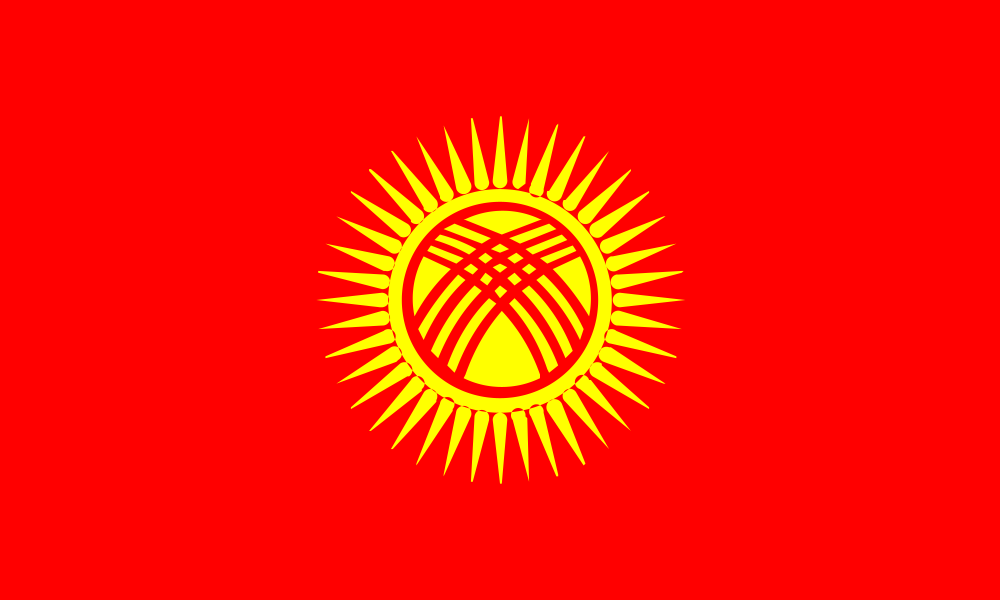
Cold-shouldered by the Whites, the Alash leaders began negotiating with the Soviet government in the spring of 1919. In March 1919 a Kazakh unit in Turgay made supporters of Bukeikhanov and Baitursynov recognise Soviet power, and Akhmet Baitursynov himself went to negotiate and urged other Alash figures to break with the Whites. After secret talks the western branch also turned neutral, weakening the White offensive. The Russian Sovnarkom set up a Revolutionary Committee for the Kirghiz (Kazakh) Territory on 10 July 1919, and the Red Army's Eastern Front counter-offensive that summer brought all of present-day Kazakhstan under Bolshevik control. On 10 December the western branch recognised Soviet power, and Bukeikhanov of the eastern branch followed. Despite the promised amnesty, the Alash Orda was abolished in early March 1920. On 26 August 1920 the Kirghiz Autonomous Socialist Soviet Republic was founded with its capital at Orenburg—"Kirghiz" then meant the Kazakhs. Alash leaders took various posts but most were executed in the 1930s; Bukeikhanov was shot in 1937. 16 18 19 17
 The rise of the Basmachi: Fergana, 1918–1920
"Basmachi" is Uzbek for "bandits", a name the Soviet side used to paint the resistance as criminals; the fighters called themselves mujahideen. The roots ran deep. Under Russian rule the Fergana Valley had been turned into a cotton monoculture, indebted farmers and a landless rural proletariat multiplied, and the revolt of 1916 was the first mass anti-Russian rising. The Kokand massacre and the execution of Fergana peasants suspected of hoarding cotton and food enraged the Muslim population. Ergash fought on as self-styled "Supreme Leader of the Islamic Army", and as nationalisations from Tashkent wrecked the economy and the loss of grain imports brought famine, people joined in large numbers. An English-language source puts the scattered bands at roughly 20,000 men by the end of 1918; the Russian-language source says Ergash's forces alone reached 25,000 by November, with nearly 40 other bands besides. Madamin Bek, a former militia chief of Old Margilan, refused to accept Ergash's leadership and built up his own following; by 1919 he controlled most of the valley outside the large towns and the railways. 3 20 21
To defend themselves against Basmachi raids, Russian settlers formed the Peasant Army of Fergana in the spring of 1919, about 20,000 men commanded by the retired colonel Konstantin Monstrov. At first it fought the Basmachi alongside the Bolsheviks, but as resentment of the Cheka and grain requisitioning grew it allied with Madamin Bek at the end of August 1919. Together they took Osh and attacked Andijan in September, only to be beaten by reinforcements including a Kazan regiment. On 22 October a "Fergana Provisional Government" was formed with Madamin Bek at its head and Monstrov as his deputy, envisaging a joint Russian–Muslim state, but quarrels over its Islamic character soon broke up the alliance. Monstrov surrendered to the Bolsheviks on 17 January 1920, and after a string of defeats in February Madamin Bek, surrounded, signed an agreement recognising Soviet power on 6 March. Mikhail Frunze, commander of the Turkestan Front, attended a celebratory parade in Fergana on 20 March. Sent to win over other kurbashi, Madamin Bek was captured and killed in May 1920 by the bands of Kurshirmat and Khal-Khodzha. When the Soviet authorities resumed food requisitioning and the conscription of Muslims in the summer of 1920, Kurshirmat gathered an "Army of Islam" and the revolt flared up again. 22 3 20 21
Calm in Fergana did not last. Kurshirmat (Sher Muhammad Bek), who took Madamin Bek's place as leader, gathered a number of bands into an "Army of Islam" in the summer of 1920 and went on the offensive around Andijan, Jalal-Abad, Osh, Kokand and Namangan. When Frunze diverted troops to the Bukhara expedition the Basmachi regrouped, and by the end of the year the movement had spread widely again. In the autumn of 1920 the Turkestan Front under Grigory Sokolnikov carried out three sweeps of the Fergana Valley that drove the bands to the gorges on its edges; a report by the front staff noted that some bands had returned to peasant life "for the time being". By April 1921 most of the large bands had been defeated. The Soviet side also sent Muslim units against the Basmachi, such as the Dungan Cavalry Regiment formed by the Dungan Magaza Masanchi. Meanwhile in Samarkand province Muslim rebels and clergy declared independence in November 1918, and 9,000 cavalry and 4,000 foot from the Matcha district on the upper Zeravshan seized Panjakent and the Ura-Tyube and Khujand districts in the autumn of 1919. The Red Army did not retake the area until March 1923. 20 23 3
 Frunze and the Turkkomissiya: Moscow returns, and the Muslim communists
Kolchak's defeat changed the situation in Turkestan. In August 1919 the Southern Group of the Eastern Front was reorganised as the Turkestan Front, and on 15 August Mikhail Frunze took command. After smashing Kolchak's Southern Army, the Turkestan Front linked up with the Turkestan republic's forces on 13 September, restoring the connection with Moscow. Political control lay with the Turkestan Commission (Turkkomissiya). It had been created in February 1919 under Shalva Eliava but, held up by Kolchak's advance, got no further than Samara and Orenburg; from October it acted with powers delegated by the All-Russian Central Executive Committee, the Sovnarkom and the Bolshevik Central Committee, in effect as the supreme authority in the region. Valerian Kuibyshev joined it as deputy chairman and as a member of the Turkestan Front's Revolutionary Military Council. The commission took a direct part in founding the Communist Party of Turkestan in January 1920, and in March 1920 it revived the Turkestan Sovnarkom under Jānis Rudzutaks. Between February and December 1920 the Turkkomissiya alone received 614 wagons of goods, while Turkestan shipped cotton and wool to the centre. The commission was dissolved in August 1920, and its role in guiding the party passed to the Turkestan Bureau of the Bolshevik Central Committee. 23 24 25 26 5
As Moscow set out to bring natives into government, Muslim communists came to the fore. Turar Ryskulov, a Kazakh who had taken part in the 1916 revolt, became chairman of the Muslim Bureau of the Turkestan Communist Party in 1919 and chairman of the Turkestan Central Executive Committee in January 1920. Holding that the Turkic peoples of Turkestan were a single nation divided only by history, he argued that the republic should be renamed a "Turkic Republic", the party turned into a "Turkic Communist Party" separate from the Russian party, and non-Muslim units withdrawn. In a resolution of 8 March 1920 the Bolshevik Central Committee reaffirmed the party's name and Turkestan's status as an "autonomous republic of the RSFSR", reserving defence, foreign relations, railways and finance to the federal government. In May a delegation including Ryskulov set out its views in Moscow and was rebuffed as contrary to the party's nationalities policy; according to an English-language source, Vladimir Lenin summoned him personally and persuaded him to drop the idea. Ryskulov left the chairmanship in July, and in September the Ninth Congress of Soviets of Turkestan condemned the "national deviationists". In June 1923 Stalin accused him of "pan-Turkism" and of backing Mirsaid Sultan-Galiev. 27 28 5
Moscow's return also meant the arrival of War Communism. The Turkestan Central Executive Committee adopted a grain monopoly decree only on 4 June 1919 and, for want of preparation and in the face of kulak resistance, could not enforce it; in February 1920 it set up food-requisition squads and committees of the poor in villages with European populations and assigned requisition quotas to all settler peasants. From the autumn of 1920 requisitioning was extended to the native population, and some 8,500 people, mostly of local nationalities, were mobilised into requisition squads and units such as the "Muslim inspection". The Russian-language source notes that, unlike in the centre, part of the grain surplus could be sold on the market. In 1920 the distribution of feudal lords' land to working peasants began, and from late 1919 until March 1921 revolutionary committees exercised power in place of the executive committees of the soviets. Natives were not conscripted until the summer of 1920, but when Muslim conscription and food requisitioning resumed, revolt flared up again in Fergana. An English-language source quotes the historian Kotelnikov's view that the grain monopoly of 25 June 1919 was in effect a robbery of the peasants that caused famine in some places. 5 3
Khiva and Bukhara: two People's Soviet Republics
In the former protectorate of the Khanate of Khiva, the Turkmen tribal leader Junaid Khan was made commander-in-chief of the khan's army in January 1918 and became the power in the land at the head of some 1,600 horsemen. In 1918 he killed Asfandiyar Khan (sources date this from the spring to October) and installed the late khan's uncle Said Abdulla as a figurehead while keeping real power for himself. The Young Khivans, opponents of Junaid's dictatorship, joined forces with Turkmen chiefs hostile to him and appealed to the Turkkomissiya, which sanctioned a military expedition. The Red Army crossed the Amu Darya on 25 December 1919 and on 22–23 January 1920 took Junaid's seat at Bedirkend. Persuaded by the commission's envoy Skalov, Said Abdulla signed a manifesto of abdication on 2 February. Skalov reported the former khan's remark that Khiva would live "under your wing" and noted that real power would rest with the Russian mission. On 26 April the First Khorezm Kurultai proclaimed the Khorezm People's Soviet Republic and adopted a constitution that preserved private ownership of land and the means of production. A treaty with Russia on 13 September recognised Khorezm's full independence, but before the year was out the Soviets deposed the Young Khivan government, and the nationalists went over to Junaid. 20 29 30 31 3
In Bukhara, reform was pursued by the Young Bukharans, a Jadid group founded as a secret society in 1909. When they told the Bolsheviks in March 1918 that the people of Bukhara were waiting for revolution, Kolesov led troops to the city gates in person and demanded that Emir Said Alim Khan hand over power. According to Russian accounts the emir killed the Bolshevik delegation and proclaimed a holy war; thousands of Russians in and around Bukhara were killed and many Young Bukharans executed. Faizulla Khodzhayev, who escaped to Tashkent and was sentenced to death in absentia, later admitted that they had been "gullible" and had underestimated the clergy's influence and the strength of the old regime. For the next two years both sides prepared for a showdown behind a façade of truce. The emir ordered a mobilisation in February 1920, and former tsarist officers and White veterans found refuge at his court. As late as March 1920 Frunze told the emir that Soviet Russia was "interested in the highest degree" in Bukhara's territorial integrity, but on 3 August 1920 the Bolsheviks and the Young Bukharans agreed to act together, and on 16 August the Fourth Congress of the Bukharan Communist Party, meeting in Chardzhou, resolved to overthrow the emir. 32 33 34 6 35
At the end of August Young Bukharans and Bukharan communists rose in Chardzhou, and the Red Army, presenting its intervention as "revolutionary fraternal help", launched the Bukhara operation on 29 August. According to the Russian-language source the Turkestan Front committed 6,000–7,000 infantry, 2,300–2,690 cavalry, 8 armoured cars, 5 armoured trains and 11 aircraft, against roughly 16,000 regular troops of the emir and more than 27,000 irregulars raised by provincial governors. When the first two days of attacks stalled before the walls, command was unified on 31 August under Georgy Zinoviev, commander of the 1st Army, and heavy guns including 152-mm fortress pieces were brought up close. Some 12,000 shells were fired into the city, and the Russian-language source says that not a few of them were chemical. The Red Army broke through the Karshi Gate on 1 September and took the city, and on 2 September Frunze telegraphed Lenin that "the red banner... is flying over the Registan". The emir had already slipped away to eastern Bukhara on the night of 30–31 August with an escort of about 1,000 men. The Ark citadel was reduced to ruins by artillery and air attack, and hundreds of civilians were killed. On 8 October the Bukharan People's Soviet Republic was proclaimed, with Khodzhayev as chairman of the Council of People's Nazirs (ministers). 35 36 32 34
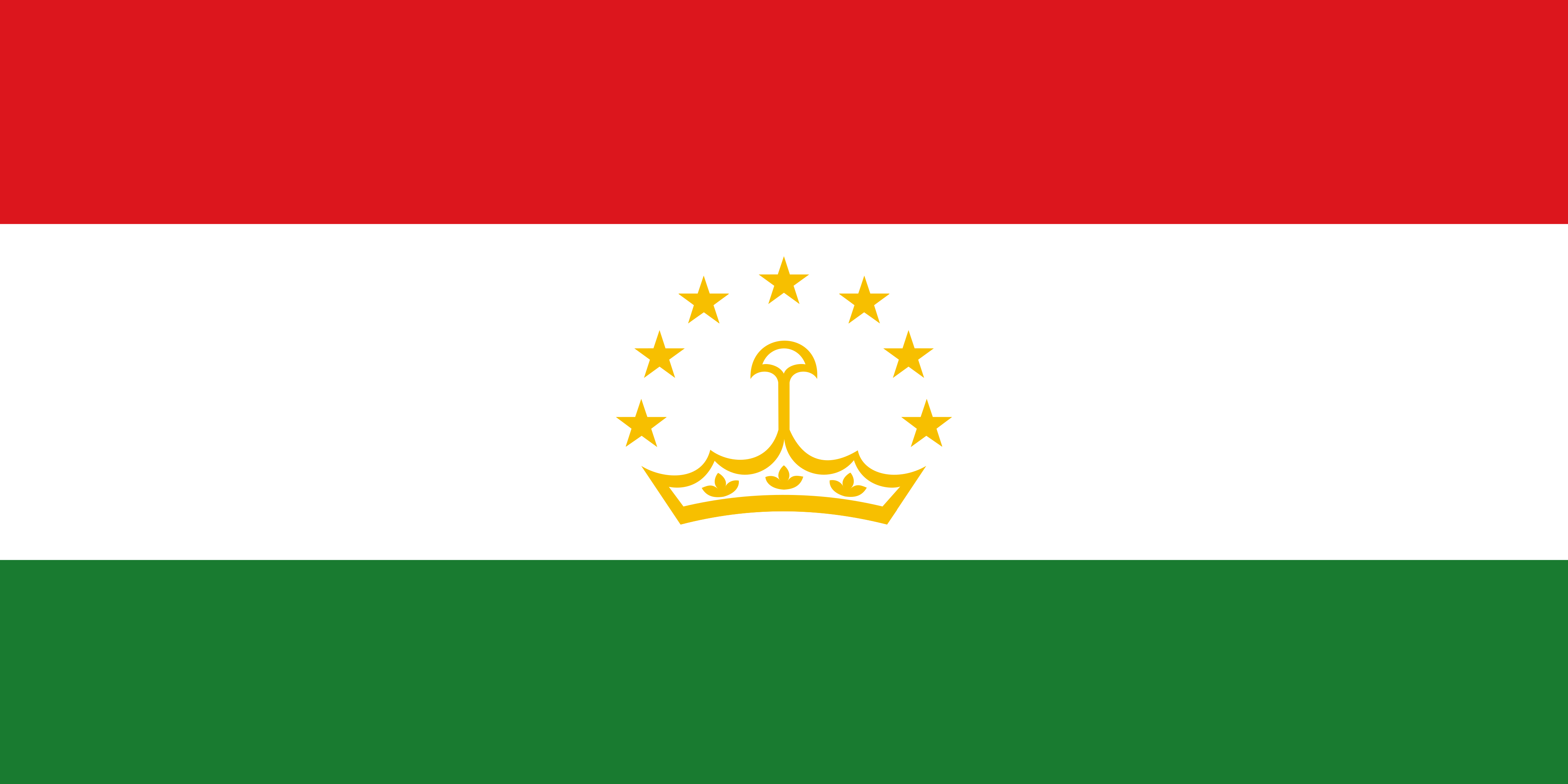
In Soviet terminology the Bukharan People's Soviet Republic was a "revolutionary-democratic dictatorship", a transitional stage on the way to a socialist republic. Its constitution of September 1921, unlike the Russian one, recognised private ownership of land and the means of production and gave non-proletarians the vote, and Article 26 laid down that no law could contradict the fundamental principles of Islam. The aksakal system, under which villages chose their own representatives, was kept. Uzbek became the state language in place of Persian, the language of the elite, and the education nazir Abdurauf Fitrat sent many students to European, especially German, universities. The flag added a crescent to the hammer and sickle. Two weeks after the republic was proclaimed, Communist Party membership had swelled to 14,000, but a series of expulsions cut it to 1,000 by 1922. On 7 July 1922 Khodzhayev survived a Basmachi assassination attempt. From 1923 Moscow stepped up the pressure, accusing the Bukharan government of "bourgeois nationalism", and sweeping purges hit the government and the party. Khorezm, too, became a Socialist Soviet Republic in October 1923 and joined the USSR. 32 34 31
 The Soviet Republic of Gilan, Persia, 1920–1921
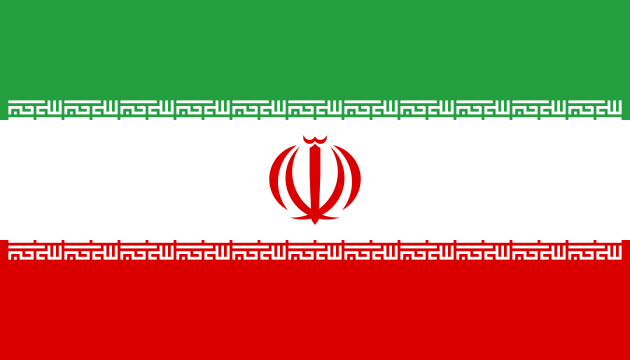
In Gilan, the Persian province on the southern shore of the Caspian, Mirza Kuchik Khan, a native of Rasht and a veteran of the Constitutional Revolution, had since 1914 led the Jungle (Jangali) movement from its base in the forests. Defeated at Manjil by the British and Bicherakhov's Cossacks in June 1918, it came to terms with the British in August, but when British troops entered Rasht in March 1919 with the support of landlords and mullahs it turned against them again. By then communists such as Ehsanollah Khan and non-Marxist Islamic socialists such as Kuchik Khan were organising separately within the movement. In the spring of 1920 the White Caspian Flotilla, beaten in South Russia, lay interned at the British-held port of Enzeli. On 17 May, just after the Sovietisation of Azerbaijan, the Volga–Caspian Flotilla under Fyodor Raskolnikov, with Grigory Ordzhonikidze aboard, sailed from Baku, and on 18 May off Enzeli it sent an ultimatum demanding that the British withdraw and hand over the military stores. When some 2,000 landing troops cut the road east of the town and cavalry closed it from the west, the British accepted and fell back to Rasht. The Soviets recovered 23 ships, 4 seaplanes and 50 guns. On 23 May People's Commissar for Foreign Affairs Georgy Chicherin assured the Iranian government that the operation had been carried out without the Soviet government's knowledge. 37 38 39 40 41
Kuchik Khan agreed to cooperate on condition that he would lead the republic and that the Soviets would not interfere directly in its internal affairs. Having taken Rasht on 4 June, the Jangalis proclaimed the Socialist Soviet Republic of Gilan on 5 June, with Seyyed Jafar Pishevari as commissar for foreign affairs. The republic did not distribute land to poor peasants, however, and conflict soon broke out between Kuchik Khan and the Communist Party of Persia, which had grown out of the Baku-based Edalat party, and his deputy Ehsanollah Khan, who had become a communist. Kuchik Khan left Rasht, and according to the article on the Jungle movement a coup removed him on 31 July. Yakov Blumkin, sent by the Cheka, helped foment the coup and became chief of staff of the Persian Red Army. Under the nominal government of Ehsanollah Khan real power lay with the Soviet commissar Abukov, and radical measures such as anti-religious propaganda and levies on the rich alienated the middle classes and the clergy. An offensive aimed at Tehran in August was thrown back by Iranian troops. 42 40 41 43
Moscow's calculations soon changed. In September 1920 the Russian government decided to wind up its military operation in Iran and negotiate with the Shah's government, and on 26 February 1921 Chicherin and Lev Karakhan signed the Russo-Persian Treaty of Friendship with Iran's envoy in Moscow. The treaty annulled the tsarist treaties, Turkmenchay among them, and gave both countries equal shipping rights on the Caspian, while allowing Russian troops to enter Iran if a third power used it as a base against Russia. That same month Reza Khan staged a coup in Tehran. The Soviet envoy in Tehran, Fyodor Rothstein, corresponded with Kuchik Khan urging withdrawal and told the Soviet officers in Ehsanollah Khan's force heading for Qazvin not to obey his orders. The Red Army began leaving in April 1921 and was gone by 8 September. Kuchik Khan, who had again taken charge of the government, struck on 29 September and killed the communist leader Heydar Khan Amu-oghli; amid the infighting government troops took Rasht. Fleeing into the mountains, Kuchik Khan froze to death on 2 December, and his severed head was displayed in Rasht. On the reasons for the withdrawal, Cosroe Chaqueri points to a Soviet shift from world revolution to the security of the Soviet state, while Kayhan Nejad argues that the infighting between communists and non-communists came first. 41 44 42 39 40
Enver Pasha, the Basmachi decline and the delimitation of 1924
The fall of Bukhara set off a new Basmachi war in eastern Bukhara. Said Alim Khan fled via Dushanbe into exile in Kabul and directed the movement from there, while Ibrahim Bek of the Lakai tribe fought in the emir's name. In 1922 most of eastern Bukhara, from Hisor to the western Pamirs, was in Basmachi hands. Into this stepped Enver Pasha, the former Ottoman war minister. He had come to Moscow in August 1920, mixed with the Bolshevik leaders, and attended the Congress of the Peoples of the East in Baku in September. Trusted by the Soviets, he was sent to Bukhara in November 1921 but soon contacted rebel leaders and went over to the Basmachi. He drew the bands into a German-style command structure, for a time made himself supreme commander, and used a golden seal styling him "Commander-in-Chief of all the Armies of Islam". Ibrahim Bek distrusted him and at one point arrested him, and the emir broke with him in the first half of 1922. After Enver rejected a peace offer in May 1922 and demanded that the Red Army leave Turkestan within fifteen days, Red forces defeated the Basmachi at the Battle of Kafrun in June. He was killed on 4 August fighting Melkumov's cavalry near Baljuan or near Dushanbe; accounts of exactly how differ. 32 45 46 3 47
The Soviet authorities paired overwhelming force with concessions. They restored sharia courts, Koran schools and waqf (religious endowment) lands, created a volunteer militia of Muslim peasants known as the "Red Sticks", and an estimated 15–25% of the Red Army troops in the region were Muslim. With civil-war veterans in the regular army now backed by air support, the movement crumbled. Enver's successor Selim Pasha fled to Afghanistan in 1923, and a large offensive in July–August 1923 drove the Basmachi out of Garm. In Fergana, Kurshirmat, who according to British intelligence had once commanded 5,000–6,000 men, was down to about 2,000 and left for Afghanistan in early 1923; by the first half of 1924 no bands remained in the valley. In the Tajik lands 200,000 people had fled and two-thirds of the arable land lay abandoned. An English-language source judges that the Basmachi were neither a genuine liberation movement nor a nationalist one but a temporary tribal alliance aimed at removing Russian rule, and that Enver's premature turn to semi-regular warfare inflicted losses from which it never recovered. In Khorezm, Junaid Khan, who with the backing of the Muslim clergy had built his forces up to 9,000 men, rose again at the end of 1923 and in January 1924 besieged Khiva and Novo-Urgench; the Red Army did not defeat him decisively until the end of 1924. Ibrahim Bek withdrew to Afghanistan in 1926 but kept raiding across the border until he was executed in 1931. 3 20 48 47
The last stage was the drawing of borders. National delimitation had been discussed since 1920, and on 25 February 1924 the Bolshevik leadership announced that it would go ahead in Central Asia. Uzbek, Turkmen and Kazakh sub-committees worked fast, and in April it was decided to dissolve the Bukharan and Khorezm republics as well. Their communist parties objected openly; the Khorezm party in particular had to be strong-armed in July into voting for its own republic's dissolution. Bukhara, renamed a Socialist Soviet Republic on 19 September, disappeared little more than a month later. On 27 October 1924 the Turkestan Autonomous Republic, Bukhara and Khorezm were divided into the Uzbek SSR, the Turkmen SSR, a Tajik Autonomous Republic inside the Uzbek SSR, and the Kara-Kirghiz and Kara-Kalpak Autonomous Oblasts of the RSFSR, while much of Syr Darya province and half of Jetysu went to the Kirghiz (Kazakh) Autonomous Republic. An English-language source writes that Ryskulov and others who wanted to keep Turkestan whole were pitted against Khodzhayev and Akmal Ikramov, who favoured smaller units, and that the latter won; yet at his trial in 1938 Khodzhayev "confessed" to having opposed the breakup into four republics. In December 1924 he became chairman of the Uzbek Revolutionary Committee and led the new republic's government. 19 5 9 32 31 34
Assessments: anti-colonial revolution or continued Russian rule?
Soviet historiography described the period as "the struggle of the peoples of Central Asia for Soviet power". The Basmachi appeared as counter-revolutionary brigands driven by Islamic fundamentalism and backed by Britain and America, and the upheavals in Khiva and Bukhara in 1920 as fraternal aid to popular revolutions. After the Soviet collapse, the Central Asian states reversed the verdict: the Basmachi were recast as a national liberation movement in defence of the faith and their leaders as national heroes. The Uzbek historian Rajabov proposed treating the Kokand Autonomy, the Jadids and the Basmachi as one independence movement, a view shared by the émigré historian Baymirza Hayit. Against this, Alexander Morrison of Oxford argues that the Fergana Basmachi had no clear political aims and that Ibrahim Bek, acting nominally for the emir, was largely concerned with carving out a personal domain around Surkhandarya, and he rejects the idea that a single "Turkestani" identity drove mass resistance. Marie Bennigsen-Broxup concluded that the Basmachi had neither a political programme nor any vision of a liberated Turkestan, that theirs was the struggle of a threatened and ruined rural community to preserve its traditional values and way of life, and that the anti-Muslim policies of the Turksovnarkom fuelled the revolt. 20 3 47
Views also divide over revolutionary power itself. Kolesov's all-Russian Sovnarkom, the destruction of Kokand and a Bolshevism dominated by Russian settlers made tsarist and Soviet rule look identical, as an English-language source puts it. Even the Russian-language article on the Bukhara operation describes it as a blow dealt to Bukharan independence "by the military aggression of Soviet Russia". On the other hand, Moscow's intervention after 1919 brought native cadres into government and attacked the settlers' "great-power chauvinism"; the Bukharan constitution respected Islamic principles and private property; and under the indigenisation policies of the 1920s many Central Asians rose to high office in the republics. The delimitation of 1924 is often condemned as divide and rule, but an English-language source notes that the attempt to weigh ethnicity together with economic viability in mixed regions such as Fergana produced convoluted borders and large minorities, and that no one intended these lines to become international frontiers. At a party congress in 1930 Ryskulov said that Central Asia still bore the marks of tsarist colonial policy. He and Khodzhayev were executed in 1938 and Bukeikhanov in 1937, while Mustafa Shokay carried on Turkestani nationalism in exile in France. 3 35 5 32 19 28 7
Consequences
The emir of Bukhara and the khan of Khiva were driven out in 1920, and the Basmachi movement declined after Enver Pasha was killed in 1922. The Gilan republic collapsed after the Red Army withdrew under the Soviet–Persian treaty of 1921. The national delimitation of October 1924 created the Uzbek and Turkmen Soviet Socialist Republics among others.
Timeline & Map
- 11917.11.14Tashkent Soviet takes power
The Tashkent Soviet, dominated by Russian workers and soldiers, took the city in an armed rising. The Sovnarkom formed afterwards included not a single native.
- 21917.12.10Kokand Autonomy proclaimed
A Muslim congress in Kokand proclaimed Turkestan's autonomy within a federal Russia, first under Tynyshpaev and soon under Mustafa Shokay.
- 31917.12.18–12.26Alash Orda founded
The Second All-Kazakh Congress in Orenburg resolved on an Alash autonomy and elected Alikhan Bukeikhanov chairman.
- 41918.02.19–02.22Fall of Kokand and massacre
Tashkent Soviet troops shelled and took Kokand. Sources put the victims of the looting and massacre that followed at 10,000 to 25,000.
- 51918.03Kolesov's attack on Bukhara fails
Kolesov and the Young Bukharans tried to overthrow the emir and failed; thousands of Russians were killed and many Young Bukharans executed.
- 1918.04.30Turkestan Soviet Republic proclaimed
The Fifth Regional Congress of Soviets proclaimed an autonomous republic within the Russian Federation.
- 61918.07.11–07.12Ashgabat uprising
Railway workers ousted the Bolsheviks and formed the SR–Menshevik Transcaspian Government, which concluded an agreement with Britain's Malleson mission in August.
- 1918.10.14Battle of Dushak
British Indian and Transcaspian forces defeated the Bolsheviks and pushed them back towards Merv.
- 71919.01.18–01.20Osipov revolt
Military commissar Osipov rose in Tashkent and killed fourteen of the republic's leaders, but was put down by the workers and the fortress garrison.
- 1919.09.13Blockade of Turkestan broken
Frunze's Turkestan Front linked up with the Turkestan republic's forces, restoring the connection with Moscow.
- 1919.10.22Fergana Provisional Government
The Basmachi leader Madamin Bek and Monstrov of the Russian settlers' Peasant Army set up a joint government.
- 1919.12.10Alash western branch recognises Soviet power
The western branch of the Alash Orda recognised Soviet power and the eastern branch followed; the Alash Orda was abolished in March 1920.
- 81920.02.02Abdication of the Khan of Khiva
After the Red Army drove out Junaid Khan, Said Abdulla Khan abdicated; the Khorezm People's Soviet Republic was proclaimed on 26 April.
- 1920.03.06Madamin Bek submits
Madamin Bek, leader of the Fergana Basmachi, recognised Soviet power; he was killed by rival kurbashi in May.
- 91920.05.18Enzeli operation
Raskolnikov's Caspian flotilla landed at Enzeli, forced the British out and recovered 23 White ships.
- 101920.06.05Soviet Republic of Gilan proclaimed
Having taken Rasht, Mirza Kuchik Khan's Jangalis proclaimed a republic in alliance with the Soviets.
- 1920.08.26Kirghiz (Kazakh) Autonomous Republic founded
An autonomous republic of the Kazakhs, with its capital at Orenburg, was set up within the Russian Federation.
- 111920.08.29–09.02Bukhara operation
Frunze's Red Army shelled and took Bukhara; Emir Said Alim Khan fled to eastern Bukhara.
- 1920.10.08Bukharan People's Soviet Republic proclaimed
Faizulla Khodzhayev headed the government as chairman of the Council of People's Nazirs.
- 1921.02.26Russo-Persian Treaty of Friendship
Chicherin and Karakhan signed a treaty with Iran; the Red Army was out of Gilan by 8 September.
- 1921.11Enver Pasha joins the Basmachi
Sent to Bukhara, Enver Pasha went over to the Basmachi and tried to unite the movement.
- 1921.12.02Death of Mirza Kuchik Khan
Fleeing into the mountains after the republic's collapse, Kuchik Khan froze to death; his head was displayed in Rasht.
- 1922.08.04Enver Pasha killed
Enver Pasha was killed fighting Red Army cavalry in eastern Bukhara.
- 1924.10.27National delimitation of Central Asia
Turkestan, Bukhara and Khorezm were dissolved, creating the Uzbek and Turkmen SSRs and Tajik, Kara-Kirghiz and Kara-Kalpak autonomous units.
Related people 25
Soviet forces16
Leadership4
Kept Muslims out of the government, destroyed the Kokand Autonomy in February 1918 and failed in his attack on Bukhara in March.
Commander of the Turkestan FrontMikhail Frunze1885–1925Broke the blockade of Turkestan in 1919 and directed the conquest of Khiva and Bukhara and the campaign against the Fergana Basmachi in 1920; telegraphed Lenin after taking Bukhara.
Chairman of the Turkestan Central Executive CommitteeTurar Ryskulov1894–1938As head of the Muslim Bureau he called for a "Turkic Republic" and a separate "Turkic Communist Party", was rebuffed by Moscow in 1920 and left the chairmanship.
Head of government of the Bukharan People's Soviet RepublicFaizulla Khodzhayev1896–1938Led the Young Bukharans into exile after the failure of 1918, became chairman of the Bukharan Council of People's Nazirs in 1920 and headed the Uzbek SSR government in 1924.
Implementers & commanders5
Deputy chairman of the Turkestan Commission and member of the Turkestan Front's Revolutionary Military Council from October 1919 to August 1920, then plenipotentiary in Bukhara from September 1920.
Commander of the Turkestan FrontGrigory Sokolnikov1888–1939Succeeded Frunze in command of the Turkestan Front from September 1920 to March 1921 and fought the Fergana Basmachi.
Commander of the 1st ArmyGeorgy Zinoviev1887–1934Took unified command of the assault on Bukhara on 31 August 1920, led the breach of the walls and pursued the emir with cavalry as far as Karshi.
Commander of the Caspian FlotillaFyodor Raskolnikov1892–1939Led the Enzeli operation of 18 May 1920, recovering the White ships and opening the way to the Gilan republic.
Cheka agentYakov Blumkin1900–1929Sent to Gilan in 1920, he helped foment the coup that ousted Kuchik Khan and became chief of staff of the Persian Red Army.
Participants7
Answered an appeal to recognise the Kokand Autonomy by telling Turkestan's workers to disperse the Tashkent commissariat by force, and in 1923 accused Ryskulov of pan-Turkism.
Chairman of the SovnarkomVladimir Lenin1870–1924Summoned Ryskulov in 1920 and talked him out of his Turkic-republic plan, and in November 1921 sent Enver Pasha to Bukhara.
Bolshevik leaderGrigory Ordzhonikidze1886–1937Planned the Enzeli operation with Raskolnikov and sailed with the flotilla.
Soviet envoy in TehranFyodor Rothstein1871–1953Urged Kuchik Khan to stand down and told Soviet officers in Ehsanollah Khan's force not to obey his orders.
People's Commissar for Foreign AffairsGeorgy Chicherin1872–1936Assured Iran that the Enzeli operation had happened without the government's knowledge and signed the Russo-Persian Treaty of Friendship in February 1921.
Deputy People's Commissar for Foreign AffairsLev Karakhan1889–1937Signed the Russo-Persian Treaty of Friendship with Chicherin on 26 February 1921.
Uzbek communist of Young Bukharan backgroundAkmal Ikramov1898–1938According to an English-language source, he sided with those who wanted Turkestan divided into smaller national units and supported the 1924 delimitation.
Local national governments2
Leadership2
Handled the Autonomy's external relations, then became prime minister; escaped after Ergash's coup and the fall of Kokand in February 1918 and later went into exile in France.
Chairman of the Alash OrdaAlikhan Bukeikhanov1866–1937Headed the Alash autonomous government, negotiated with Komuch and the Siberian government, and recognised Soviet power at the end of 1919.
The Basmachi2
Leadership2
A Lakai tribesman who fought in the emir's name, he distrusted Enver Pasha and at one point arrested him; he withdrew to Afghanistan in 1926.
Former Ottoman minister turned Basmachi commanderEnver Pasha1881–1922Sent to Bukhara by the Soviets in November 1921, he went over to the Basmachi and was killed on 4 August 1922.
The emirate of Bukhara and the khanate of Khiva2
Leadership2
Held real power in the Khanate of Khiva until the Red Army drove him out in 1920, and then fought on against Soviet rule.
Last Emir of BukharaSaid Alim Khan1880–1944Repulsed Kolesov's attack in 1918 but fled to eastern Bukhara during the 1920 Bukhara operation and directed the Basmachi from exile in Afghanistan.
The British and the Whites2
Related terms
Sources: reference 1reference 2reference 3reference 4reference 5reference 6reference 7reference 8reference 9reference 10reference 11reference 12reference 13reference 14reference 15reference 16reference 17reference 18reference 19reference 20reference 21reference 22reference 23reference 24reference 25reference 26reference 27reference 28reference 29reference 30reference 31reference 32reference 33reference 34reference 35reference 36reference 37reference 38reference 39reference 40reference 41reference 42reference 43reference 44reference 45reference 46reference 47reference 48
← Historical events