French Revolution
Why did a revolution proclaiming legal equality become a struggle over subsistence, citizenship, and emergency power?
A revolution that began in royal fiscal crisis and dismantled inherited privilege and monarchy. It connects assemblies and popular movements, women and colonial emancipation, wartime emergency rule, the Directory, and Brumaire.
A fiscal crisis becomes a crisis of sovereignty
The crown sought tax reform to meet war costs and accumulated debt, but encountered resistance from privileged bodies and the sovereign courts known as parlements. Support for American independence had added to its financial burden. The poor harvest of 1788 and rising bread prices connected royal insolvency with everyday insecurity. When Louis XVI convened the Estates-General at Versailles on 5 May 1789, debate moved beyond authorizing revenue to the question of who could represent the nation. 1
The legal division into clergy, nobility, and Third Estate did not map neatly onto wealth. The Third Estate included prosperous merchants and lawyers alongside artisans, wage earners, and peasants. Treating the Revolution as the unanimous project of one class obscures these differences. Ending privilege, securing representation, reducing obligations on land, and obtaining food were connected demands, but they were not identical. 2
1789: assembly, streets, and countryside
Third Estate deputies declared themselves the National Assembly on 17 June and pledged in the Tennis Court Oath of 20 June to remain together until a constitution was established. Anxiety over royal troop concentrations helped drive the storming of the Bastille on 14 July. In the countryside, the Great Fear accompanied attacks on records of seigneurial obligations. Collective action outside the assembly both strengthened its challenge to royal authority and pressed it toward further change. 3 2
The decisions against privilege begun on the night of 4 August became legislative decrees, but not every seigneurial payment vanished without compensation: some were initially redeemable, and remaining feudal dues were abolished without compensation in 1793. The Declaration of Rights of 26 August proclaimed national sovereignty and legal equality while protecting property. The women-led march to Versailles on 5–6 October joined subsistence demands to politics and brought the royal family to Paris. 4 5 6
The Great Fear was more than an undirected riot of hungry people. Rumors that aristocrats had hired brigands to destroy the harvest circulated alongside anxiety about grain shortages. Villagers armed themselves defensively and then turned against seigneurial archives and title deeds. Rumors traveled through different regional networks, and responses were not uniform. Peasant action exerted an independent pressure against seigneurial obligations rather than passively waiting for decisions in Paris. 7
Institutions and fractures of constitutional monarchy
The Constituent Assembly nationalized church property and used it to back assignats. The Civil Constitution of the Clergy in 1790 and the subsequent oath requirement divided clergy and believers. The new state was attempting to reorganize ecclesiastical property, institutions, and allegiance, rather than simply abolish religion. The king’s failed flight to Varennes in June 1791 intensified doubts about his commitment to the revolutionary settlement. 8
The Constitution of 1791 assigned executive power to the king and established a Legislative Assembly, but political participation remained unequal. Active citizenship required age, tax, and independence qualifications; electors faced higher property thresholds. The Le Chapelier Law of the same year prohibited occupational combinations and workers’ collective wage action. Abolishing inherited legal privilege did not automatically establish universal suffrage or workers’ freedom of association. 9 10
Assignats began as instruments connected to national property but expanded into circulating money. Increased issues to meet fiscal needs and declining confidence contributed to depreciation; wages and prices did not move together, intensifying insecurity. Sales of national property changed ownership without distributing equal plots to every peasant. Economic change thus exposed a gap between legal equality and the distribution of purchasing power and assets. 11
The new order also changed the geography and procedures of government. The 1791 constitution organized the kingdom into 83 departments and provided for elected administrators and judges. It rejected the sale and inheritance of offices and distinctions of birth, and required equal punishments for the same offenses. Such measures recast royal and corporate privileges as public powers exercised in the nation’s name. The king’s veto and property-based electoral structure nevertheless left unresolved who would control those powers. 9
1792: war and the overthrow of monarchy
Jacques Pierre Brissot and his allies argued that war could defend the Revolution and expose its enemies. Robespierre opposed the policy, warning of defeat and the growing power of generals. The king supported war for different reasons. France’s declaration against the Austrian ruler on 20 April 1792 opened a conflict whose early defeats and threat of invasion sharpened political conflict at home. 12 13
After the Tuileries insurrection of 10 August, royal authority was suspended. Prisoners were massacred in Paris in September; appeals to defend the Revolution neither establish every victim’s guilt nor justify these killings. On 21 September, the day after Valmy, the new National Convention abolished monarchy, and republican dating began from 22 September. Louis XVI was executed on 21 January 1793 after trial and votes in the Convention. The military narrative continues in French Revolutionary Wars. 8 9
Sans-culottes and the politics of subsistence
The sans-culottes were not simply a modern factory proletariat. Artisans, shopkeepers, and wage earners participated in Paris sections and popular societies, demanding food supplies, restraints on speculation, vigilance, and political participation. Their alliance with the Mountain put pressure on the Girondins, without making parliamentary leaders and popular organizations identical in purpose. The mobilization of 31 May–2 June 1793 led to the arrest of leading Girondin deputies. 14 2
Robespierre’s 1792 speech on subsistence connected property rights with the preservation of life. The General Maximum of 29 September 1793 capped wages as well as commodity prices and provided for requisitioning labor. It was neither an unqualified benefit to workers nor the establishment of social ownership of production. Within a republic retaining private property, military supply, consumer survival, production, and distribution pulled policy in different directions. The Subsistence and Equality collection lets readers examine these tensions in the documents. 15
Jean-Paul Marat’s L’Ami du peuple publicized popular grievances and accused officials and political leaders of wrongdoing. His journalism combined demands for vigilance and accountability with calls for preemptive violence against perceived enemies. After Charlotte Corday assassinated him on 13 July 1793, he was commemorated as a revolutionary martyr, an image shaped by David’s painting. Newspapers, petitions, clubs, funerals, and festivals became arenas for deciding who spoke for the people alongside debate in the assembly. 16
The gap between the 1793 constitution and revolutionary government
The June 1793 constitution and declaration envisaged broad male electoral participation, public assistance, education, and resistance to oppression. Its regular constitutional government never went into operation. In October the Convention instead declared government revolutionary until peace. Constitutional promises must therefore be distinguished from governing practice. The Committees of Public Safety and General Security, representatives on mission, and local committees exercised different functions and powers. 9 17
The Vendée rebellion, provincial opposition to the Mountain, and foreign invasion formed the setting for emergency measures. The Law of Suspects of 17 September widened arrest powers; revolutionary tribunals and provincial repression took many civilian lives. The Law of 22 Prairial, 10 June 1794, sharply curtailed defendants’ protections. Robespierre’s speech linking virtue and terror articulated a justification for this government, not an authoritative verdict on its legitimacy. Explaining the emergency and assessing state violence are distinct tasks. 17 14
Provincial resistance was not one uniform movement. In the Vendée, disputes over clergy and recruitment contributed to peasant rebellion and a Catholic and Royal Army. Anti-Montagnard movements in Lyon, Marseille, and Bordeaux arose from distinct local conflicts; not all initially sought restoration of monarchy. Civilian massacres in the Vendée, drownings at Nantes, and mass executions at Lyon show how emergency rule operated locally. Estimates and the classification of the Vendée killings remain disputed, making definitions and geographical scope essential to assessing claims. 18 19
Louis Antoine de Saint-Just linked military discipline and supply with political reliability through the Committee of Public Safety and missions to the armies. His Ventôse proposals in 1794 envisaged transferring property of people regarded as enemies of the republic to needy patriots, but did not produce extensive redistribution in practice. Revolutionary government combined projects for greater subsistence and equality with coercive classification and exclusion. Proposals, decrees, and implementation must be distinguished rather than treating an individual’s speech as a description of the entire state. 20
Revolutionary leaders also disagreed over religion. Dechristianization in 1793 involved church closures, destruction of religious symbols, and festivals of Reason. Robespierre opposed atheism and coercive dechristianization; in May 1794 the Convention recognized a Supreme Being and the immortality of the soul. The festival of 8 June sought to express republican civic morality through public ritual. These experiments show a revolution attempting to reorganize time, festivals, belief, and communal feeling as well as law and armed force. 21
Women’s participation and the boundaries of citizenship
Women helped drive the Revolution through markets, demonstrations, petitions, and political associations while remaining excluded from national electoral citizenship. Olympe de Gouges’s 1791 declaration demanded that the universality claimed in 1789 also apply to women. Her text was a challenge to exclusion, not legislation adopted by the Assembly. Studying citizenship requires comparing proclaimed universal principles with the people actually permitted to exercise political rights. 5
The Revolution opened changes in civil life, including divorce, yet the prohibition of women’s political clubs in October 1793 closed an important avenue of participation. Gouges was executed that November. Women did not share a single political program, and popular activism itself contained disagreements over food, religion, and republicanism. The central point is that expanded civil possibilities and political exclusion coexisted within the same revolution. 6
Colonial slavery and the agents of emancipation
France’s declaration of liberty did not initially abolish colonial slavery. In sugar- and coffee-producing Saint-Domingue, white colonists, free people of color, and enslaved people occupied unequal positions. The slave uprising of 1791 was an independent revolutionary force, not merely an effect of decisions in Paris. Resistance and warfare in the colony pressed metropolitan lawmakers to reconsider the reach of liberty and citizenship. 22
After emancipation measures in Saint-Domingue in 1793, the Convention decreed abolition throughout the colonies on 4 February 1794 and declared citizenship without distinction of color. It referred implementation to the Committee of Public Safety; enforcement differed between colonies. This was a major rupture, but not an irreversible guarantee. Bonaparte’s subsequent colonial policy attacked these gains. Haitian independence in 1804 lies beyond this article’s dates, but emancipation should not be narrated as a gift bestowed unilaterally by France. 5 22
Thermidor and the Directory
Executions of the Hébertists and then Danton, Desmoulins, and their associates in spring 1794 deepened the destruction of rival revolutionary groups. On 27 July, 9 Thermidor, the Convention arrested Robespierre and his allies; they were executed the following day. Repression did not simply end overnight. Jacobin organizations and popular activism came under attack, price controls were removed, and anti-Jacobin violence followed. 3
The Constitution of 1795 established two legislative chambers and a five-member Directory. Designed to disperse power, it retained property-based political selection. Babeuf and his associates’ egalitarian movement challenged the incompleteness of social equality and was suppressed in 1796. Under pressure from royalists and the left, the Directory increasingly relied on annulled elections and military force. The Directory and Consulate documents allow comparison between constitutional design and the actual transfer of power. 23 15 24
The Directory’s difficulties cannot be reduced to corruption. The collapse of assignats and failure of their replacement disrupted finance and subsistence. The Fructidor coup of 1797 reversed royalist gains; electoral annulments in Floréal 1798 targeted victories on the left. Efforts to stabilize administration and preserve the republic existed alongside these interventions. By reversing unfavorable electoral outcomes through force and exceptional measures, rulers undermined confidence in representative institutions. 25 11
Brumaire and the Revolution’s legacies
The coup of 18–19 Brumaire, 9–10 November 1799, overthrew the Directory and led to a Consulate dominated by Bonaparte. Military prestige combined with civilian politicians’ plans for constitutional revision, but the outcome concentrated power in the general’s hands. Dating the Revolution’s end to 1799 is a political periodization, not a claim that social change stopped. The destruction of the old monarchy and inherited privilege, and the language of national sovereignty, outlasted the revolutionary decade. 24 26
Interpretations differ in their emphasis on class and property, political culture and sovereignty, or the experiences of war, religion, empire, and gender. Sans-culotte demands and Babeuf’s egalitarianism became important reference points for later socialists, but the republic of the 1790s cannot simply be labeled a socialist state. The central problem for study is how declarations of rights, protection of property, demands for subsistence, and coercive emergency rule appeared together. 26 15
Consequences
The old legal order of estates was dismantled and the language of sovereignty and rights spread. Inequalities of property, gender, and colonial status remained contested; in 1799 power concentrated in Bonaparte’s Consulate.
Timeline & Map
- 11789.05.05
 Estates-General convenes
The fiscal crisis became a dispute over national representation.
- 21789.06.17National Assembly declared
Third Estate deputies declared a national representative assembly.
- 31789.06.20Tennis Court Oath
Deputies pledged not to disperse before establishing a constitution.
- 41789.07.14Storming of the Bastille
Armed popular action in Paris challenged royal authority.
- 51789.08.04Decisions against privilege
August decrees began dismantling seigneurial privilege; some dues initially remained redeemable.
- 61789.08.26Declaration of the Rights of Man and Citizen
Proclaimed national sovereignty, legal equality, and property rights.
- 71789.10.05–06March on Versailles
The women-led march brought the royal family to Paris.
- 81791.06.20–21Flight to Varennes fails
The attempted royal flight undermined confidence in constitutional monarchy.
- 91791.09.03Constitutional monarchy
The constitution established king and assembly with restricted electoral participation.
- 101792.04.20War declared on Austria
War and domestic revolution began intensifying one another.
- 111792.08.10Royal authority suspended
The Tuileries insurrection led to suspension of royal authority.
- 121792.09.21Monarchy abolished
The Convention abolished monarchy; republican dating began the next day.
- 131793.01.21Execution of Louis XVI
The former king was executed after trial and votes in the Convention.
- 141793.06.24Constitution of 1793 adopted
It proclaimed extensive rights but never operated as regular constitutional government.
- 151793.09.17–29Suspects and General Maximum laws
Wider repression and price and wage controls formed part of emergency government.
- 161794.02.04
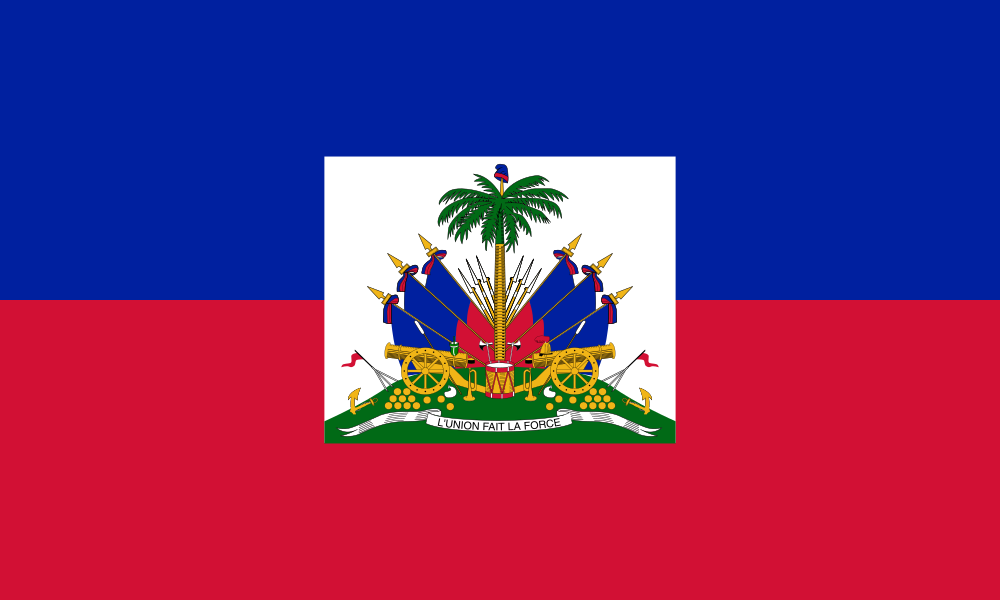 Colonial abolition decree
The Convention decreed abolition, with uneven implementation.
- 171794.07.27–28Thermidor
Robespierre and his allies were arrested and executed.
- 181795.08.22Constitution of 1795
Established two legislative chambers and a five-member Directory.
- 191796.05Suppression of the Equals
Babeuf and his associates’ movement was suppressed.
- 201799.11.09–10Brumaire coup
The Directory fell and the Consulate followed.
Related people 9
Leadership4
Advocated war and was executed in 1793 after conflict with the Mountain.
Montagnard and committee leaderMaximilien Robespierre1758–1794Opposed war in 1792 and became one of the leaders of revolutionary government in 1793–1794.
Committee member and representative on missionLouis Antoine de Saint-Just1767–1794Served revolutionary government and the armies and proposed Ventôse redistribution.
Leader during the republic’s foundingGeorges Danton1759–1794Helped mobilize France in 1792, served on the early Committee of Public Safety, and was executed in 1794.
Participants4
Criticized repression in Le Vieux Cordelier and was executed with Danton.
Popular journalist and Convention deputyJean-Paul Marat1743–1793Published L’Ami du peuple and was assassinated in 1793.
Advocate of women’s citizenshipOlympe de Gouges1748–1793Published her declaration of women’s rights in 1791 and was executed in 1793.
Organizer of the EqualsGracchus Babeuf1760–1797Organized a movement demanding social equality under the Directory.
Sources: reference 1reference 2reference 3reference 4reference 5reference 6reference 7reference 8reference 9reference 10reference 11reference 12reference 13reference 14reference 15reference 16reference 17reference 18reference 19reference 20reference 21reference 22reference 23reference 24reference 25reference 26
← Historical events