The Belarusian People’s Republic and Soviet Belarus
In Belarus, the rear of the Western Front, how did the Belarusian People’s Republic proclaimed under German occupation in 1918 compete with the Soviet Belarus of 1919, and why did the Treaty of Riga of 1921 divide the land between Poland and the Soviets?
A Belarusian national movement arose in 1917, but real power in Minsk lay with the Bolsheviks of the Western Front, and the All-Belarusian Congress of December was dispersed. In March 1918, under German occupation, the Rada declared the independence of the Belarusian People’s Republic; when the Germans left, the Socialist Soviet Republic of Byelorussia was proclaimed in January 1919 and soon merged with Lithuania as Litbel. Amid the Polish advance and the Soviet counter-attack the Rada split, Soviet Belarus was proclaimed again in 1920, and the Treaty of Riga of 1921 gave Western Belarus to Poland.
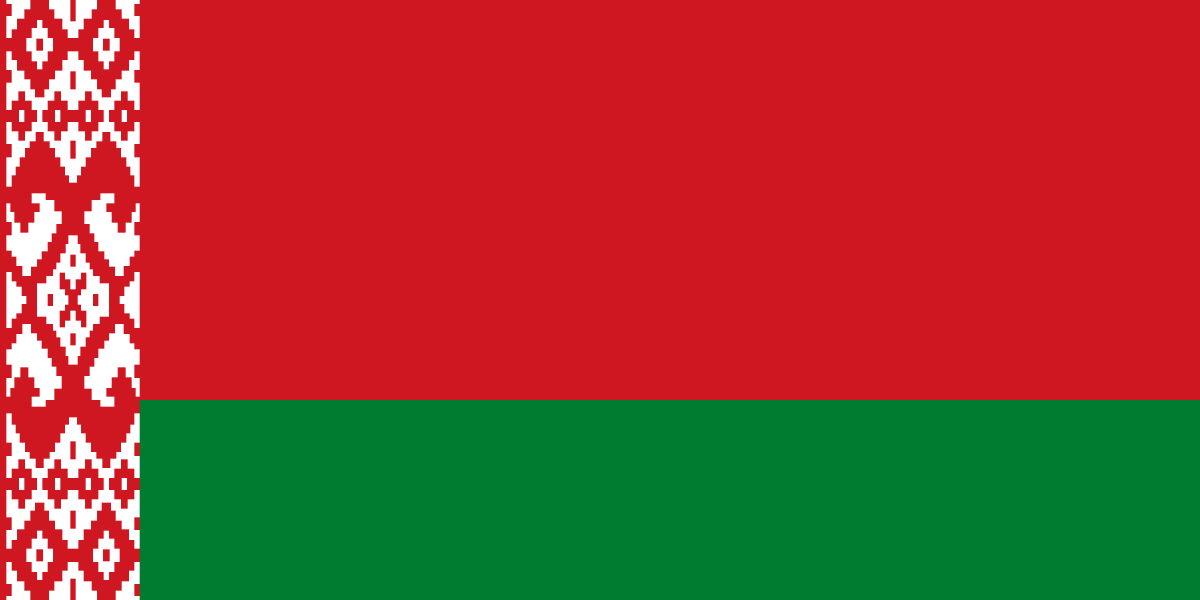
 1917: behind the Western Front, and a national movement
The Great Retreat of August–September 1915 left the Grodno Governorate and most of the Vilna Governorate under German occupation, and the front froze some 100 kilometres west of Minsk. Neither the Lake Naroch offensive in the spring of 1916 nor the summer thrust near Baranovichi moved it. The lands of present-day Belarus thus became the rear and barracks of Russia's Western Front. The Belarusian national movement was older. The Belarusian Revolutionary Hramada, founded in 1902–1903, soon renamed itself the Belarusian Socialist Hramada and called for political autonomy within a Russian federation, with a diet in Vilnius. The newspaper Nasha Niva, published in Vilnius from 1906 to 1915, was the school of a national elite. Anton Luckievič, one of the founders of the Hramada, ran this publishing work with his brother Ivan, and in German-occupied Vilnius in 1915 he led the clandestine Belarusian People's Committee behind the front of a war-relief society. Vaclau Lastouski, too, openly advocated independence from both Russia and Poland from 1915. English-language sources nonetheless judge that the national parties of the time could not win mass support and that the movement remained confined to a small, divided intelligentsia. 1 2 3 4 5
When the February Revolution removed the Tsar, political life in Belarus revived. In the summer of 1917 a congress of Belarusian national organisations convened on the Hramada's initiative set the goal of autonomy within a democratic Russian republic, and on 8–10 July in Minsk the Central Rada of Belarusian Organisations was reorganised as the Great Belarusian Rada. It called itself the guardian of the whole Belarusian people and claimed to stand above class, but most of its members were moderates who wanted autonomy inside the Russian republic; only the most radical wanted independence. That summer the Hramada itself split into the Belarusian Party of Socialist-Revolutionaries, the Belarusian Social Democratic Party, the Party of Socialist Federalists and others. There were other forces outside the movement. Within the All-Russian Soviet of Peasants' Deputies in Petrograd sat a Belarusian Regional Committee, whose supporters, mostly from the eastern provinces, valued union with Russia. In Minsk the Polish Rada of the Minsk Land was formed in May 1917; it first supported Belarusian autonomy but after October demanded that the Minsk region join Poland. The 1st Polish Corps, up to 50,000 strong, was raised that summer. The Jewish workers' party, the Bund, joined the Christian democrats and others in the Belarusian Central Rada. Much of the urban population was Jewish, a majority in some towns. 2 6 3 7 1
On 7 November 1917, the day of the October Revolution, the Minsk Soviet of Workers' and Soldiers' Deputies took over the city's administration. The Bolsheviks of the Western Front were led by the Armenian Alexander Myasnikov. Arriving in Minsk just after the February Revolution, he had led the Bolshevik faction in the front's soldiers' committee with Mikhail Frunze and in September became chairman of the party's North-Western Regional Committee. As soon as news of October arrived he set up a Military Revolutionary Committee and took power in Minsk without bloodshed; in November a soldiers' congress elected him commander-in-chief of the Western Front. In November a congress of soviets of the Western Oblast, a peasant congress of the Minsk and Vilna governorates and a congress of the front's armies, all held in Minsk, resolved to create a single authority, and on 9 December (26 November O.S.) the executive committees of the oblast and the front merged into the Obliskomzap. Karl Lander chaired the oblast government. The new power distributed landlords' land to peasants under the Decree on Land and introduced the eight-hour day. Yet the oblast's Bolshevik leaders regarded Belarus as a region of the Russian republic. According to Russian-language sources they argued that the Belarusians, lacking a clear national consciousness, were not a separate nation and that self-determination did not apply to them. The Great Belarusian Rada refused to recognise the Obliskomzap, calling it merely a military body of the front, and its offer of cooperation in building an independent state was rejected by Lander and Vilgelm Knorin. 1 8 9 10 11 6 2
 December 1917: the First All-Belarusian Congress and its dispersal
In November the Great Belarusian Rada issued an appeal, To the Whole Belarusian People, calling a congress that would proclaim Belarus a democratic republic and hand all power to a regional rada. The Belarusian Regional Committee in Petrograd and the Belarusian People's Hramada in Moscow dropped their own plans for a congress and joined in. The First All-Belarusian Congress opened in the Minsk city theatre on 18 December 1917 (5 December O.S.). Its first session was attended by 1,872 delegates, 1,167 of them with a vote. Almost every force was present: the associations of people from Minsk, Mogilev, Vitebsk, Grodno, Smolensk and Vilnius, right and left Socialist-Revolutionaries, Bolsheviks and Mensheviks, the Hramada, zemstvos and town councils, trade unions, soldiers' and refugees' deputies and soviets; most delegates were of peasant origin. One general later recalled that on hearing Belarusian speech and song and seeing Belarusian theatre on the stage, “all hearts began to unite”. The congress elected a 71-member Council of the Congress and its executive committee under the chairmanship of Jan Sierada, a veterinarian trained in Warsaw, agricultural college teacher and Hramada activist. 12 13 2 6 14
The core dispute was the relationship with Russia. The Hramada and delegates from the west argued for broad autonomy or even independence; the so-called regionalists, mostly from the east, wanted to keep the union with Russia. After long debate the Council of the Congress and the faction leaders produced a fifteen-point resolution, a compromise that avoided even the words "autonomous Belarus". Its first point affirmed the right to self-determination and a republican order and, to save the homeland from partition and separation from the Russian Democratic Federative Republic, set up at once an All-Belarusian Soviet of peasants', soldiers' and workers' deputies as the regional authority, which was to convene a constituent body to decide the fate of the Belarusian people. The resolution was read out at 1:15 a.m. on 31 December (18 December O.S.), and the delegates managed to adopt only the first point, unanimously. Then Red Guards surrounded the building. Ludwik Rezavsky, the oblast's commissar for internal affairs, walked in and declared the congress dissolved and the presidium under arrest. The delegates elected a new presidium, threw up barricades by the stage and came to blows, but 27 members of the presidium, Jan Sierada among them, were arrested and the delegates were driven out. 12 13 2
The Council of the Congress met again in secret the next day and on 2 January 1918 elected a seventeen-member executive committee that carried on underground. Some delegates hoped the central government in Petrograd would not condone the repression by the Minsk Bolsheviks, but the Sovnarkom was not ready to back a solution based on self-determination and federal status either. According to Russian-language sources the oblast Bolsheviks gave the centre a distorted account: Lander's telegram to the Sovnarkom and to the People's Commissar for Nationalities, Joseph Stalin, and his account for Pravda badly misrepresented the congress. The same sources trace the dispersal mainly to the unwillingness of the oblast government and executive committee to share power, and find no legal basis for it. Alexander Chervyakov, Zmicier Zhylunovich and Vilgelm Knorin, who witnessed the events, later doubted that it had been necessary. According to Belarusian authors the dispersal became an international issue: the Soviet side was criticised for it at the Brest-Litovsk peace talks, and German, Swiss and non-Bolshevik Russian papers reported it. In February 1919 the Bolsheviks would hold, in the same building, a congress with an almost identical name, the First All-Belarusian Congress of Soviets of Workers', Peasants' and Red Army Deputies, which adopted a Soviet constitution. 13 12 15
 1918: German occupation and the Belarusian People's Republic
When the Brest-Litovsk talks broke down, German and Austro-Hungarian troops resumed their offensive on 18 February 1918 and by evening had reached Molodechno, 65 kilometres from Minsk. During the night of 18–19 February the Bolsheviks decided to evacuate to Smolensk without resistance. According to Russian-language sources Alexander Myasnikov organised neither a defence of Minsk nor a partisan struggle, though he did get most of the artillery and ammunition away. On the 19th members of the Belarusian Central Military Rada whom the Bolsheviks had jailed escaped in the confusion and resolved to take control of the city; their chairman, Konstantin Yezovitov, became its commandant. The Polish military organisation appointed a commandant of its own. That night Belarusian detachments seized the arsenal and the governor's house and burst into the Hotel Europa, headquarters of the Obliskomzap, the Cheka and the Red Guards, but Lander and others escaped through the back door. Polish units soon began disarming the Belarusians and declared that they would keep order until General Józef Dowbor-Muśnicki's Polish Corps arrived, setting the two national movements against each other. On 21 February the executive committee of the congress issued the First Constituent Charter, To the Peoples of Belarus, declaring itself the provisional authority in Belarus and forming a People's Secretariat under Ivan Varonka. At eleven that morning German troops entered Minsk. 2 9 7 13
The Treaty of Brest-Litovsk, signed on 3 March, divided the Belarusian lands between the German-occupied zone and the Russian side. In its Second Constituent Charter of 9 March the executive committee proclaimed a People's Republic of "Belarus within the bounds of settlement and numerical predominance of the Belarusian people"; according to English-language sources the charter also abolished private ownership of land. The Council of the Congress was enlarged into the Rada of the Belarusian People's Republic. As of 25 March it had 77 members: 36 elected at the congress, 6 representatives of the Vilnius Belarusians, 15 of the minorities (Russian, Polish, Jewish and others), and 10 each from local government and the major cities. Anton Luckievič and Vaclau Lastouski joined as delegates of the Belarusian Council of Vilnius. At eight in the morning of 25 March, in the Peasants' Land Bank building in Minsk, the Rada adopted the Third Constituent Charter: "Now we, the Rada of the Belarusian People's Republic, throw off from our native land the last yoke of state dependence that the Russian tsars forcibly imposed on our free and independent country." The charter proclaimed the republic an independent and free state and left its future state ties to the peoples of Belarus. It claimed the whole Mogilev Governorate and the Belarusian parts of the Minsk, Grodno (with Białystok), Vilna, Vitebsk, Smolensk and Chernigov governorates. Belarusian was the official language and Minsk the capital; the white-red-white flag and the Pahonia, from the arms of the Grand Duchy of Lithuania, became the state symbols. 2 7 15 16 4 5
Neither the German government nor the occupation authorities had any interest in an independent Belarus. For Germany it was at most part of a Mitteleuropa of buffer states, and the declaration contradicted the terms of Brest-Litovsk. Seeking recognition, the Rada sent Wilhelm II a telegram that same 25 March thanking him for the liberation of Belarus by German troops "from the yoke of foreign anarchy and oppression" and asking for protection to strengthen its independence and indivisibility "in union with the German Empire". According to Russian-language sources it was signed by the Rada's chairman Jan Sierada, the head of the People's Secretariat Varonka and others. The telegram plunged the Rada into a severe crisis. The SRs and Social Democrats left the government, the Hramada split, and Paluta Badunova and others who quit the People's Secretariat in protest went over to the Belarusian Party of Socialist-Revolutionaries. The right-wing government formed afterwards did not last. Germany never recognised the republic, and the government won only limited powers in cultural affairs. English-language sources add that in the spring of 1918 the Germans, displeased with the nationalists' socialist leanings, forced a change of leadership, and that growing repression by the occupiers provoked a peasant revolt that benefited the communists. The supplementary Treaty of Berlin between Germany and Soviet Russia of 27 August provided for German withdrawal east of the Berezina and committed Germany not to support local separatist movements, in effect abandoning the Belarusian People's Republic. 7 2 15 1 17
Within these limits the Rada tried to build a state framework. According to English-language sources 150 to 350 schools were opened and preparations began for a university in Minsk. In May 1918 the Belarusian State Theatre and the Belarusian People's House named after Maksim Bahdanovič opened, and citizenship, a state seal and postage stamps appeared. In April a Rada delegation went to Kyiv and was received unofficially by Mykhailo Hrushevsky; the Ukrainians welcomed the Third Charter and wanted a friendly neutral neighbour but did not recognise independence. Consuls were exchanged with Pavlo Skoropadskyi's Hetmanate, and according to English-language sources food brought in from Ukraine averted famine. The border remained unresolved because the Belarusians claimed Polesia, then under Ukrainian control. Anton Luckievič, prime minister from 12 October, met Skoropadskyi in Ukraine in September–November and secretly contacted the Bolshevik Christian Rakovsky, but only confirmed that Soviet Russia would not recognise the republic. Russian-language sources sum up that the republic had citizenship, a seal and a school system, but no sovereignty over its occupied territory, no apparatus of coercion, no monopoly of taxation or force, and no local administration or courts. Varonka himself wrote in 1919 that "the superhuman efforts of Belarusian activists to place Belarus at least among the small states" had come to nothing. 7 2 4
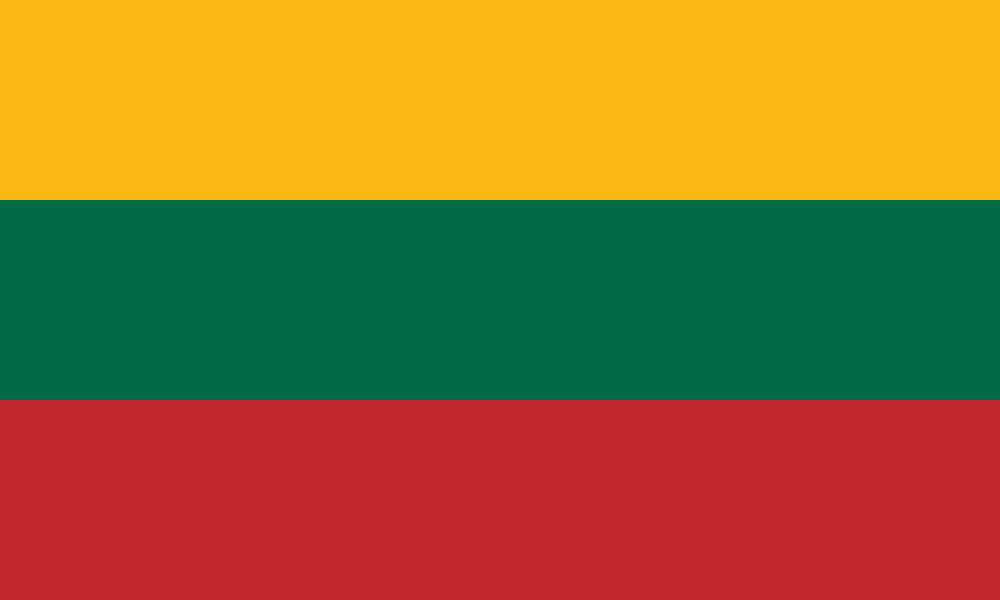 1919: the Socialist Soviet Republic of Byelorussia and Litbel
The Belarusian question divided the Bolsheviks too. On 31 January 1918 a Belarusian National Commissariat (Belnatskom) was created within the People's Commissariat for Nationalities, led by Alexander Chervyakov and Zmicier Zhylunovich. Zhylunovich, from a peasant family in Kapyl, had worked in Petrograd factories and wrote poetry as a worker-poet under the pen name Tsishka Hartny. The Belnatskom and the Belarusian sections of the Russian Communist Party, formed from refugees, called for a Byelorussian Soviet republic and held two congresses of Belarusian refugees in Moscow. Against them stood the Obliskomzap, now in Smolensk, and the party's North-Western Regional Committee. Alexander Myasnikov and Vilgelm Knorin regarded Belarus as a region of the Russian republic, and in 1918 a "Western Commune" uniting the Smolensk, Vitebsk, Mogilev, Chernigov, Minsk, Vilna and Kovno governorates was proposed. Russian-language sources see the declaration of 25 March as an important prompt that made a national republic seem necessary. After Germany's defeat Soviet Russia annulled the Brest treaty on 13 November and began moving west on the 17th. The Rada and government left Minsk for Vilnius on 3 December and moved to Grodno on the 27th; the Red Army, keeping 10–15 kilometres behind the Germans, entered Minsk on 10 December. 11 18 10 1 2
In November Moscow decided to abolish regional associations of soviets, and on 21–23 December a conference of the Belarusian sections of the Russian Communist Party in Moscow resolved to found a Belarusian Soviet republic on the territory of the Western Oblast. On 25 December Joseph Stalin informed Alexander Myasnikov that the party Central Committee, for many reasons, had sided with the Belarusians on the republic. On 30–31 December the Sixth Conference of the oblast's party organisations in Smolensk declared itself the founding congress of the Communist Party (Bolsheviks) of Byelorussia, and on 1 January 1919 the Socialist Soviet Republic of Byelorussia was proclaimed, with Zhylunovich heading a provisional workers' and peasants' government that moved to Minsk in early January. But on 16 January the Central Committee of the Russian party passed two resolutions: to unite with Soviet Lithuania, and to transfer the Vitebsk, Smolensk and Mogilev governorates to Russia. When Adolph Joffe arrived in Minsk on 22 January as Moscow's representative, the Belarusian leaders rejected both decisions and protested that he was incompetent. At the First All-Belarusian Congress of Soviets in Minsk on 2–3 February, Yakov Sverdlov, chairman of the All-Russian Central Executive Committee, called for unity with Lithuania, and the Mogilev, Smolensk and Vitebsk delegations walked out. The congress adopted a constitution and cut the republic to the Minsk and Grodno governorates; given the war, the government actually ruled only six uyezds of Minsk Governorate. Zhylunovich stepped down in early February, and from 4 February Myasnikov chaired the Central Executive Committee. 11 10 19 1 8 18
On 27 February a joint meeting of the two republics' Central Executive Committees in Vilnius founded the Socialist Soviet Republic of Lithuania and Belorussia, or Litbel, with Vilnius as its capital and Vincas Kapsukas as head of government. Zigmas Angarietis took internal affairs, Józef Unszlicht military affairs and Moisei Kalmanovich food supply. According to English-language sources Joffe hand-picked the key ministers, local leaders who had resisted the merger were passed over, and Belarusians were mostly confined to second-tier posts; the historian Borzęcki holds that there was not a single ethnic Belarusian in the government. The republic had five official languages, Russian, Belarusian, Lithuanian, Polish and Yiddish, but Russian dominated in practice. In March the party unification congress decided to turn confiscated estates into state farms rather than divide them among peasants, souring relations with the peasantry. A decree conscripting men aged 18 to 40 met fierce resistance, and by June there were some 33,000 deserters in Minsk Governorate. Assessments differ. Many Polish and Western historians call Litbel a Soviet Russian puppet or a "paper state"; Soviet historiography presented it as a defensive measure against counter-revolution and an expression of the historical ties between the two peoples. Some interpret it as presented in the guise of a revived Grand Duchy of Lithuania. 19 20 1
 The Polish advance and the split of the Rada
Litbel had barely been founded when the Polish Army approached from the west. The first clash between the regular armies came in mid-February in western Belarus, and on 19 February Poland set up the Civil Administration of the Eastern Lands to govern the territory it took. On 19–21 April Polish troops captured Vilnius after three days of street fighting, and the Litbel government fell back via Daugavpils to Minsk and in May to Bobruisk. On 22 April Józef Piłsudski, in his proclamation to the inhabitants of the former Grand Duchy of Lithuania, promised civil rather than military administration for the conquered lands; according to English-language sources the Belarusian leadership welcomed it. Litbel's powers vanished with its territory. On 30 May it handed military and economic affairs to the Russian government, and on 1 June it joined the military-political union of Soviet republics. On 13 July Stalin, sent to supervise the Western Front, proposed dissolving Litbel's Defence Council and government; the Defence Council was dissolved on 17 July. Polish forces took Minsk on 8 August, and by September the front had settled on the line of the Daugava, Ptsich and Berezina. The Sejm voted to annex the occupied territory up to that line, Minsk included. Why Piłsudski halted, and what it meant for Denikin, is covered in the Polish–Soviet War entry. 21 22 23 15 19
The people of the Rada returned to Minsk behind the Polish Army in August–September 1919. When Piłsudski came to Minsk in September, every Belarusian party except the Bolsheviks welcomed him. Anton Luckievič had demanded admission to the Paris Peace Conference in a memorandum of 22 January and led a delegation to Paris; in July he handed the Polish prime minister, Ignacy Paderewski, a draft treaty on "the union of two sovereign states, the Belarusian People's Republic and the Polish Republic". But the Polish foreign ministry did not recognise Belarusian passports, and talks with Piłsudski brought no support. According to English-language sources Piłsudski proposed limiting the Belarusian government to cultural matters, which Luckievič rejected. The occupation authorities returned land confiscated by the communists to its owners and introduced Polish as an official language. As resentment grew, the Rada split in December 1919. Luckievič's Supreme Rada sought statehood through federation with Poland, believing this could keep the lands as far east as Smolensk; Vaclau Lastouski's People's Rada protested against Poland's "colonising policy" and looked to the Baltic states as allies. Appointed prime minister, Lastouski was arrested by the Polish authorities in Minsk on 17 December, released in February 1920 and went to Riga. Luckievič, unable to reach agreement with Poland, resigned on 28 February and left for Vilnius. 2 4 15 1 5 16
Each Rada insisted abroad that it alone represented Belarus. The republic's diplomatic and military missions and consulates worked in Kaunas, Riga, Kyiv, Odesa, Prague, Berlin, Copenhagen and elsewhere, without legal recognition. English-language sources state that Estonia officially recognised the republic in October 1919 and Finland in December. Russian-language sources tell the story differently: a telegram received on 28 December by the consul in Prague from Luckievič in Warsaw relayed a report from the envoy in Latvia that at Tartu, where Estonian–Soviet armistice talks were under way, both the conference and Finland had "recognised" Belarusian independence. The mission in Finland was headed in 1920 by a Belarusian-born former White general, who moved on to Estonia that autumn. On 3 January 1920 Luckievič met Piłsudski again in Warsaw. The great powers did not even consider autonomy for the Belarusians. In Paris French diplomats told Luckievič frankly: "If you had even a scrap of land where you were the masters, the question of international recognition of independence would have been settled positively, and you would have been given help." In late 1920 the Rada also negotiated again with the Bolsheviks in Moscow, asking for recognition and the release of political prisoners, without result. 7 2 15 4
1920: Soviet Byelorussia proclaimed again, and a scattered national movement
Poland's Kiev offensive began in April 1920, but in Belarus Polish attacks towards Zhlobin and Orsha were thrown back in May. On 6 June the exiled Litbel government was disbanded to preserve Lithuanian neutrality. On 4 July the second northern offensive of the Western Front under Mikhail Tukhachevsky began, and the 3rd Cavalry Corps broke the Polish front. The Red Army retook Minsk on 11 July, and on the 12th Soviet Russia made peace with Lithuania. On 30 July the Communist Party of Lithuania and Belorussia, represented by Knorin, Iosif Adamovich and Chervyakov, Vsevolod Ignatovsky's Belorussian Communist Organisation and Aron Vainshtein's Bund agreed to re-establish the Soviet republic and formed the Belorussian Military Revolutionary Committee as an emergency provisional authority. The next day, 31 July, the republic's restoration was proclaimed in Minsk; the declaration of independence printed that day in Sovetskaya Belorussiya covered less than six uyezds of Minsk Governorate, while Vitebsk, Gomel and Mogilev remained in Russia. Its leaders were Chervyakov, head of the Minsk Military Revolutionary Committee, and Knorin as chairman of the Central Committee of the Communist Party of Byelorussia. As the Red Army crossed into Poland the republic hoped to expand, but defeat at Warsaw in August and on the Niemen in September put it on the defensive again. An armistice signed on 12 October took effect on the 18th. 1 21 19 11
While the new border was being drawn, the Belarusian national movement scattered further. When the Poles left Minsk in July, the Supreme Rada went to Poland and most supporters of the People's Rada to Kaunas. On 8 October the Polish general Lucjan Żeligowski staged a "mutiny" and seized Vilnius, and the Lithuanian government sought to win over the Belarusian population of the disputed lands. On 11 November it signed a secret treaty with Lastouski's government: Lithuania would finance the government of the Belarusian People's Republic and Belarusian organisations in the Vilnius region and northern Grodno; the People's Rada would support Lithuania in a plebiscite and let it use Belarusian military units; and the Belarusian-speaking areas there would become an autonomous region within Lithuania on federal principles. Present-day eastern Belarus did not figure in the treaty. Rada member Alaksandar Cvikievič later recalled: "The Lithuanian government decided to use us in its fight with Poland for Vilnius, and we decided to use the 'Lithuanian base' for the struggle for Belarusian independence." Earlier, on 20 October, Lastouski had proposed at a Belarusian conference in Riga a union of Belarusian parties "against Soviet rule and Polish occupation". On the Polish side, Stanisław Bułak-Bałachowicz's force held Mozyr for a few days in November, after the armistice. He proclaimed Belarusian independence and on the 16th a new government, but pogroms against Jews broke out in the occupied area; driven out by the Red Army on the 18th, his troops were interned and disarmed in Poland. 2 15 5 21
The Slutsk uprising, November–December 1920
The demarcation line of the preliminary peace of 12 October placed most of Slutsk district on the side of Soviet Byelorussia. That autumn resolutions across Minsk Governorate called for "peacefully freeing Belarus from both Polish and Soviet troops". A report of the Belorussian Military Revolutionary Committee of 15 November stated that the population of some volosts recognised no authority but the non-existent government of "independent Belarus" and said that power should be elected, not appointed from Moscow. In Slutsk a Belarusian National Committee under Paval Zhavryd had been formed in 1918, and the Polish occupation authorities relied on this pro-Polish committee. Most supporters of independence gathered in the Slutsk committee of the Belarusian Party of Socialist-Revolutionaries, whose leaflets declared the partition of Belarusian lands between Poland and Soviet Russia illegal and Soviet Byelorussia's independence a fiction that "covers the occupation of the Belarusian people by Russian centralism". Russian-language sources describe peasants resisting War Communism as the main force, led by local intelligentsia and gentry. The congress of Slutsk district, which opened on 15 November, gathered 105 to 132 delegates, along with two officers of the Polish 11th Division and several representatives of Bułak-Bałachowicz's force. It proclaimed the authority of the Belarusian People's Republic in and around Slutsk, protested against "Bolshevik occupation" and elected a seventeen-member Slutsk Rada under the SR Uladzimir Prakulevich. 24 25 1
The Slutsk Rada declared a general mobilisation of men aged 16 to 50 and within three days formed the Slutsk Brigade of two regiments, the 1st Slutsk and the 2nd Hrozava; an account cited in Russian-language sources puts its strength at about 4,000. Belarusian historians disagree about where its arms and money came from: some say the Polish command supplied weapons and funds, others that only Bułak-Bałachowicz gave meagre help. The Polish Army left Slutsk on 24 November, and the brigade followed westwards and moved its headquarters to Semezhevo. Fighting began on 27 November. The insurgents beat the Red Army near Vasilchitsy and drove it out of Timkovichi, but the tide turned when the Red Army brought the 8th and 17th Divisions into the district. Driven from Semezhevo on 7 December, the insurgents retook it on the 12th together with large stocks of shells, but withdrew from Vyzna on the 19th and from Semezhevo on the 20th. They lacked arms, officers and food, and typhus broke out. On 28 December, out of ammunition, the brigade crossed the Morach River, now the border, laid down its arms and was interned by Poland. English-language sources note that the Red Army had to commit two divisions to overcome nearly a month of resistance. 24 1
The meaning of the uprising is still disputed. According to Russian-language sources the view most widely held among Belarusian academics treats it as a "myth": the area the Polish Army was to leave under the demarcation line had as yet neither Red Army troops nor Soviet authority, so there was no enemy to rise against, and the congress, without protesting that Western Belarus would stay in Poland, asked for Slutsk to be left on the Polish side. Anton Sokal-Kutyloŭski, who took over the brigade, flatly declared that "there was no uprising in Slutsk district", and Yury Listapad, a member of the Slutsk Rada, said he had gone to Warsaw for money allotted by the Polish General Staff. Other historians, by contrast, see it as the first independent armed struggle of Belarusians for their independence, fought under the slogan "Neither Polish lords nor Moscow communists". Since the national revival of the late 1980s the Belarusian Popular Front and others have marked 27 November as Heroes' Day, but Lukashenko's government does not regard the event as significant. Accounts of the exiled Rada's role also differ. English-language sources say the Rada, then in Lithuania, sent officers to help organise the resistance; Russian-language sources say historians have established no link between the insurgents and the Rada, while reporting that the Belarusian Military Rada sent 20 officers, of whom only three reached Slutsk. Vasil Bykaŭ's story On Black Slash-and-Burn Fields is set in these events. 24 25 7 2
The Treaty of Riga and the partition of Belarus
Peace talks opened in Minsk on 17 August 1920 and resumed in Riga on 21 September. Adolph Joffe led the Soviet delegation and Jan Dąbski the Polish. According to the sources on the Slutsk uprising, neither the Belarusian People's Republic nor Soviet Byelorussia was invited, and Soviet Russia signed on Soviet Byelorussia's behalf. According to the Belarusian historian Anatol Hrytskevich, Joffe offered Poland the whole of Soviet Byelorussia in exchange for territorial concessions in Ukraine, and the Poles declined. The Polish delegation was dominated by the National Democrats, Piłsudski's opponents, who did not want non-Polish minorities to exceed a third of the population; in the eastern countryside Ukrainians and Belarusians outnumbered Poles and voted for Piłsudski, so a border too far east would also hurt them at the polls. A special delegation of six Sejm deputies, under pressure from the National Democrat ideologue Stanisław Grabski, rejected some 100 kilometres of extra territory that would have put Minsk on the Polish side. English-language sources note that only at the Riga talks did Piłsudski or his allies seek to claim Minsk as the capital of a Belarusian People's Republic associated with Poland. In the end Minsk stayed Soviet. 26 25 24 21
The Treaty of Riga was signed on 18 March 1921 between Poland on one side and Soviet Russia, acting also for Soviet Byelorussia, and Soviet Ukraine on the other. Poland recognised Soviet Ukraine and Soviet Byelorussia and undertook not to form federations with Lithuania, Belarus or Ukraine; the Soviet side renounced claims west of the line. The so-called Western Belarus, including the Grodno Governorate and the west of the Minsk Governorate, went to Poland. English-language sources place the new border some 200–250 kilometres east of the Curzon Line and count over a million Belarusians in the ceded areas; the Polish census of 1921 recorded about a million Belarusians, while some estimates run to 1.7–2 million. Article 7 guaranteed all nationalities free intellectual development, the use of their language and the exercise of their religion. What remained to Soviet Byelorussia was a small republic of 52,400 square kilometres and 1.544 million people; Gomel, Vitebsk and parts of Smolensk were administered by Russia. Belarusian activists saw the treaty as a tragic betrayal. Without Minsk, the Belarusians of Poland became a mostly rural, marginalised group, and to many of them the Soviet republic to the east looked like an attractive alternative. In the autumn of 1921 a congress of Belarusian representatives in Prague condemned the partition and adopted a resolution to fight for the unification of Belarus. 26 27 21 16 1
Soviet Byelorussia's status was settled afterwards. On 16 January 1921 Russia and Byelorussia concluded a Union Workers' and Peasants' Treaty recognising each other's independence and sovereignty, and on 30 December 1922 the republic became a founding member of the Soviet Union. English-language sources explain that its small territory and weak national sentiment would have made absorption into Russia unremarkable, but for Leon Trotsky and other advocates of world revolution, who saw Riga as a temporary setback, the republic was a bridgehead for a future advance west and a magnet for the minorities of Poland, and so it received the status of a full union republic. In March 1924 Russia handed over most of the Vitebsk and Mogilev governorates and parts of Smolensk, doubling its area to 110,600 square kilometres and raising its population to 4.2 million. In the 1920s the Soviet Union supported Belarusian culture, founding national institutions and thousands of Belarusian schools, though most of this was destroyed under Stalin in the 1930s. In Western Belarus, Belarusian deputies in the Polish Sejm founded the Belarusian Peasants' and Workers' Hramada in 1925, demanding self-government for Western Belarus, recognition of Belarusian as a second official language and an end to "colonisation" by Polish settlers; the party received help from the Soviet Union and money from the Comintern. 11 1 21 28
The Rada in exile, the aftermath and assessments
From 1919 the Rada of the Belarusian People's Republic was a body in exile. After the Polish Sejm ratified the annexation of the Vilnius region in March 1922, Lithuania lost interest in the Rada and stopped funding it, and in November 1923 the government left Kaunas for Prague; Lastouski gave up the premiership that year. When the Soviet side transferred more Belarusian land to Soviet Byelorussia in 1924, pro-Soviet feeling grew in Western Belarus and among the émigrés. At the Second Belarusian Political Conference in Berlin in October 1925 the government headed by Cvikievič handed its powers to the government of Soviet Byelorussia, recognised Minsk as the sole cultural and political centre and dissolved itself. The Rada's chairman, Piotra Krečeŭski, rejected this as a "betrayal of independence", and the Rada stayed in exile without ever recognising Soviet Byelorussia. Those who went back met tragic fates. Lastouski, who moved to Soviet Byelorussia in 1927 and became director of the State Museum and an academician, was arrested in 1930 in the case of the "Union for the Liberation of Belarus" and exiled to Saratov, then rearrested in 1937 and executed in January 1938. Jan Sierada, working in agriculture in Soviet Byelorussia, was arrested in the same case in 1930 and passed through exile and the Gulag; his fate after his release in 1943 is unknown. Zmicier Zhylunovich, a communist, was arrested in 1936 and died in a psychiatric hospital in Mogilev in 1937. 2 7 15 5 14 18
Those who stayed in Western Belarus were not safe either. Anton Luckievič revived Nasha Niva in Vilnius and led Belarusian school and museum work, but in 1927 the Polish authorities arrested him on charges of working with German and Soviet intelligence; he was acquitted. In the 1930s the publishing society he headed was banned, and in Soviet Byelorussia a 1937 order required his books to be burned. When the Soviet Union occupied Western Belarus in 1939 he was arrested in Vilnius, sentenced to eight years, and died in 1942 while being transferred to a camp. On the Soviet side, Alexander Myasnikov went on to head the government of Soviet Armenia and died in a plane crash near Tbilisi in 1925. The exiled Rada spent the Second World War in Prague; sources differ in judging its chairman Vasil Zacharka's dealings with Nazi Germany. After the war the Rada continued its work in the West. When Belarus declared sovereignty in 1990 the Rada said it was ready to hand its status to a democratically elected parliament, but dropped the idea after Alexander Lukashenko came to power in 1994. Unlike the exile governments of its neighbours, which handed over their mandates, the Rada remains the oldest existing government in exile. 4 9 8 7 2 15
How to judge Belarusian state-building in these years depends on the camp. The Bolsheviks branded the Belarusian People's Republic an attempt by bourgeois and landlord circles to tear Belarus away from Russia, and Vladimir Lenin called the Hramada a "nationalist petty-bourgeois party of left-populist orientation"; the Second Congress of Soviets of the Western Oblast declared the Rada counter-revolutionary and anti-Soviet. Russian-language sources point out that the republic did not manage to become a real state in its short life and that the idea of an independent state based on national sovereignty did not win the support of the whole population of the Belarusian lands. Since the late 1980s, by contrast, the Belarusian national-democratic opposition has celebrated 25 March as Freedom Day and treats the republic as the starting point of an independent state. Soviet historians counted the proclamation of 1 January 1919 as the first founding of the Byelorussian Soviet Socialist Republic, and according to Russian-language sources Belarusian historiography also treats it as a continuation of modern Belarusian statehood. The scholar Tania Raffass observed that both states owed their almost "unsolicited" existence to the competing German, Russian and Polish attempts to control the area. The border drawn at Riga lasted until the Soviet invasion of Poland in September 1939. 2 3 7 11 16
Consequences
The Treaty of Riga of March 1921 divided Belarus between Poland’s Western Belarus and Soviet Byelorussia. The Rada of the Belarusian People’s Republic continued in exile, and Soviet Byelorussia joined the formation of the USSR in 1922.
Timeline & Map
- 11917.07.08–07.10Great Belarusian Rada formed
In Minsk the Central Rada of Belarusian Organisations was reorganised as the Great Belarusian Rada; most of its members wanted autonomy within the Russian republic.
- 21917.11.07Minsk Soviet takes power
On the day of the October Revolution the Minsk Soviet took over the city; Alexander Myasnikov's Military Revolutionary Committee seized power without bloodshed.
- 1917.12.09The Obliskomzap formed
The executive committees of the Western Oblast and the Western Front merged into a single authority.
- 31917.12.18–12.31First All-Belarusian Congress dispersed
Just after the 1,872-delegate congress adopted its first resolution, Red Guards dispersed it before dawn on the 31st and arrested its presidium.
- 41918.02.21First Charter; Germans enter Minsk
The congress executive declared itself the provisional authority and formed a People's Secretariat; German troops entered Minsk that morning.
- 51918.03.03Treaty of Brest-Litovsk
Peace between Soviet Russia and the Central Powers divided the Belarusian lands between the German-occupied zone and Russia.
- 61918.03.25Belarusian People's Republic declares independence
The Rada proclaimed independence in its Third Charter; a telegram of thanks to Wilhelm II the same day split the Rada.
- 1918.08.27Supplementary Treaty of Berlin
Germany agreed to withdraw east of the Berezina and not to support local separatist movements.
- 71918.12.10Red Army enters Minsk
The Rada and government had left for Vilnius on 3 December; the Red Army entered Minsk behind the withdrawing Germans.
- 1919.01.01Socialist Soviet Republic of Byelorussia proclaimed
The republic was proclaimed in Smolensk, with Zmicier Zhylunovich at the head of a provisional government.
- 81919.02.02–02.03First All-Belarusian Congress of Soviets
The congress in Minsk adopted a constitution, cut the republic to the Minsk and Grodno governorates and resolved to unite with Lithuania.
- 91919.02.27Litbel founded
In Vilnius the Lithuanian and Byelorussian Soviet republics merged under a government headed by Vincas Kapsukas.
- 101919.04.19–04.21Poles take Vilnius
After three days of street fighting the Polish Army took Litbel's capital; on the 22nd Piłsudski issued his proclamation to the inhabitants of the former Grand Duchy.
- 111919.08.08Poles take Minsk
Polish forces occupied Minsk, and the people of the Rada returned behind them.
- 121919.12The Rada splits
The Rada split into the pro-Polish Supreme Rada and Lastouski's People's Rada; Lastouski was arrested by the Polish authorities in Minsk on the 17th.
- 131920.07.11Red Army retakes Minsk
Tukhachevsky's Western Front retook Minsk in the offensive launched on 4 July.
- 141920.07.31Soviet republic proclaimed again
The restoration of the Socialist Soviet Republic of Byelorussia was proclaimed in Minsk, over less than six uyezds of Minsk Governorate.
- 1920.10.12Armistice and preliminary peace
The armistice signed in Riga took effect on the 18th; no Belarusian representatives had been invited.
- 151920.11.09–11.18Bułak-Bałachowicz at Mozyr
Bułak-Bałachowicz took Mozyr and proclaimed Belarusian independence, but was driven out on the 18th; pogroms broke out in the area he held.
- 1920.11.11Secret treaty with Lithuania
Lastouski's government and Lithuania signed a secret treaty trading Belarusian support in the Vilnius region for Lithuanian funding.
- 161920.11.15–12.28Slutsk uprising
The Slutsk district congress proclaimed the authority of the Belarusian People's Republic and raised a brigade, which fought the Red Army from 27 November until it crossed the Morach and was interned on 28 December.
- 1921.03.18Treaty of Riga
Poland made peace with Soviet Russia and Soviet Ukraine; Western Belarus went to Poland and Minsk remained Soviet.
Related people 24
Soviet forces15
Leadership4
Led the establishment of Soviet power in Minsk in 1917 and opposed Belarusian autonomy; chaired the Central Executive Committee of the Byelorussian Soviet republic in February 1919.
Head of the provisional workers' and peasants' governmentZmicier Zhylunovich1887–1937Argued for a Belarusian Soviet republic in the Belnatskom and headed its provisional government from 1 January to early February 1919; arrested in 1936, he died the following year.
Head of the Belorussian Military Revolutionary CommitteeAlexander Chervyakov1892–1937Led the Belnatskom, took part in the July 1920 meeting that re-established the republic, and headed the Minsk Military Revolutionary Committee.
Head of the Litbel governmentVincas Kapsukas1880–1935Headed the government of the Socialist Soviet Republic of Lithuania and Belorussia from February 1919 and chaired its Defence Council.
Participants11
Rejected the Great Belarusian Rada's offer of cooperation in 1917 and opposed a Belarusian republic; took part in re-establishing the republic in 1920 and chaired the party Central Committee.
Litbel Commissar for Internal AffairsZigmas Angarietis1882–1940Served as Commissar for Internal Affairs in the Litbel government in 1919.
Litbel Commissar for Military AffairsIosif Unshlikht1879–1938Litbel's Commissar for Military Affairs and deputy chairman of its Central Executive Committee, and a member of the Defence Council.
Litbel Commissar of FoodMoisei Kalmanovich1888–1937Active in the Western Oblast in 1917–1918, he was Litbel's Commissar of Food and a member of its Defence Council in 1919.
Moscow's envoy; chief Soviet negotiator at RigaAdolph Joffe1883–1927Came to Minsk in January 1919 to push through the Litbel merger and chose its ministers; led the Soviet delegation at the Riga peace talks of 1920–1921.
Chairman of the All-Russian Central Executive CommitteeYakov Sverdlov1885–1919At the First All-Belarusian Congress of Soviets in February 1919 called for union with Lithuania.
People's Commissar for NationalitiesJoseph Stalin1878–1953The Belnatskom was set up within his commissariat; in December 1918 he told Myasnikov the party agreed to a Belarusian republic, and in July 1919 proposed dissolving Litbel's organs.
Chairman of the SovnarkomVladimir Lenin1870–1924Called the Hramada a nationalist petty-bourgeois party; Zhylunovich won the support of Lenin and Stalin in his campaign for a Belarusian republic.
Bolshevik diplomatChristian Rakovsky1873–1941Met Luckievič secretly in 1918, leaving him convinced that Soviet Russia would not recognise the republic.
Commander of the Western FrontMikhail Tukhachevsky1893–1937Retook Minsk in the offensive of July 1920 and directed the advance on Warsaw from his headquarters in Minsk.
Commander of the Lithuanian-Belorussian ArmyAndrei Snesarev1865–1937Commanded the Litbel army until the end of May 1919.
The Belarusian People’s Republic5
Leadership4
Chairman of the Rada from 1919, he led it through the splits of the Polish occupation and, in exile from 1920, represented the Rada in Kaunas, Berlin and Prague.
Chairman of the congress and of the RadaJan Sierada1879–1943 이후Chaired the First All-Belarusian Congress and was arrested at its dispersal; as chairman of the Rada he presided over the declaration of independence in 1918. Arrested by the Soviet authorities in 1930.
Prime minister of the Belarusian People's RepublicAnton Luckievič1884–1942A founder of the Hramada, he became prime minister in October 1918, sought recognition at the Paris Peace Conference and from Poland, and after the split led the pro-Polish Supreme Rada until resigning in February 1920.
Prime minister of the Belarusian People's RepublicVaclau Lastouski1883–1938Prime minister from December 1919 and leader of the anti-Polish People's Rada; arrested and released by the Polish authorities, he signed a secret treaty with Lithuania in 1920. Returned to Soviet Byelorussia in 1927 and was executed in 1938.
Poland4
Participants3
Led the Polish delegation at the Riga peace talks of 1920–1921.
National Democrat ideologueStanisław Grabski1871–1949At Riga pressed the delegation to reject additional territory that would have included Minsk.
Polish generalLucjan Żeligowski1865–1947Seized Vilnius in a staged "mutiny" in October 1920, prompting Lithuania's secret treaty with the Belarusian People's Republic.
Related terms
Sources: reference 1reference 2reference 3reference 4reference 5reference 6reference 7reference 8reference 9reference 10reference 11reference 12reference 13reference 14reference 15reference 16reference 17reference 18reference 19reference 20reference 21reference 22reference 23reference 24reference 25reference 26reference 27reference 28
← Historical events