The German Revolution of 1848–1849
How did the German revolution that began with the risings in Baden and Berlin in March 1848 force the princes to accept liberal ministries and the Frankfurt National Assembly, why did the Assembly's imperial constitution end with the Prussian king's refusal and the fall of Rastatt in 1849, and what did the Communist League and the workers' associations attempt and learn along the way?
At the end of the Vormärz, with its harvest failures, pauperism and resentment of the Metternich system, news of the February Revolution in Paris in 1848 set off the Mannheim assembly in Baden and risings in Vienna and Berlin. After the barricade fighting of 18 March in Berlin, King Frederick William IV withdrew his troops and appointed a liberal March ministry, and on 18 May the National Assembly, the first freely elected all-German parliament, opened in St Paul's Church in Frankfurt. It drew up basic rights and a Lesser German imperial constitution, but it had neither army nor power to tax, and its acceptance of the Malmö armistice broke it from the democrats. In the autumn of 1848 the fall of Vienna, the execution of Blum and the dissolution of the Prussian National Assembly restored the counter-revolution, and when the King of Prussia refused the imperial crown in April 1849 the Imperial Constitution campaign rose in Dresden, the Rhineland, the Palatinate and Baden, only to be crushed with the fall of Rastatt on 23 July. Meanwhile Marx and Engels, with the Demands of the Communist Party in Germany and the Neue Rheinische Zeitung, and Gottschalk and Born, with the Cologne Workers' Association and the Workers' Brotherhood, attempted independent organisation of the workers.
 Vormärz: the Metternich system and the hungry 1840s
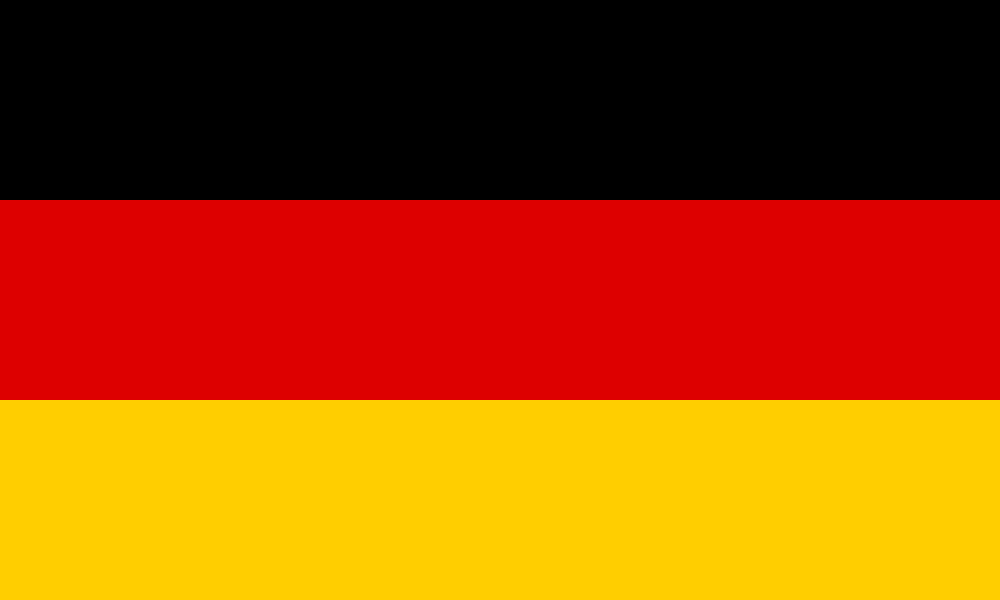
In 1815 the Congress of Vienna replaced the dissolved Holy Roman Empire with the German Confederation, a loose association of 39 states over which Austria presided. The restoration policy led by the Austrian chancellor Klemens von Metternich aimed to revive the dominance of the nobility as it had been before the French Revolution. When the student fraternities (Burschenschaften) called for national unity at the Wartburg Festival of 1817, the Confederation used the murder of the playwright Kotzebue by the student Karl Ludwig Sand in 1819 as a pretext for the Carlsbad Decrees, which tightened press censorship and the surveillance of universities. After the French July Revolution of 1830, risings in Brunswick, Electoral Hesse, Saxony and Hanover won constitutions in some states, and at the Hambach Festival of 1832 the banned black, red and gold flags were flown. On 3 April 1833 some 50 students stormed the guardhouses of Frankfurt, seat of the Federal Diet, in a failed attempt to set off a general German rising. 1 2 3
The name Vormärz ("pre-March") refers to the period before the March Revolution of 1848; some date its beginning to 1815, others to the July Revolution of 1830. Internationally it is known as the Age of Metternich, and culturally it coincides with the Biedermeier era. Austria and Prussia were police states that practised censorship and surveillance on an unprecedented scale and pressed the other German states to do the same. In 1837 seven Göttingen professors were dismissed for protesting against the abolition of the Hanoverian constitution. At the same time the German Customs Union (Zollverein), founded on 22 March 1833, eased trade between the states, and national liberals took it as a step towards a Lesser German unification under Prussia. Writers such as Heinrich Heine, Georg Herwegh and Georg Büchner escaped censorship by going into exile in France and Switzerland, and Büchner's pamphlet Der Hessische Landbote spread the slogan "Peace to the cottages, war on the palaces!" 2 1
The Industrial Revolution and population growth produced more labour than the countryside and the towns could absorb, and amid the decline of the crafts and mass unemployment "pauperism" became the word of the age. In June 1844 the weavers of Langenbielau and Peterswaldau in Silesia rose in hunger and were crushed by Prussian troops within a few days. Wilhelm Wolff's essay on the misery and the revolt in Silesia later served Gerhart Hauptmann as the basis of his play The Weavers. After the crop failure of 1846, famine and food riots broke out in almost every German state in 1847, and in April Berlin saw the "potato revolution". As food prices rose, demand for manufactured goods, above all textiles, collapsed and hastened the decline of domestic weaving. 1 4
Regional differences were large. The Rhineland, whose feudal structures had been dismantled under revolutionary and Napoleonic France, became the leading industrial area of Germany in the nineteenth century thanks to nearby coal and access to the Rhine, and by 1848 Aachen, Cologne and Düsseldorf were heavily industrialised. Prussia, which took the region over after 1814, treated the Rhinelanders as alien subjects and began to reinstate feudal structures, so that the revolutionary mood there was coloured by strong anti-Prussian feeling. Whereas the liberal petty bourgeoisie led the risings in other German states, in the Rhineland the proletariat had been asserting its interests openly against the bourgeoisie since about 1840. 3
 From Baden to Vienna: the March demands and the March ministries
The revolution began in the Grand Duchy of Baden, reputed to be the most liberal of the German states. At the Offenburg assembly of 12 September 1847 Friedrich Hecker and Gustav Struve put forward the thirteen "demands of the people of Baden" for civil rights, social security and equality. When news of the February Revolution in Paris arrived, a people's assembly at Mannheim on 27 February 1848 petitioned the government and first formulated the so-called March demands: "arming of the people with free election of officers, unconditional freedom of the press, jury courts on the English model, immediate creation of a German parliament". Across Baden peasants burned the mansions of local aristocrats and threatened them. 1 5 3
Within weeks the wave spread across the Confederation. On 29 February the Federal Diet set up a political committee, on 1 March demonstrators occupied the Baden parliament building in Karlsruhe, and on 3 March the Diet yielded to pressure and released the press. On 4 March a rising broke out in Munich, and on 5 March 51 liberals meeting at Heidelberg resolved to call a pre-parliament to prepare a national assembly. The same day Heinrich von Gagern became head of government in the Grand Duchy of Hesse, and on 9 March the King of Württemberg installed a "March ministry" under the opposition leader Friedrich Römer. Where princes gave way quickly, as in Württemberg, Hanover and Hesse-Darmstadt, jury courts, the end of censorship and peasant emancipation were promised, though much of it remained promise. On 19 March 20,000 people gathered at Offenburg. 1 6 5
In Bavaria King Ludwig I had lost prestige through his relationship with the dancer Lola Montez; on 9 February 1848 conservatives demonstrated to have her removed, and liberal students turned the affair into a demand for constitutional reform. Ludwig I abdicated in favour of his son Maximilian II; English Wikipedia dates the abdication 16 March, the chronology of German Wikipedia 20 March. Ludwig complained: "I could not rule any longer, and I did not want to give up my powers. In order to not become a slave, I became a lord." 3 1
In Vienna, capital of Austria, the strongest state of the Confederation, students took to the streets on 13 March to demand a constitution and a constituent assembly elected by universal male suffrage; when troops fired on them the workers joined in and the demonstration became an armed rising. That night Metternich resigned and fled to England, and on 14–15 March Emperor Ferdinand I promised a national guard, "complete freedom of the press" and a constitution. One account holds that the date of the Vienna demonstrations is why the risings throughout Germany came to be called the March Revolution. The revolutions in Vienna and Hungary are treated in a separate event. 3 1
Berlin, 18 March, and the Prussian March ministry
In Berlin meetings went on from 6 March, and from the 13th troops attacked the demonstrators. On 18 March King Frederick William IV issued a patent promising to convene the United Diet, introduce press freedom and reform the Confederation; as the crowd gathered on the palace square to hear it, two shots were fired from army muskets. Whether by intent or by accident was never established. The crowd threw up barricades, and street fighting between some 20,000 soldiers and the townspeople lasted twelve to thirteen hours. The next day, 19 March, the king withdrew the army from Berlin. 1 7 3
Casualty figures vary by source. The official count was 303 dead (288 men, 11 women and 4 children); the German literature on the Berlin March Revolution gives over 200 civilian dead, over 600 insurgents wounded or captured and fewer than 50 dead among the troops, while noting that figures of 400 to 1,800 "military corpses" circulated in rumours and the press for weeks. English Wikipedia gives 254 victims laid out on the Gendarmenmarkt. Of the civilians captured or killed only 3 percent belonged to the bourgeoisie and 85 percent to the urban lower classes, and journeymen, who made up only about 20 percent of Berlin's working population, made up half of the fighters. 1 7 3
On 19 March the king was forced to appear before the "March dead" laid out in the palace courtyard and to doff his cap. On 21 March he rode through Berlin wearing a black, red and gold armband and promised that "Prussia is henceforth merged into Germany", and the next day some 40,000 people followed the funeral procession to the Friedrichshain cemetery. Ninety Polish prisoners held in Moabit for the conspiracy of 1846 were freed and paraded to the acclaim of the crowd. Yet on the following day the king wrote secretly to his brother Prince Wilhelm, who had sought to crush the rising with cannon, earned the nickname "Prince of Grapeshot" and had to take refuge in England for a time. 1 3 8
On 29 March a liberal "March ministry" led by the Rhenish bankers Ludolf Camphausen and David Hansemann took office, but the bureaucracy and the army were left almost untouched, and the ministry itself aimed only at a "limited reform" in alliance with the monarchy. The electoral law of 8 April provided for universal, equal and indirect suffrage, and on 22 May the Prussian National Assembly opened in Berlin. With fewer professors and lawyers than Frankfurt but 46 farmers and artisans and 27 large landowners, it was considered closer to the people. On 14 June Berliners stormed the arsenal to arm themselves, and on 20 June the March ministry fell. The constitutional draft of July, the "Charte Waldeck", was rejected both by the conservative deputies and by the king. 1 9 3
From the Pre-Parliament to St Paul's Church: the Frankfurt National Assembly
At the invitation of the Heidelberg meeting the Frankfurt Pre-Parliament met in St Paul's Church from 31 March to 3 April. The liberal majority prevailed over the radical democrats and decided to cooperate with the Federal Diet in holding elections to a constituent national assembly, with a Committee of Fifty to act in the meantime. Hecker's motion that Germany be declared a republic and the programme for a federal republic that Struve published were both rejected, and the two men, in the minority, walked out in protest on 2 April. 10 3 11 12
The Pre-Parliament set one deputy per 50,000 inhabitants, 649 seats in all, but Czech-majority constituencies in Bohemia and Moravia boycotted the election, reducing the total to 585. Because of frequent replacements, counts of all deputies who sat between May 1848 and June 1849 range from 799 (Kühne) to 830 (Nipperdey), with 812 (Siemann) and 809 (Jansen) the most commonly cited. The National Assembly opened in St Paul's Church on 18 May and elected the moderate liberal Heinrich von Gagern as president (German Wikipedia dates his election 19 May, with 305 of 397 votes). Mocked as a "professors' parliament" for its many senior officials, judges, lawyers and professors, it was in fact a parliament of officials and jurists, each group making up nearly half. Accounts differ on whether no workers sat in it at all or whether the one working-class member was a Pole. 10 6 1 3
The deputies divided into parliamentary groups named after their meeting places. English Wikipedia counts some 400 deputies as Café Milani on the right (40), the right-centre Casino (120), the centre Landsberg (40), the left-centre Württemberger Hof (100), the left Deutscher Hof (60) and the far-left Donnersberg (40). In the language of the time the left, which wanted a democratic republic, were "the Wholes" (Ganze), and the liberal centre, which wanted a constitutional monarchy with a hereditary emperor, "the Halves" (Halbe). On 21 November 1848 the left groups, among them Deutscher Hof and Donnersberg, founded a nationwide organisation, the Central March Association. 3 1
On 28 June the Assembly voted 450 to 100 to create a Provisional Central Power, and the next day elected Archduke John of Austria Regent of the Empire with 436 votes. Prince Leiningen became head of the "Reich ministry", and on 14 June the Assembly had also voted to found an imperial fleet. But most states never fully recognised the new government, and the Assembly had neither the power to raise taxes nor an army of its own. This lack of any means of enforcing its decisions was soon exposed over Schleswig and in the suppression of Vienna. 10 1 3

 Hecker, Posen, Schleswig: the fronts of spring and summer 1848
Pushed aside in the Pre-Parliament, Hecker and Struve tried to found a republic by armed rising. When a friend of Hecker's, the editor of the Constanzer Seeblatt, was arrested at Karlsruhe station on 8 April, the two men called on 12 April for the people of the Lake Constance district and the Black Forest to assemble in arms at Donaueschingen. They expected 70,000 men but only a few thousand came; German Wikipedia puts Hecker's column at about 1,200. The plan to join the "German Democratic Legion" of the poet Georg Herwegh, coming from France, and march on Karlsruhe ended on 20 April at the Scheideck near Kandern: the government commander, General Friedrich von Gagern, was killed, but Hecker's force was beaten, and Herwegh's was routed a week later at Dossenbach. Hecker escaped to Switzerland and in September emigrated to America. 11 1 3
In the Prussian Grand Duchy of Posen a demonstration inspired by the news from Berlin on 20 March formed a Polish National Committee, and Ludwik Mierosławski, freed in Berlin, took command of Polish forces. In the first phase of the revolution German democrats sympathised with Polish independence, but the mood soon turned nationalist. On 14 and 26 April the king excluded much of the province from the planned Polish "reorganisation"; Mierosławski defeated Prussian troops at Miłosław on 30 April, but the rising was crushed on 9 May. It had been directed against the inclusion of Polish-majority districts in the elections to the Frankfurt National Assembly and thus in a German nation-state, and in the end the Grand Duchy was demoted to an ordinary Province of Posen. 13 1 3
In the duchies of Schleswig and Holstein, ruled by the King of Denmark in personal union, a "March government" took office in Copenhagen on 21–22 March, and on 24 March a German-oriented provisional government was set up at Kiel and raised an army of 7,000. Danish national liberals wanted a nation-state that included Schleswig, German national liberals wanted both duchies joined together in the German Confederation. Prussian troops acting for the Confederation under General Friedrich von Wrangel pushed into Jutland, but under pressure from Britain and Russia, which did not want a strong power controlling the Danish straits, Prussia signed a six-month armistice at Malmö on 26 August. It provided for the withdrawal of federal troops and the dissolution of the Kiel government, and the Provisional Central Power in Frankfurt was not even recognised in the negotiations. 14 1 10
The Malmö armistice exposed the Assembly's impotence. On 5 September, at Dahlmann's instigation, it rejected the armistice by 238 votes to 221 and the Leiningen ministry resigned, but in a second vote on 16 September it accepted the armistice by a narrow majority. On 18 September barricade fighting broke out in Frankfurt, the Casino deputies Lichnowsky and Auerswald were murdered, and the Regent called in Prussian and Austrian troops from the fortress of Mainz to restore order. On 21 September Struve proclaimed a German republic at Lörrach and was captured. The acceptance of Malmö is taken as the latest possible date of the final breach between liberals and radical democrats: to the democrats the liberals were traitors who, as Hecker had said, "negotiate with the princes" instead of "acting in the name of the sovereign people", while the liberals saw the September rising as proof that the left meant anarchy and terror. 10 1 12
The autumn of counter-revolution: the fall of Vienna, the execution of Blum, the dissolution of the Prussian Assembly
After the Paris June rising was crushed in June 1848, counter-revolution gained strength in the German states as well. In Austria Windischgrätz put down the Whitsun rising in Prague on 16 June, and on 6 October Viennese opposed to the war against Hungary murdered the war minister Latour and launched the "October rising". On 23 October the armies of Jelačić and Windischgrätz encircled Vienna and retook the city within a week; some 2,000 insurgents were killed. Robert Blum, sent to Vienna by the left of the National Assembly on a fact-finding mission, joined the street fighting, was arrested on 4 November, pleaded his immunity as a deputy in vain before a military tribunal and was shot on 9 November. His death was mourned in song as a martyrdom of the revolution, and on 2 December Ferdinand I abdicated in favour of his nephew Franz Joseph. 1 15 3
On 12 October the Prussian National Assembly struck the words "by the grace of God" from its draft constitution, and on 31 October it abolished noble titles and privileges. The king counter-attacked: on 1–2 November he appointed the soldier Count Brandenburg, his uncle, minister president, and General Wrangel's troops reoccupied Berlin. The Assembly was ordered to move "for its own safety" to Brandenburg an der Havel, and on 10 and 15 November troops broke up its sessions in Berlin. When a delegation of deputies was received by the king, Johann Jacoby made himself famous by telling him, "It is the misfortune of kings that they will not listen to the truth!" In Düsseldorf a tax boycott was proclaimed on 14 November, and the same month Ferdinand Lassalle was arrested for inciting armed resistance. 16 1 9 17 18
On 5 December the king dissolved the National Assembly, now at Brandenburg, and on the same day imposed a constitution of his own. The king kept a veto over every resolution and the right to dissolve parliament at any time, and the ministry answered to him, not to parliament. The constitution took over some liberal provisions of the Charte Waldeck but these were soon modified, and the three-class franchise introduced at the end of May 1849 and written into the revised constitution of 31 January 1850 weighted votes by taxes paid, so that more than 80 percent of the electorate controlled only one third of the seats. It remained in force in Prussia until 1918. The conservative deputy Otto von Bismarck joined the king's secret circle of advisers at the end of 1848 and sat in the first Landtag elected under the new constitution. 1 16 3
The Basic Rights, the imperial constitution and the "crown baked from dirt"
On 27 December 1848 the National Assembly passed the "Basic Rights of the German People"; published in the Reich law gazette the next day, the law declared equality before the law and the other basic rights immediately applicable. After the victory of the counter-revolution, however, the Basic Rights had been abolished nearly everywhere by 1851, and on 23 August 1851 the restored Federal Diet's "federal reaction decree" declared the Assembly's imperial legislation null and void. 10 3 1
The central question of the constitutional debate was whether the new Germany should include the German-speaking lands of Austria. The "Greater German solution" would have taken them in and separated them constitutionally from the rest of the Habsburg Empire; the "Lesser German solution" would exclude Austria and leave the leadership to Prussia. When Franz Joseph made clear in November 1848 that he would not accept the title of emperor from Frankfurt and the Austrian government introduced a centralised constitution for the entire empire, hopes for a Greater Germany were dashed. After the Austrian prime minister Schmerling resigned in December, Gagern became head of the Reich ministry and put forward the "Gagern programme", which would bind Austria to the new state only by a treaty of union; on 11 January 1849 it won a majority in the Assembly. 3 16 19 6
The imperial constitution was passed at the end of March 1849. English Wikipedia gives a narrow 267 to 263 in the late afternoon of 27 March, German Wikipedia a majority of 42 on 28 March, so the date and the margin differ between the sources. The constitutional monarchy with a hereditary emperor won its majority only through the "Simon-Gagern pact" of 26 March between the hereditary-emperor party around Gagern and the moderate leftist Heinrich Simon, in return for concessions to the left. On 28 March the Assembly elected the King of Prussia "Emperor of the Germans" with 290 votes, while 248 left-wing, southern German and Austrian deputies abstained. The constitution was proclaimed on 28 March, providing for a Lesser German federal state, basic rights enforceable before an imperial court, a Reichstag of a House of the People elected by equal manhood suffrage and a House of States appointed half by the state governments and half by the state parliaments, and an emperor with only a suspensive veto over legislation. 10 1 6 20
On 3 April the Emperor Deputation led by the Assembly's president Eduard von Simson offered the crown in Berlin, but Frederick William IV equivocated, saying he could not accept without the consent of the princes and free cities, and rejected it finally on 28 April. In a private letter he called it "an imaginary hoop baked from dirt and weeds" and wrote that "if the thousand-year-old crown of the German nation ... is to be awarded once again, it is I and those like me who will award it." Twenty-nine smaller states accepted the constitution, but Austria, Prussia, Bavaria, Saxony and Hanover rejected it. After Austria, Prussia too illegally recalled its deputies on 14 May; the rest moved to Stuttgart on 30 May and met as a "rump parliament" from 6 June until Württemberg troops dispersed it on 18 June, when only 99 deputies remained. 10 16 1 3
The Imperial Constitution campaign: Dresden, the Rhineland, the Palatinate
In May 1849 the democrats launched the "Imperial Constitution campaign" to enforce from below the constitution the princes had rejected. When King Frederick Augustus II of Saxony refused the constitution and dissolved the chambers, a rising broke out in Dresden on 3 May and within hours 108 barricades went up. The king fled to the fortress of Königstein, and Tzschirner, Todt and Heubner of the dissolved parliament formed a provisional government. The Russian revolutionary Mikhail Bakunin, the court conductor Richard Wagner, the architect Gottfried Semper and Stephan Born of the Workers' Brotherhood stood on the barricades. Most of the Saxon army was away in Holstein, and Prussian troops called in by the government crushed the rising after bitter street fighting on 9 May. 21 1 3
Sources differ widely on the size and cost of the Dresden rising. German Wikipedia's article on the revolution puts the insurgents at about 12,000; English Wikipedia's article on the German revolutions gives about 2,500 combatants on the barricades; and the article on the Dresden rising cites recent studies for about 3,000 revolutionaries against 5,000 Saxon and Prussian troops. One count gives about 200 dead insurgents (a 1995 estimate) and 8 Saxon and 23 Prussian soldiers killed, while the article on Frederick William IV gives 250 killed and 700 taken prisoner. Bakunin was arrested and repeatedly sentenced to death and extradited, while Wagner and Semper, on the wanted list, escaped to Zurich. 1 3 21 16 22
In Prussia's Rhine Province and Westphalia the spark was the call-up of the army reserve (Landwehr), considered illegal in peacetime. On 9 May risings broke out in Elberfeld, Düsseldorf, Iserlohn and Solingen; in Elberfeld 15,000 workers erected barricades and a Committee of Public Safety was formed. Workers from Solingen stormed the arsenal at Gräfrath, and workers and democrats from around Trier stormed the arsenal at Prüm on 17–18 May. Engels came to Elberfeld with two cases of cartridges and served as Inspector of Barricades, but was expelled by the bourgeois Committee of Public Safety, which feared his "red-radical" presence. Frightened by the armed working class, the upper bourgeoisie separated itself from the movement and described its leaders as bloodthirsty terrorists. 3 23
In the Bavarian Rhenish Palatinate some 12,000 people gathered at Kaiserslautern on 1 May under the slogan "If the government becomes rebellious, the citizens of the Palatinate will become the enforcers of the laws" and set up a committee for the defence of the constitution. On 17 May a provisional government under the lawyer Joseph Martin Reichard took office and prepared to secede from Bavaria, and on 18 May it allied with Baden. Thousands of Bavarian soldiers joined the Palatine revolutionary army; the Communist League member Fritz Anneke organised the artillery, and August Willich commanded all the Palatine volunteers. But arms and money were short, and on 11 June the Prussian army marched in. 24 3
The Baden republic and the fall of Rastatt
In Baden a soldiers' assembly at the federal fortress of Rastatt on 9 May saw regulars and the civic militia fraternise, and on 11 May the garrison mutinied. On 13 May a people's assembly at Offenburg adopted a sixteen-point programme demanding unconditional recognition of the imperial constitution and a new government under the liberal Lorenz Brentano, and that night Grand Duke Leopold fled from Karlsruhe. On 1 June a provisional government under Brentano took office. In Baden both the army and the public supported the constitution, and arsenals and treasury were well stocked, so conditions were far better than in the Palatinate. Struve, sentenced to eight years for the September rising of 1848, was freed. 5 25 1 3
Command of the revolutionary army went to Mierosławski, the leader of the Posen rising, facing Prussian and federal troops under Prince Wilhelm, the "Prince of Grapeshot". Defeated at Waghäusel on 21–22 June, the revolutionaries withdrew to escape encirclement. At the end of June Struve's followers overthrew Brentano, who relied on negotiation and delayed a general arming of the people, but this could not stop the army's disintegration, and Mierosławski resigned his command on 1 July. Engels served as aide-de-camp in Willich's volunteer corps, which tried in vain at Rinnthal to halt the Prussian advance on Landau, was the last unit to follow the revolutionary army's retreat from the Palatinate into Baden on 19 June, and fought on the Murg line on 28–30 June. Wilhelm Liebknecht served as Struve's adjutant. 1 5 12 26 23
On 23 July, after a three-week siege, Rastatt fortress surrendered to the Prussian troops of General Groeben, ending the Baden revolution and the German revolution with it. Courts martial sat in Mannheim, Rastatt and Freiburg from 27 July to 27 October. German Wikipedia's article on the revolution gives 23 revolutionaries executed, English Wikipedia's article on the Baden revolution 27 (among them Tiedemann, the fortress commander, with 19 death sentences in Rastatt alone). About 80,000 Badeners, some five percent of the population, left the country after the revolution. Engels reached Switzerland only on 25 July, and Struve, Brentano and Carl Schurz also escaped into exile. Engels later wrote that "a hundred thousand Prussian, Bavarian, and Hessian soldiers had already settled the whole affair in the last battle under the walls of Rastatt." 1 5 25 3 27
The Communist League, the Demands of the Communist Party in Germany and the Neue Rheinische Zeitung
In 1836 German émigré journeymen in Paris broke away from the League of Outlaws to found the League of the Just, whose most prominent leader was the tailor Wilhelm Weitling, alongside Karl Schapper, Joseph Moll and others. Expelled from France after taking part in the Blanquist revolt of 12 May 1839, the League moved to London, founded the German Workers' Educational Society in 1840 and grew to over 1,000 members. In June 1847 it merged with the Brussels Communist Correspondence Committee of Marx and Engels to form the Communist League and changed its motto to "Working Men of All Countries, Unite!" The Communist Manifesto, commissioned by the League's second congress in London in November–December 1847, appeared in February 1848. Specialists estimate the League's actual membership at 200 to 300. 28 29 30
When the March Revolution broke out, Marx and Engels wrote the seventeen "Demands of the Communist Party in Germany" in Paris between 21 and 29 March 1848 and had them printed as a leaflet signed by the League's Central Committee: Marx, Schapper, H. Bauer, Engels, Moll and W. Wolff. The first demand read: "The whole of Germany shall be declared a united, indivisible republic." Then came the vote for every German aged 21, pay for deputies, universal arming of the people, free justice, abolition without compensation of all feudal burdens on the peasantry, state ownership of princely and feudal estates and of mines, state ownership of mortgages on peasant farms, a state bank to replace private banks, state ownership of railways, canals, posts and other transport, separation of church and state, limitation of inheritance, strongly progressive taxes and abolition of consumption taxes, national workshops, and universal free education. The leaflet concluded that it was in the interest of "the German proletariat, the petty bourgeoisie and the peasantry" to work for these measures. 31 32
Back in Cologne in April, Marx and Engels founded the Neue Rheinische Zeitung: Organ der Demokratie with the League's Cologne members; it first appeared on 1 June 1848. Under Marx as editor-in-chief the editorial board comprised Heinrich Bürgers, Ernst Dronke, Engels, Georg Weerth, Ferdinand Wolff and Wilhelm Wolff, and on 12 October the poet Ferdinand Freiligrath joined to run the foreign news. The "democracy" of the subtitle meant not parliamentary democracy but the revolutionary "democratic front" of the progressive petty bourgeoisie, the working class and the peasantry. As Engels recalled, the paper's programme was "a single, indivisible, democratic German republic, and war with Russia, including the restoration of Poland". It attacked with mockery the liberal bourgeoisie's willingness to compromise with the monarchist counter-revolution, and Marx's economic articles of April 1849 were later collected as Wage-Labour and Capital. 30 33 23
Its circulation of 3,000 to 6,000 copies far exceeded the League's membership, and the historian Tatyana Vasilyeva regards it as "the leading centre of the Communist League" during the revolution. When a state of siege was declared in Cologne from 25 September to 4 October 1848 the paper was suspended, Engels faced an arrest warrant for high treason and Wilhelm Wolff a warrant for "conspiracy". Restarted in mid-October, the paper had 6,000 subscribers when the government forced it to close in May 1849. On 16 May Marx was ordered to leave Prussia within 24 hours, and on 19 May the 301st and last issue appeared, printed entirely in red ink. "When our turn comes," Marx wrote, "we shall not make excuses for the terror." 30 34 23
The Cologne Workers' Association and the Workers' Brotherhood: two roads for workers' organisation
The Cologne poor-law doctor Andreas Gottschalk was one of the founders of the Cologne community of the Communist League. On 3 March 1848 he organised a mass meeting outside the city hall demanding universal suffrage, freedom of the press and assembly and the "protection of labour", was arrested and was freed after the revolution in Berlin. At the founding meeting of 13 April, attended by some 300 delegates, he was elected president of the Cologne Workers' Association, with Fritz Anneke, a former Prussian artillery officer, as secretary. The Association demanded a say in workplace decisions, social security and labour protection laws, and boycotted the indirect elections to the Frankfurt National Assembly. Its membership is given as up to 7,000 in the article on the Association and as more than 8,000 within a few weeks in the article on Gottschalk. In early May Gottschalk left the League because he no longer agreed with its strategy and tactics. 35 36
After the democratic congress at Frankfurt in June Gottschalk proposed a merger with the Democratic Society of Marx and Engels, but was rebuffed. When he and Anneke were arrested on 3 July for demanding the immediate establishment of a democratic republic, the League members Joseph Moll and Karl Schapper became president and vice-president and steered the Association onto the Marxist line. It built barricades during the September unrest, and after Schapper was jailed and Moll fled to London a general meeting elected Marx president on 22 October. Acquitted by a jury, Gottschalk opposed the Association's participation in the elections to the Prussian second chamber in December, which Marx and the majority supported. Gottschalk called Marx a "learned sun-god" and accused him: "the misery of the worker, the hunger of the poor have for you only a scientific, doctrinaire interest". He died in September 1849 of cholera caught while treating patients. 36 35
In Berlin the typesetter Stephan Born took another road. Having met Engels in Paris and Marx in Brussels and worked for the League, he returned to Berlin after the March Revolution, became president of the "Central Committee of Workers" and publisher of its paper Das Volk, and led two printers' strikes. A general workers' congress held in Berlin from 23 August to 3 September 1848 founded the Workers' Brotherhood, which became the largest workers' organisation of the revolution, with more than 170 associations and 15,000 members; 37 of its 64 Prussian associations were in the Rhine Province. Its founding congress declared, "We workers must help ourselves," yet it took its stand on the constitutional process rather than against parliament, building trade unions, cooperatives, mutual funds and workers' education, and petitioned the National Assembly for joint commissions to set minimum wages and working hours, a progressive income tax and free education. 37 38
In practice Born drifted away from Marx and Engels, later recalling that "all communist thoughts were wiped away at a stroke; they had no connection whatever with what the present demanded." The Brotherhood shared members with the League and read the Communist Manifesto, and Born even proposed a division of labour in which the League would handle programme and the Brotherhood practical organisation, but the Brotherhood drifted towards social reform and its publications came to use the term "Social Democrat". Marx, fearing that this moderate federation would blunt the workers' revolutionary will, kept the Cologne Workers' Association out of it. Even so the Brotherhood took an active part in the Imperial Constitution campaign, and Born fought on the barricades in Dresden. In 1850 the governments of Prussia, Saxony and Bavaria agreed to persecute it as a "nursery of communism"; it held out until the general ban on workers' associations in 1854, and the places where it had been active reappear in the 1860s as strongholds of Lassalle's General German Workers' Association. 37 38 36
Aftermath: the split of the League and the Cologne Communist Trial (1850–1852)
Reassembled in London, the Communist League split in two on 15 September 1850: Willich and Schapper wanted to concentrate on an imminent revolution, Marx and Engels on the long-term building of an international workers' movement. Willich insulted Marx and even challenged him to a duel. When the tailor Peter Nothjung was arrested at Leipzig station in May 1851 carrying copies of the League's addresses, Frederick William IV ordered that the Prussian public be given the "yearned-for spectacle of an exposed and (above all) punished conspiracy", and the police official Wilhelm Stieber assembled evidence, some of it fabricated. 39 29 40
The Cologne Communist Trial was held before the Rhenish jury court from 4 October to 12 November 1852. The "minutes book of the Marx party" that Stieber produced on 23 October was also forged, and in London Willich had the forger arrested by the English police, while Marx worked from London to prove the forgeries. Of the eleven defendants four, among them Daniels, were acquitted; Roeser, Nothjung and Bürgers received six years' fortress imprisonment, Reiff, Otto and Becker five, and Lessner three. Freiligrath escaped arrest by fleeing to London. Immediately after the verdict the Communist League dissolved itself, and Engels made the trial the subject of the final piece of Revolution and Counter-Revolution in Germany. 39 26 41
Assessment
At Marx's request in August 1851, Engels wrote nineteen articles on the German revolution for the New York Daily Tribune between October 1851 and October 1852, published under Marx's name. They were collected in 1896 as Revolution and Counter-Revolution in Germany, and Engels's authorship became known only in 1913. In the first article Engels rejected explanations of the counter-revolution's victory by the "betrayal" of individual leaders and insisted that its causes were to be sought "in the general social state and conditions of existence of each of the convulsed nations." The last article concluded that the industrial and commercial capitalist class had been more severely defeated in Germany than anywhere else, that "political Liberalism, the rule of the bourgeoisie, be it under a Monarchical or Republican form of government, is forever impossible in Germany," and that the democrats, representing the small traders and part of the farmers, had by their cowardice at every decisive moment lost the confidence of "the real fighting mass of all European insurrections, the working class." In The Peasant War in Germany (1850) Engels traced the failure of 1848–49 to the same cause as the sixteenth-century Peasants' War: a German bourgeoisie too timid to challenge the aristocracy. 41 42 27 23
The Address of the Central Committee to the Communist League that Marx wrote in March 1850 was the first text in which the phrase "permanent revolution" carried a strategic meaning. Expecting the petty-bourgeois democrats to gain the upper hand for a time in the next revolution, the Address held that, while they wanted to bring the revolution to an end as quickly as possible once some of their demands were met, it was the interest and task of the workers' party "to make the revolution permanent until all the more or less propertied classes have been driven from their ruling positions, until the proletariat has conquered state power and until the association of the proletarians has progressed sufficiently far – not only in one country but in all the leading countries of the world". Its core was that the workers keep their own organisation and demands even in alliance with the democrats, and it has been read as differing from Trotsky's later claim that a period of bourgeois rule could be skipped. In his introduction of 1895 Engels admitted that in 1848 they had been wrong about the ripeness of economic conditions, and Bernstein cited this in support of a parliamentary road. 43 44 45 23
Defeat produced mass exile. Tens of thousands fled to France, England or Switzerland, and those who could afford the passage crossed to the United States and Australia, where they were known as Forty-Eighters. In America the exiles mostly opposed slavery and nativism, supported Lincoln and the Republicans and fought for the Union in the Civil War. Hecker commanded the 24th and 82nd Illinois Infantry and was badly wounded at Chancellorsville; Willich commanded the 32nd Indiana, rose to brigadier general and led the assault up Missionary Ridge; Struve served as a captain under Blenker. Carl Schurz was US Secretary of the Interior from 1877 to 1881. Marx wrote that "in the Civil War in North America, Willich showed that he is more than a visionary". Many radical democrats who stayed in Germany or returned after the amnesty of 1862 joined the labour movement and social democracy of the 1860s. 1 46 11 40 12
The label "failed revolution" is itself disputed today. Hans-Ulrich Wehler identifies six factors that weakened the revolution, among them overconfidence after the early successes, the withdrawal of a countryside satisfied by agrarian reform, liberals who were "revolutionaries against their will" and too many modernising tasks at once, yet he rejects the one-sided formula of failure, pointing out that the reactionary governments did not dare reverse the agrarian reforms, that jury courts remained and that every German state except Austria now had a constitution. Thomas Nipperdey defends the liberals as seeking to carry the revolution into legality out of fear of social revolution and terror, while Mike Rapport sees in their choice of national unity over political freedom the start of a German special path that led to Bismarck's empire built from above. Helga Grebing, following Michael Stürmer, proposes calling it an "unfinished" rather than a "failed" revolution. The peasant revolts of 1848–49 involved more people than the national revolutions and ended the remnants of serfdom across the German Confederation, Austria and Prussia. National unity, by contrast, came from above through Prussia's wars in 1871, while the socialist movement inherited from 1848 independent workers' organisation, the experience of the Neue Rheinische Zeitung and the lesson not to rely on the bourgeois democrats. 1 3
Consequences
The German Confederation was restored in 1850, the Basic Rights had been abolished in nearly every state by 1851, and Prussia gained the three-class franchise that lasted until 1918. Tens of thousands went into exile, about 80,000 from Baden alone, and some of them, such as Hecker, Willich and Struve, fought for the Union in the American Civil War. Yet peasant emancipation, public jury trials and constitutions in every German state except Austria survived the reaction. National unity came from above through Prussia's wars in 1871, and the Communist League dissolved after the Cologne Communist Trial of 1852, but Marx's Address of 1850 and Engels's Revolution and Counter-Revolution in Germany left the socialist movement the idea of an independent workers' line that did not rely on the bourgeois democrats and the conception of permanent revolution.
Timeline & Map
- 11844-06Silesian weavers' revolt
The weavers of Langenbielau and Peterswaldau rose in hunger and were crushed by Prussian troops within days; Wilhelm Wolff wrote the account of it.
- 21847-09-12The thirteen Offenburg demands
Hecker and Struve put forward the thirteen "demands of the people of Baden" for civil rights, social security and equality.
- 31848-02-27Mannheim people's assembly
With news of the February Revolution in Paris, the March demands for a people's army, a free press, jury courts and a German parliament were first formulated.
- 41848-03-13Vienna rising; Metternich resigns
Amid a rising of students and workers, Chancellor Metternich resigned and fled to England.
- 51848-03-18Barricade fighting in Berlin
Two shots on the palace square set off twelve to thirteen hours of street fighting; the official count was 303 dead.
- 61848-03-21The king rides in the tricolour
Frederick William IV rode through Berlin wearing the revolutionary tricolour and promised that Prussia would merge into Germany.
- 71848-03-24Provisional government at Kiel
The German population of Schleswig and Holstein set up a provisional government and an army of 7,000 against Denmark.
- 81848-03-31The Frankfurt Pre-Parliament
The Pre-Parliament met in St Paul's Church and arranged elections to a national assembly; Hecker's republican motion was defeated.
- 91848-04-13Cologne Workers' Association founded
Some 300 delegates elected Andreas Gottschalk president.
- 101848-04-20Battle on the Scheideck
The Hecker uprising was defeated near Kandern; the government commander Friedrich von Gagern was killed.
- 111848-05-09Posen rising crushed
The Polish rising led by Mierosławski was crushed by Prussian troops.
- 121848-05-18Frankfurt National Assembly opens
The first freely elected all-German parliament opened in St Paul's Church and chose Heinrich von Gagern as president.
- 131848-06-01First issue of the Neue Rheinische Zeitung
The "Organ of Democracy" edited by Marx appeared in Cologne.
- 141848-06-29Archduke John elected Regent
The Assembly created a Provisional Central Power and elected Archduke John of Austria Regent with 436 votes.
- 1848-08-26Malmö armistice
Under British and Russian pressure Prussia signed a six-month armistice with Denmark.
- 151848-09-03Workers' Brotherhood founded
The general workers' congress in Berlin founded the Workers' Brotherhood under Stephan Born's leadership.
- 161848-09-18September rising in Frankfurt
Barricade fighting against the acceptance of Malmö left the deputies Lichnowsky and Auerswald dead; Prussian and Austrian troops restored order.
- 171848-09-21Struve's Lörrach rising
Struve proclaimed a German republic and was captured.
- 181848-11-09Execution of Robert Blum
Blum, a deputy of the National Assembly who had joined the Vienna October rising, was shot despite his immunity.
- 191848-12-05Prussian Assembly dissolved; constitution imposed
The king dissolved the National Assembly, moved to Brandenburg, and imposed a constitution.
- 201848-12-27Basic Rights of the German People
The Assembly passed the basic rights, including equality before the law, as immediately applicable law.
- 211849-03-28Imperial constitution and emperor election
The Assembly proclaimed a Lesser German constitution with a hereditary emperor and elected the King of Prussia (290 votes, 248 abstentions).
- 221849-04-28Imperial crown finally refused
Having equivocated on 3 April, Frederick William IV finally refused the crown.
- 231849-05-03May Uprising in Dresden
Bakunin, Wagner and Born joined the rising against the king's rejection of the constitution; Prussian troops crushed it on 9 May.
- 241849-05-09Elberfeld rising
Fifteen thousand workers built barricades against the Landwehr call-up; Engels served as Inspector of Barricades.
- 251849-05-11Rastatt garrison mutinies
The Baden garrison of the federal fortress mutinied, and two days later Grand Duke Leopold fled.
- 261849-05-19Red last issue of the Neue Rheinische Zeitung
After Marx's expulsion order the paper ended with its 301st issue, printed entirely in red.
- 271849-06-01Baden provisional government
A provisional government under Lorenz Brentano took office.
- 281849-06-18Stuttgart rump parliament dispersed
Württemberg troops dispersed the rump parliament of 99 remaining deputies.
- 291849-06-21Battle of Waghäusel
Mierosławski's Baden revolutionary army was beaten by the Prussians and withdrew.
- 301849-07-23Rastatt surrenders
After a three-week siege the fortress surrendered, ending the German revolution; courts martial executed 23 to 27 men.
- 1850-03Address of the Central Committee
Marx sent the Communist League the Address calling for the revolution to be made permanent.
- 311852-11-12Cologne Communist Trial verdict
Seven of the eleven defendants received three to six years, and the Communist League dissolved itself.
Related people 42
Democrats, republicans and workers' associations27
Leadership8
Wrote the Demands of the Communist Party in Germany with Engels, ran the Neue Rheinische Zeitung in Cologne and became president of the Cologne Workers' Association in October 1848. Expelled in May 1849, he wrote the League's Address of March 1850.
Leader of the left in the Frankfurt National AssemblyRobert Blum1807–1848Vice-president of the Pre-Parliament and opponent of the Malmö armistice, he joined the Vienna October rising and was shot on 9 November 1848.
Leader of the Hecker uprisingFriedrich Hecker1811–1881After his motion for a republic failed in the Pre-Parliament he led an armed rising in April 1848, was defeated at the Scheideck and emigrated to America.
Leader of the Baden radical democratsGustav Struve1805–1870Led the April rising with Hecker and proclaimed a republic at Lörrach in September; joined the Baden revolutionary government in 1849 and overthrew Brentano.
Founder of the Workers' BrotherhoodStephan Born1824–1898Led the Berlin Central Committee of Workers, founded the Workers' Brotherhood in September 1848 and fought on the Dresden barricades in 1849.
Founding president of the Cologne Workers' AssociationAndreas Gottschalk1815–1849Founded and led the Association in April 1848 on a programme of labour protection and boycott of the Frankfurt elections; after his arrest in July he clashed with Marx, who took it over.
Leader of the German Democratic LegionGeorg Herwegh1817–1875Led the German Democratic Legion from France to join the Hecker uprising; Württemberg troops routed it at Dossenbach on 27 April 1848
Head of the Baden provisional governmentLorenz Brentano1813–1891Named by the Offenburg assembly of 13 May 1849 to head a new government, he led the provisional government from 1 June, but relying on negotiation and delaying a general arming he was overthrown by Struve's followers at the end of June and went into exile
Participants18
Wrote the paper's military and diplomatic commentary, served as Inspector of Barricades in Elberfeld in 1849 and then as aide-de-camp in Willich's volunteer corps. Wrote Revolution and Counter-Revolution in Germany.
Commander of the Palatine volunteer corpsAugust Willich1810–1878Fought at the Scheideck in 1848 and in 1849 led a volunteer corps, with Engels as aide, against the Prussians at Rinnthal and on the Murg; led the League's left faction in 1850.
Editor of the Neue Rheinische Zeitung, deputy in the National AssemblyWilhelm Wolff1809–1864Signed the Demands of the Communist Party, ran the paper's news from the German states and sat with the Donnersberg group in the rump parliament in May–June 1849.
Revolutionary poet, editor of the Neue Rheinische ZeitungFerdinand Freiligrath1810–1876Acquitted over "The Dead to the Living", he ran the paper's foreign news from October 1848 and published poems such as "Blum" in it.
Left deputy in the Prussian and Frankfurt assembliesJohann Jacoby1805–1877Became famous in November 1848 for telling the king, "It is the misfortune of kings that they will not listen to the truth!"
Rhineland democratFerdinand Lassalle1825–1864Met Marx and Engels in Cologne in 1848 and was arrested in November for inciting armed resistance to the dissolution of the Prussian Assembly.
Member of Herwegh's legion, Struve's adjutantWilhelm Liebknecht1826–1900Joined Herwegh's German Democratic Legion in 1848, took part in Struve's September rising and served as Struve's adjutant in the Baden revolution of 1849.
Participant in the Dresden May UprisingMikhail Bakunin1814–1876Stood on the Dresden barricades in 1849, was named ringleader by the Saxon government, and was arrested, sentenced to death and extradited repeatedly.
Vice-president of the Cologne Workers' Association, Communist League leaderKarl Schapper1812–1870A leader of the League of the Just, he signed the Demands of the Communist Party. After Gottschalk's arrest he and Moll steered the Cologne Workers' Association to Marx's line, and he helped publish the Neue Rheinische Zeitung. Jailed after the September unrest, he was tried for treason in Nassau in 1849 and in 1850 led the League's left faction with Willich.
President of the Cologne Workers' Association, killed in the Baden campaignJoseph Moll1813–1849A League of the Just leader who signed the Demands of the Communist Party, he became president of the Cologne Workers' Association after Gottschalk's arrest in July 1848. He fled to London after the September unrest, came back secretly, fought in the Baden-Palatinate rising and was killed on the Murg on 28 June 1849.
Theorist of the League of the JustWilhelm Weitling1808–1871The best-known leader of the League of the Just, he broke with Marx in 1846. Back from America in 1848, he published Der Urwähler in Berlin but played a minor part, and returned to the United States at the end of 1849.
Officer in the Palatinate-Baden army, Forty-EighterCarl Schurz1829–1906Published the Bonner Zeitung with Kinkel in 1848 and in the 1849 campaign for the imperial constitution served as adjutant to Anneke, artillery chief of the Palatinate-Baden army. He escaped from Rastatt, freed Kinkel from Spandau in 1850 and in America became a senator and Secretary of the Interior (1877–1881).
Frankfurt deputy, leader of the Westendhall groupHeinrich Simon (Frankfurt deputy)1805–1860His Simon-Gagern pact of 26 March 1849 gave the hereditary-emperor party its majority in return for concessions to the left; in June he joined the regency of the Stuttgart rump parliament
Secretary of the Cologne Workers' Association, artillery commander of the Palatine armyFritz Anneke1818–1872Became secretary of the Cologne Workers' Association in April 1848 and was arrested with Gottschalk on 3 July; in 1849 he organised the artillery of the Palatine revolutionary army
Dresden court conductorRichard Wagner1813–1883Stood on the barricades of the Dresden May Uprising of 1849 with Bakunin, Semper and Born, and fled to Zürich when he was put on the wanted list
Architect, member of the Dresden civic guardGottfried Semper1803–1879Built barricades in the Dresden May Uprising of 1849 and escaped to Zürich when he was put on the wanted list
Feuilleton editor of the Neue Rheinische ZeitungGeorg Weerth1822–1856Covered Britain and Belgium and ran the feuilleton, serialising his satire on the nobility, Schnapphahnski, which cost him a prison term in 1850
Editor of the Neue Rheinische ZeitungFerdinand Wolff1812–1905Known as "Red Wolff", he covered France and the aftermath of the February Revolution in more than 170 articles
Constitutional liberals (the Frankfurt majority and the March ministries)5
Leadership3
Led the liberal majority, carried the election of Archduke John as Regent and, with the Gagern programme excluding Austria, the passage of the imperial constitution.
Head of the Prussian March ministryLudolf Camphausen1803–1890Formed the liberal March ministry with Hansemann on 29 March 1848, leaving the bureaucracy and army almost untouched and aiming only at limited reform in alliance with the crown; offered his resignation on 20 June
Regent of the EmpireArchduke John1782–1859Elected Regent of the Provisional Central Power by the Assembly with 436 votes on 29 June 1848; the states kept their armies from him, and he resigned on 20 December 1849
Participants2
Rhenish banker who led the March ministry with Camphausen and stayed finance minister under Auerswald until 8 September 1848
President of the Frankfurt National AssemblyEduard von Simson1810–1899Led the Emperor Deputation that offered Frederick William IV the crown in Berlin on 3 April 1849, which the king refused
The monarchs, princely governments and their armies9
Implementers & commanders5
Earned the name "Prince of Grapeshot" for using cannon against the Berlin rising and fled to England; in 1849 commanded the Prussian army that crushed the Baden rising.
Commander who retook ViennaAlfred Windisch-Grätz1787–1862Crushed Prague in June 1848 and retook Vienna with Jelačić in October; Blum was executed after the capital's surrender to him.
Prussian generalFriedrich von Wrangel (Prussian field marshal)1784–1877Led the Prussian troops acting for the Confederation into Jutland in 1848, and in November his troops reoccupied Berlin
Prussian minister-presidentFriedrich Wilhelm von Brandenburg1792–1850Appointed minister-president on 1–2 November 1848 for the king's counter-attack; the National Assembly was moved to Brandenburg and dissolved on 5 December
Prussian police officialWilhelm Stieber1818–1882Assembled the evidence for the Cologne Communist Trial of 1851–1852, some of it fabricated; the minutes book of the Marx party he produced was also forged
Participants2
Took part in the counter-revolution, joined the king's secret circle of advisers at the end of 1848 and sat in the first Landtag under the imposed constitution.
Emperor of AustriaFranz Joseph I1830–1916Acceding in December 1848, he made clear he would not accept the title of emperor from Frankfurt, and Austria's centralised constitution ended the Greater German solution.
Related terms
Sources: reference 1reference 2reference 3reference 4reference 5reference 6reference 7reference 8reference 9reference 10reference 11reference 12reference 13reference 14reference 15reference 16reference 17reference 18reference 19reference 20reference 21reference 22reference 23reference 24reference 25reference 26reference 27reference 28reference 29reference 30reference 31reference 32reference 33reference 34reference 35reference 36reference 37reference 38reference 39reference 40reference 41reference 42reference 43reference 44reference 45reference 46