
The first non-Slavic front commander, from Bagration to the Baltic
In summer 1944, his troops reached the Baltic. Bagramyan sent Stalin a bottle of Baltic seawater, but Germans retook the shore before it arrived. Stalin said: 'Return it — let Comrade Bagramyan pour it back into the sea himself.'
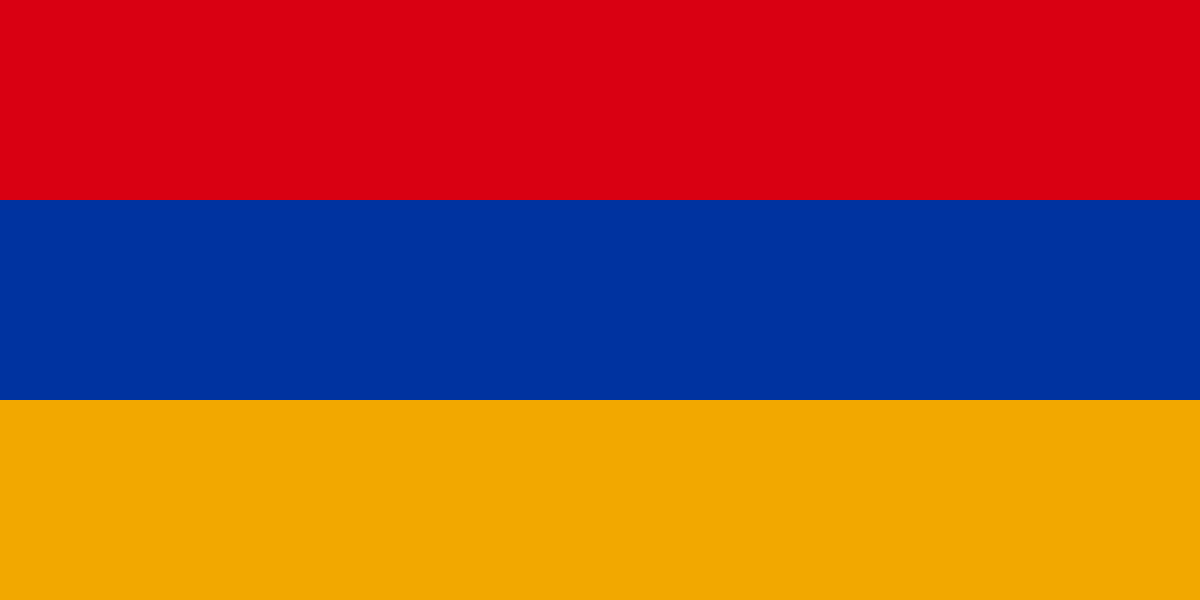
An Armenian from Azerbaijan, he became the first non-Slav to command a Soviet front. During Operation Bagration his marshland breakthrough isolated German Army Group North in the Courland pocket. Marshal of the USSR, twice Hero of the Soviet Union.
Activities and affiliations
Career Timeline
- 1915–17Volunteered for Imperial Army; Persian expedition on Caucasus Front; praporshchik
- 1918–20Armenian Army: fought Turkish forces, company and squadron CO, lieutenant
- 1920–34Joined Red Army; cavalry regiment CO; cavalry school and Frunze Academy
- 1934–40Chief of staff, cavalry division KOVO; General Staff Academy; senior instructor
- 1941–42Operations chief SW Front: Kiev defence, Rostov counteroffensive, Kharkov offensive
- 1942–43CO 16th Army / 11th Guards: Zhizdra, Orel breakthrough
- 1943–45CO 1st Baltic Front: Bagration, Memel, Königsberg capture
- 1945–55CO Baltic MD; Marshal of the USSR 1955; Deputy Defence Minister
- 1956–68Commandant, General Staff Academy; Deputy Defence Minister — Chief of Rear Services
Related historical events
- 1914–1918First World WarRussian Imperial Army volunteerFrom 1915 to 1917, he volunteered in the Imperial Russian Army and served on the Persian expedition on the Caucasus Front.
- 1918–1922The Civil War and Foreign InterventionRed Army enlistment
- 1941–1945The Great Patriotic War1st Baltic Front commanderCommanded the 1st Baltic Front during Operation Bagration, breaking through the German lines north of Vitebsk and isolating Army Group North in Courland.
- 1957The Anti-Party GroupCentral Committee member
- 1962The Cuban Missile CrisisLed planning for Operation AnadyrDuring the 1962 Cuban Missile Crisis, he led the planning of Operation Anadyr, the secret deployment of Soviet forces to Cuba.
After the War: Last Front Commander to Cuba
After the war Bagramyan remained at the centre of the Soviet military elite, serving as commander of the Baltic Military District (1945–54), Deputy Defence Minister (1955–56, 1958–68), and commandant of the General Staff Academy (1956–58). During the 1962 Cuban Missile Crisis he led the planning of Operation Anadyr, the clandestine deployment of Soviet forces to Cuba, whose codename was deliberately chosen from a Chukotka river to deflect attention northward. From 1968 he served as inspector-general of the Defence Ministry while remaining active as a Central Committee member and Supreme Soviet deputy.
As an Armenian, Bagramyan embodied the tension between national identity and imperial loyalty inside the Soviet system. A famous story recounts that at the first session of the Latvian Supreme Soviet, when every speaker used Latvian, Bagramyan deliberately delivered his speech in Armenian; thereafter proceedings were conducted in Russian, which all could understand. When he died in September 1982 he was the last surviving marshal who had commanded a front in the Great Patriotic War. His ashes were interred in the Kremlin Wall.