British admiral who won the battle of 1 June 1794
On 1 June 1794 Howe commanded the Channel Fleet against the French fleet escorting a grain convoy, capturing seven ships. Known as the Glorious First of June, the battle links directly to the site's French Revolutionary Wars event entry.
Royal Navy officer and politician. Born in London in 1726, he served in the War of the Austrian Succession and won renown in the 1759 Battle of Quiberon Bay during the Seven Years' War, then commanded the North American station and served as a peace commissioner during the American War of Independence. He was First Lord of the Admiralty in 1783 and again from December 1783 to 1788, and in the French Revolutionary Wars commanded the Channel Fleet, defeating the French fleet at the battle of 1 June 1794. During the 1797 Spithead mutiny he restored peace within twelve hours by direct persuasion rather than repression. He died on 5 August 1799.
Career timeline
- 1739Entered the navy aboard the fifth-rate HMS Pearl
- 1746Promoted to post-captain
- 1758Inherited the Irish peerage after his brother George Howe was killed
- 1776–1778North American naval commander and peace commissioner
- 1783–1788First Lord of the Admiralty
- 1788Created Earl Howe
- 1793–Channel Fleet commander in the French Revolutionary Wars
- 1796Promoted to Admiral of the Fleet
- 1797Settled the Spithead mutiny
Royal Navy admiral who destroyed the French fleet at the Nile
Commanding the British fleet as Rear-Admiral of the Blue at Aboukir Bay in August 1798, he destroyed the French fleet that had escorted Napoleon's army to Egypt: the French flagship Orient exploded, and of the 17 French ships engaged only two ships of the line and two frigates escaped.
British Royal Navy officer. Born in 1758 at the rectory of Burnham Thorpe, Norfolk, he entered the navy through his uncle Maurice Suckling's influence, served in the West Indies and the Mediterranean, lost the sight of one eye at Calvi in 1794 and his right arm at Santa Cruz de Tenerife in 1797, destroyed the French fleet at Aboukir Bay on 1–3 August 1798, stranding Napoleon's army in Egypt, defeated Denmark at Copenhagen in 1801, and was killed at Trafalgar in 1805.
Career timeline
- 1794Lost the sight of one eye at Calvi
- 1797Lost his right arm at Santa Cruz de Tenerife
- 1798Destroyed the French fleet at the Battle of the Nile
- 1801Defeated Denmark at Copenhagen
- 1805Killed at the Battle of Trafalgar
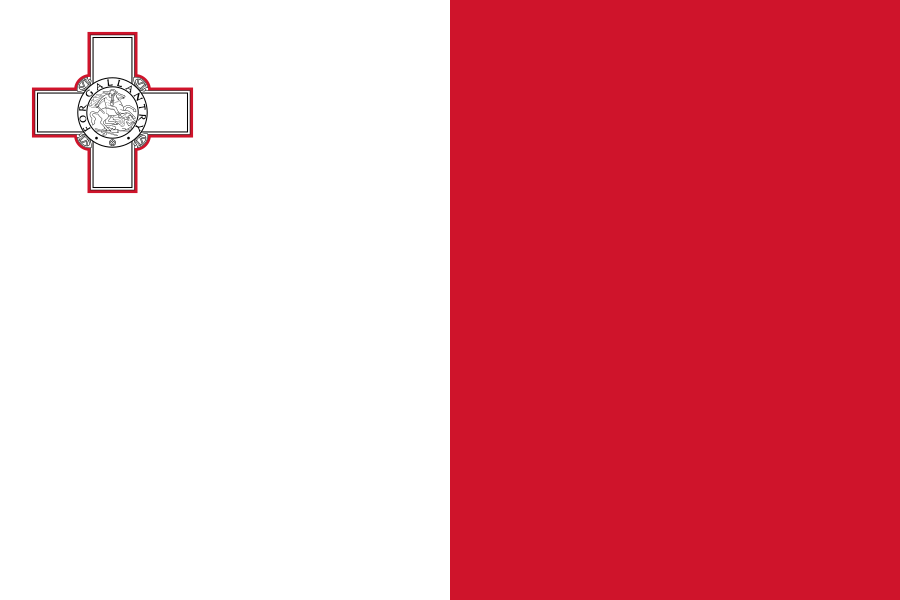
British general who negotiated the withdrawal from Saint-Domingue with Toussaint Louverture, later governor of Ceylon and Malta
A son of the 7th Earl of Lauderdale, he entered the army as a captain in 1778, became colonel and brigadier-general in 1798 and sat in Parliament for Haddington. Landing in Saint-Domingue in 1797 under orders to capture the colony, he saw his troops dying in droves of yellow fever and on his own judgment, not the War Ministry's, negotiated a total evacuation with Toussaint Louverture. By the secret agreement of 31 August 1798 Britain undertook not to attack Saint-Domingue or interfere in its affairs and Louverture made the same promise regarding Jamaica; the Maitland Convention of 1799 opened Le Cap and Port-Républicain to Anglo-American shipping. He was governor of Ceylon from 1805 to 1811 and of Malta from 1813 until his death, ruling so autocratically that he was called "King Tom".
Career timeline
- 1778Captain in the 78th Regiment of Foot
- 1790–1796MP for Haddington
- 1797–1799Commanded in Saint-Domingue; withdrawal agreements with Toussaint
- 1805–1811Governor of Ceylon
- 1813–1824Governor of Malta
- 1815–1823Lord High Commissioner of the Ionian Islands
Social reformer who emphasized education and cooperation
In A New View of Society (1816) Owen argued that “any general character may be given to any community by the application of proper means,” a principle he later tested at New Lanark and New Harmony.
A Welsh-born British manufacturer and social reformer, Owen sought to improve working, living and educational conditions at New Lanark. In A New View of Society he argued that environment and education form human character. He later pursued cooperative and communal experiments. Marx and Engels’ classification of Owen as a utopian socialist is a later, polemical interpretation. His early reform proposals should be distinguished from the International Working Men’s Association’s emphasis on workers’ self-emancipation.
Career timeline
- 1792Became manager of the Piccadilly Mill in Manchester.
- 1800Bought the New Lanark mills with partners in 1799 and managed them from January 1800.
- 1824–1827Led the New Harmony community experiment in Indiana, which was dissolved in 1827.
- 1828Settled in London, championing cooperatives, the trade union movement and child labour legislation.
- 1832Opened the National Equitable Labour Exchange, based on labour notes.
- 1834Briefly led the Grand National Consolidated Trades Union before its collapse in 1834.
- 1835Formed the Association of all Classes of all Nations and served as its first leader.