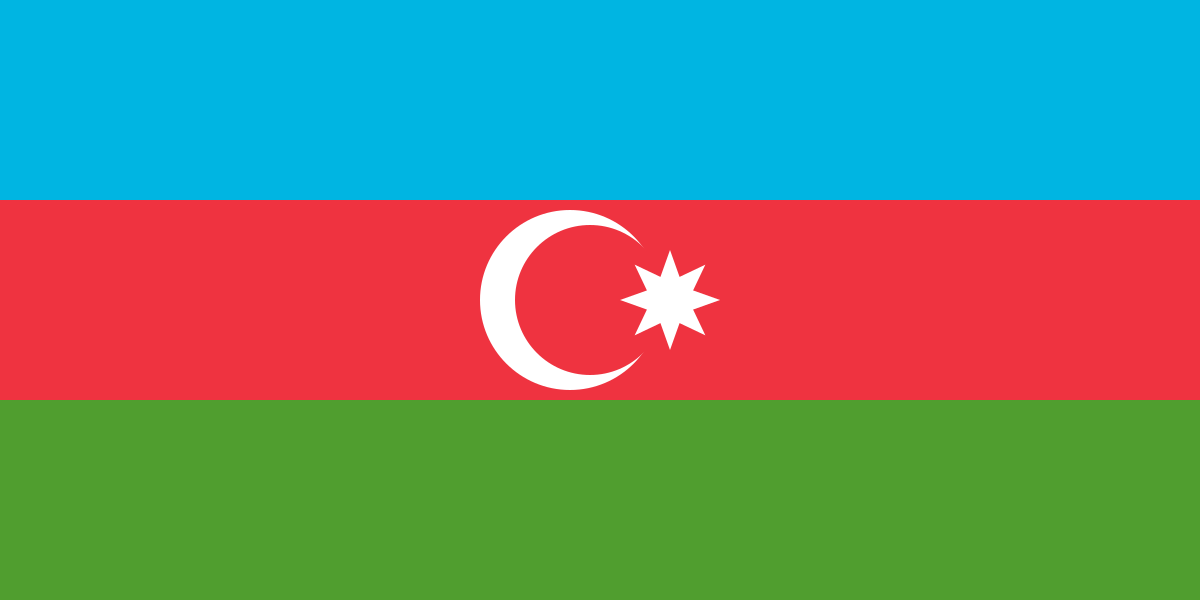
National background

Azerbaijan

19 people

People

Nariman Najaf oglu Narimanov

Нариман Наджаф оглы Нариманов
Formal heads of state Soviet Union Azerbaijan 1870–1925 ○ Heart attack

From Azerbaijani Enlightener to a Head of the Soviet State

When oil magnate Taghiyev tried to silence him at the 1906 Teachers' Congress, Narimanov renounced his scholarship and declared: "I will not be silenced for despicable metal while comrades shed blood against the tsarist yoke."

A teacher, physician, and writer, Narimanov opened a public reading room in Baku and produced some of the earliest works of Azerbaijani realist literature. After joining Hummet in 1905, he entered revolutionary politics, led the government of Soviet Azerbaijan from 1920, and later became a co-chairman of the USSR Central Executive Committee. His attempt to join national emancipation to socialism brought him into tension with centralizing nationalities policy; after his death in 1925, he was interred in the Kremlin Wall.

Career timeline
  • 1890Teacher in Kizil-Ajili village, Borchaly district
  • 1891–1902Teacher at Baku private progymnasium; founded and ran the 'Narimanov Reading Room' (1894)
  • 1895–1899Published plays and fiction incl. Bahadur and Sona (1896) and Nadir Shah (1899); translated and staged Gogol's The Government Inspector (1896)
  • 1905Joined the Muslim Social Democratic organisation Hummet
  • 1908Graduated from Novorossiysk University medical faculty, licensed physician
  • 1909–1914Arrested and exiled to Astrakhan for 5 years; practised medicine, organised Muslim theatre, chaired the Council of People's Universities
  • 1917Member of the Baku Bolshevik committee, editor of the newspaper Hummet
  • 1918Commissar for Municipal Economy, Baku Council of People's Commissars
  • 1919Head of the Near East Department, RSFSR People's Commissariat of Foreign Affairs
  • 1920–1922Chairman of the Azerbaijani Revolutionary Committee and Council of People's Commissars; concurrently People's Commissar for Foreign Affairs (1920–1921)
  • 1922Chairman of the Union Council, ZSFSR (Mar–Dec); member of the Soviet delegation to the Genoa Conference
  • 1922–1925Chairman of the USSR Central Executive Committee — one of the formal heads of the Soviet state
  • 1923–1925Candidate member, Central Committee of the Russian Communist Party (Bolsheviks)

Vsevolod Nikolayevich Merkulov

Всеволод Николаевич Меркулов
State security agencies Soviet Union Azerbaijan 1895–1953 ✕ Executed

The NKGB chief named first in the Katyn order, who wrote plays under a pseudonym

After Beria's arrest he wrote to Khrushchev of Beria signing a book he had not written: “How can one put one's signature under someone else's work. This is not even plagiarism, it is something more.” The hand that drew a line at literary dishonour drew none at the death lists of 22,000 Poles.

Merkulov was the most educated man in Beria's circle and, for a decade, his executive hand. He entered the Georgian Cheka in October 1921, where he met Beria, and by December 1938 he was the NKVD's number two. When the Politburo named a troika on 5 March 1940 to dispose of some 21,857 Polish prisoners without hearings or charges, the first name written in the decision was Merkulov's; the troika called no defendants and drew no indictments, it processed lists. After the Germans found the Katyn graves in 1943 he directed the preliminary work behind the Burdenko Commission's attribution of the massacre to the Germans, so the man who organised the killing organised the denial. He headed state security twice, until May 1946, and under the pseudonym Vsevolod Rokk wrote plays that reached the Maly Theatre. He was shot with Beria in December 1953 and has never been rehabilitated.

Career timeline
  • 1921–1931Georgian Cheka and GPU: Economic Department and Information Bureau
  • 1931–1934Assistant to the First Secretary of the Transcaucasian Regional Committee, Beria
  • 1934–1937Head of the Soviet Trade Department, then of the Special Sector, Transcaucasian Regional Committee
  • 1937–1938Head of the Industrial-Transport Department, Central Committee of the Georgian Communist Party
  • 1938Deputy chief of the Main Directorate of State Security, NKVD
  • 1938–1941First Deputy People's Commissar of Internal Affairs and chief of the GUGB
  • 1941People's Commissar of State Security, the first NKGB
  • 1941–1943First Deputy People's Commissar of Internal Affairs
  • 1943–1946People's Commissar of State Security, and from 1946 Minister of State Security
  • 1947–1950Chief of the Main Directorate of Soviet Property Abroad
  • 1950–1953Minister of State Control
  • 1953Arrested, tried and executed

Mir Jafar Abbasovich Bagirov

Мир Аббасович Джафар Багиров
Heads of government Soviet Union Azerbaijan 1895–1956 ✕ Executed

Azerbaijan's two-decade ruler and Stalin's viceroy in the Caucasus

At his trial, upon receiving the death sentence: "My guilt before the people is so great that it is not enough to shoot me, not enough to hang me — I must be quartered, torn to pieces."

First Secretary of the Azerbaijan Communist Party for two decades (1933–1953), ruling the republic through the Stalin era. He directed the Great Terror while driving industrialization and Baku's urban development. He fell immediately after Beria's arrest and was executed by shooting in 1956.

Career timeline
  • 1917Joined Bolsheviks (Mar 1917 or 1918 — disputed); deputy chairman, Quba Revolutionary Committee
  • 1918–1920Russian Civil War: regimental commander, divisional military commissar, chairman of Revolutionary Military Tribunal
  • 1921–1927Chairman of Cheka/GPU/OGPU and People's Commissar of Internal Affairs, Azerbaijan SSR
  • 1929–1930Chairman of GPU/OGPU, Azerbaijan SSR (second term)
  • 1932–1933Chairman, Council of People's Commissars, Azerbaijan SSR
  • 1933–1953First Secretary, CC of Communist Party of Azerbaijan (20 yrs); concurrently First Secretary of Baku City Committee until 1950
  • 1953Candidate member, CPSU Presidium (Mar–Jul); Chairman, Council of Ministers, Azerbaijan SSR
  • 1954–1956Arrested Mar 1954; sentenced to death Apr 1956; executed by shooting in Baku, 26 May 1956

Boris Lvovich Vannikov

Борис Львович Ванников
Heavy industry and military industry Soviet Union Azerbaijan 1897–1962 ○ Natural causes

Ammunition and atomic administrator under Beria

"Comrade Stalin, you were imprisoned by enemies, but I was imprisoned by our own."

Born to a Jewish oil worker's family in Baku, he rose from engineer to People's Commissar of Armaments in 1939. Arrested and tortured just before the war, he was summoned by Stalin after the German invasion and appointed Commissar of Ammunition, quadrupling shell production by war's end. After the war, he led the First Main Directorate alongside Kurchatov, building the administrative and industrial foundation of the Soviet atomic bomb project, and later oversaw hydrogen bomb development. He was one of the very few awarded the Hero of Socialist Labor three times.

Career timeline
  • 1930sRises through defense-industry and armaments production administration
  • 1941Arrested, then released after the war begins to return to ammunition production
  • 1941–1945Ammunition commissar directing mass production of shells and munitions
  • 1945–1953Handles atomic-bomb project administration in the First Main Directorate
  • 1953 이후Survives after Beria’s fall because of atomic-production expertise

Olga Grigoryevna Shatunovskaya

Ольга Григорьевна Шатуновская
Writers and artists Soviet Union Azerbaijan 1901–1990 ○ Natural causes

Khrushchev's chief investigator who traced Stalin's crimes to the end

"Nikita Sergeyevich, you know that I am not an enemy of the people." — a single line sent from exile to Khrushchev, 1954

An Old Bolshevik who joined the party at 15 in 1916. As chief investigator of the Shvernik Commission under Khrushchev, she proved in 64 volumes that the Kirov murder, Moscow show trials, and Katyn massacre were Stalin's fabrications. She survived eight years in Kolyma and was rehabilitated.

Career timeline
  • 1916Joins the RSDLP(b) at age 15
  • 1918Shaumyan's secretary in the Baku Commune; Turkish death sentence commuted
  • 1918–20Transcaucasian underground; courier of a secret letter to Lenin
  • 1920–37Party cadre in Baku, Bryansk, Moscow; Moscow City Committee org-dept head; CCC member
  • 1937–46Arrested; 8-year sentence in Kolyma Gulag
  • 1949–54Re-arrested; indefinite exile in Krasnoyarsk
  • 1956–62KPK member; Shvernik Commission chief investigator — exposed Kirov murder, Moscow trials fabrication, Katyn forgery
  • 1962Demands disclosure of Stalin's possible Okhranka ties; Khrushchev refuses; retires

Ivan Fyodorovich Tevosian

Иван Фёдорович Тевосян
Heavy industry and military industry Soviet Union Azerbaijan 1902–1958 ○ Natural causes

Metallurgy administrator of Stalinist industrialization

In 1930, appointed head of ferrous metallurgy at 28, he asked Ordzhonikidze to send him to the factory floor instead. He chose the furnace over the desk — and became the Soviet Union's master of steel.

An Armenian from Shusha, he trained at the Moscow Mining Academy and on the shop floor of the Elektrostal plant. Rising through the Special Steel Trust, he moved through defense industry and shipbuilding before becoming commissar for ferrous metallurgy in 1940. During the war he evacuated southern and central metal plants beyond the Urals and directed specialty steel production for tanks, aircraft and ammunition, earning the Hero of Socialist Labor title in 1943. After the war he led reconstruction as Deputy Premier and Minister of Ferrous Metallurgy, while also overseeing uranium supply for the Soviet atomic project. In 1938 his German internship nearly cost his life on suspicion of being a 'German spy,' but Stalin personally intervened.

Career timeline
  • 1920s–1930sRises through metallurgy and heavy-industry administration
  • 1939–1940As shipbuilding commissar, manages a key armaments production base
  • 1940–1953Manages wartime production across ferrous metallurgy, shipbuilding and transport machinery
  • 1949–1956Minister of ferrous metallurgy, involved in postwar heavy-industry reconstruction
  • 1956–1958Moves to ambassador to Japan, shifting from production administration to diplomacy

Lev Davidovich Landau

Лев Давидович Ландау
Science, nuclear and space development Soviet Union Azerbaijan 1908–1968 ○ Natural causes

Soviet theoretical physics titan who founded the 'Landau school' and pioneered quantum fluid dynamics

He rated physicists on a logarithmic scale by achievement: class 1 was Bohr, Heisenberg, Dirac. Einstein alone was class 0.5. He once placed himself at 2.5, later promoting himself to 1.5.

Soviet theoretical physicist. He founded the 'Landau school' in Kharkov, selecting disciples through his rigorous Theoretical Minimum exam, and pioneered condensed matter physics with his theories of superfluidity and Fermi liquids. His Course of Theoretical Physics with Lifshitz set the global textbook standard.

Career timeline
  • 1932–1937Head of Theoretical Department, UFTI · Professor at Kharkov University
  • 1937–1968Head of Theoretical Department, Institute for Physical Problems, Moscow
  • 1943–1947Professor of Low-Temperature Physics, Moscow State University
  • 1945–1953Participant in the Soviet atomic project · Three Stalin Prizes
  • 1946Elected full member (academician) of the USSR Academy of Sciences
  • 1962Nobel Prize in Physics for 'pioneering theories of condensed matter, especially liquid helium'

Nikolai Konstantinovich Baibakov

Николай Константинович Байбаков
Central planning agencies Soviet Union Azerbaijan 1911–2008 ○ Natural causes

Long-serving Gosplan chairman of the stagnation era

Some colleagues turned out to be scoundrels — they tried to brand me an enemy of the people. To dodge that filthy investigation, I joined the Red Army.

A Baku-born oil engineer who led the Soviet oil industry in his thirties, devising the 'Baibakov method' of high-pressure cement injection to revive waterlogged wells. During the war he carried out the dramatic Caucasus oilfield denial mission; afterward he drove the Romashkino field development that helped make the USSR a petroleum superpower. As Gosplan chairman for twenty years from 1965, he personified post-Kosygin-reform central planning and remained a mainstay of the Brezhnev-era administrative system until Gorbachev replaced him.

Career timeline
  • 1940sAs oil-industry commissar/minister, manages wartime energy supply
  • 1942Handles contingency work around Caucasus oilfields during the German advance
  • 1955–1957First term as Gosplan chairman
  • 1965–1985Chairman of the State Planning Committee, running planning after the Kosygin reform moment
  • 1985 이후Replaced under early Gorbachev, remaining a symbol of stagnation-era planning

Sabit Atayevich Orudzhev

Сабит Атаевич Оруджев
Heavy industry and military industry Soviet Azerbaijani 1912–1981 ○ Died in office

The Azeri engineer who built the Soviet gas industry into the world's largest

Landing on the bare tundra at the future Urengoy site in 1973, Orudzhev declared: "I am not Peter the Great, but I will borrow his words: here a city shall be built." From that moment, Novy Urengoy — Russia's 'gas capital' — was born.

An Azeri engineer from a Baku working-class family who built the Soviet gas industry into the world's largest. As Minister of the Gas Industry from 1972, he developed the West Siberian supergiant fields of Urengoy and Medvezhye and created the Unified Gas Supply System (ЕСГ), which remains the backbone of Russian gas power today.

Career timeline
  • 1936–1939Mechanic then production master, Ordzhonikidzeneft Trust, Baku
  • 1939–1946Manager then director of trusts under Azneft, Baku
  • 1946–1949Chief Engineer, Krasnodarneft; Head, Aznefterazvedka
  • 1949–1955Head of Main Directorates, USSR Ministry of Oil Industry
  • 1955–1957Deputy Minister of Oil Industry, USSR
  • 1957–1959Chairman of Sovnarkhoz, Dep. Chair of Council of Ministers, Azerbaijan SSR
  • 1965–1972First Deputy Minister of Oil-Extracting Industry, USSR
  • 1972–1981Minister of the Gas Industry, USSR

Kerim Aliyevich Kerimov

Керим Алиевич Керимов
Science, nuclear and space development Soviet Union Azerbaijan 1917–2003 ○ Natural causes

The long-hidden manager of crewed spaceflight

On April 12, 1961, Yuri Gagarin slept soundly before humanity's first spaceflight. Kerimov, monitoring the cosmonaut's sleep via bed sensors, spent a far more anxious night than the man about to ride the rocket.

His career began in World War II inspecting Katyusha rockets and gathering intelligence on the German V-2. He served on the State Commissions for Sputnik 1 and the Vostok programme, then chaired the State Commission for crewed flights from 1966 to 1991, twenty-five years in which he gave the final launch approval for every Soviet crewed mission. He was the administrative gatekeeper of Soviet crewed spaceflight's golden age, from Salyut and Soyuz-Apollo to Mir, yet his identity was kept strictly secret until perestroika.

Career timeline
  • 1966–1991State Commission chair for crewed spaceflight

Heydar Alirza oghlu Aliyev

Heydər Əlirza oğlu Əliyev
Socialist-bloc leader Azerbaijan Azerbaijan 1923–2003 ○ Natural causes

The KGB general who rose from Baku to the Kremlin and founded independent Azerbaijan

F. D. Bobkov, first deputy KGB chairman, asked him after three years: "What have you managed to achieve?" Aliyev replied: "I can guarantee only one thing — in the Central Committee of the Communist Party of Azerbaijan, no one takes bribes."

An Azerbaijani who served 28 years in Soviet state security, Aliyev rose from KGB chairman to First Secretary of the Azerbaijan Communist Party in 1969. Under Brezhnev, he drove rapid economic growth in the republic, expanding grape, oil, and cotton production, and became one of the few non-Slavs to reach the post of First Deputy Chairman of the USSR Council of Ministers and full Politburo member in 1982. Returning to Azerbaijan as it descended into civil war after the Soviet collapse, he became president in 1993, stabilized the country, and signed the 'Contract of the Century' for Caspian oil development, securing his legacy as the founder of independent Azerbaijan.

Career timeline
  • 1944–1967KGB Azerbaijan SSR: operative, head of counterintelligence, deputy chairman
  • 1967–1969Chairman, KGB under the Council of Ministers, Azerbaijan SSR (Major General)
  • 1969–1982First Secretary, Central Committee, Communist Party of Azerbaijan
  • 1976–1982Candidate member, Politburo CPSU → full member (1982)
  • 1982–1987First Deputy Chairman, USSR Council of Ministers (machine-building, light industry, transport, culture, education)
  • 1993–20033rd President, Republic of Azerbaijan

Abdurrahman Khalil oglu Vezirov

Əbdürrəhman Xəlil oğlu Vəzirov
Socialist-bloc leader Soviet Union Azerbaijan 1930–2022 ○ Removed · natural causes

Gorbachev's man for the Karabakh crisis who fled Baku as Black January consumed Soviet Azerbaijan

On the night of the 25th, Vezirov called to say 'catastrophe is brewing and we must ask Moscow for help': from Ayaz Mutallibov's recollections

First Secretary of the Azerbaijan Communist Party (1988–1990), appointed by Gorbachev as the Nagorno-Karabakh conflict spiraled. Of Karabakh descent and a career diplomat who had spent over a decade outside the republic, he was untainted by local corruption but could command neither the entrenched party clans nor the street. Having lost all control as mass protests and anti-Armenian pogroms convulsed Baku in January 1990, he fled to Moscow before Soviet troops opened fire on civilians, and was afterward blamed by the central government and Heydar Aliyev alike.

Career timeline
  • 1954–1956Secretary, then Second Secretary, CC Azerbaijan Komsomol
  • 1956–1959First Secretary, CC Azerbaijan Komsomol
  • 1959–1970Secretary, CC All-Union Komsomol
  • 1970–1976First Secretary, Kirovabad City Committee, then Head of Industry Dept, CC Azerbaijan CP
  • 1976–1979USSR Consul-General, Calcutta
  • 1979–1985USSR Ambassador to Nepal
  • 1985–1988USSR Ambassador to Pakistan; involved in Afghan withdrawal talks
  • 1988–1990First Secretary, CC Azerbaijan Communist Party

Kamran Mammad oglu Baghirov

Kamran Məmməd oğlu Bağırov
Socialist-bloc leader Soviet Union Azerbaijan 1933–2000 ○ Resigned; natural causes

Heydar Aliyev's successor who crumbled before the Karabakh crisis

In connection with the events that occurred in Nagorno-Karabakh and Sumgait, I recognize that I morally have no right to lead the party organization of the republic.

First Secretary of the Azerbaijan Communist Party (1982–1988), appointed after Heydar Aliyev was promoted to Moscow. Personally honest but politically inert, he proved unable to manage the cascading crises of February 1988, when the Nagorno-Karabakh Autonomous Oblast soviet voted for transfer to Armenia and the Sumgait pogrom erupted days later. Distrusted by Gorbachev, he resigned in May declaring that he 'morally had no right to lead the republic's party organization,' and withdrew entirely from public life thereafter.

Career timeline
  • 1949Mechanic, Baku gas office
  • 1957Graduated Azerbaijan Polytechnic Institute; assistant, senior lecturer, deputy dean of construction
  • 1968–1971Deputy Head, Construction and Public Utilities Dept, Council of Ministers, Azerbaijan SSR
  • 1971–1974Head, Construction and Urban Economy Dept, CC Azerbaijan CP
  • 1974–1978First Secretary, Sumgait City Party Committee
  • 1978–1982Secretary, CC Azerbaijan CP
  • 1982–1988First Secretary, CC Azerbaijan CP
  • 1990–1992Chairman, State Committee for Industrial Safety and Mining Control, Azerbaijan
Nationalities and federal management Soviet Union Azerbaijani 1934–1993 ○ Natural death

A Soviet republican leader who asserted institutional authority in crisis

“A state of emergency was declared and troops were sent in without the republic’s consent.”

Elmira Kafarova was an Azerbaijani Soviet politician and diplomat who moved through education and foreign-affairs administration before leading the republic’s Supreme Soviet. In January 1990, she publicly protested the declaration of emergency in Baku and the entry of Soviet troops, stating that the decision had been taken while she was in Moscow and without her knowledge. Her institutional dissent, unusual within the Soviet republican leadership, illuminates how the nationalities crisis became a collision among republican institutions, a mass movement, and Union power.

Career timeline
  • 1958Graduated from Azerbaijan State University; pursued philological research
  • 1966–1970First Secretary of the Komsomol Central Committee of the Azerbaijan SSR
  • 1971Ideology secretary of the Baku City Party Committee
  • 1980–1983Minister of Education of the Azerbaijan SSR
  • 1983–1987Minister of Foreign Affairs of the Azerbaijan SSR
  • 1987–1989Deputy Chair of the Council of Ministers of the Azerbaijan SSR
  • 1989–1990Chair of the Presidium of the Supreme Soviet of the Azerbaijan SSR
  • 1990–1992Chair of the Supreme Soviet of Azerbaijan

Abulfaz Gadirgulu oghlu Elchibey

Əbülfəz Qədirqulu oğlu Elçibəy
Socialist-bloc reform leader Azerbaijan Azerbaijan 1938–2000 ○ Natural causes

The pan-Turkist dissident who became Azerbaijan's first democratically elected president

During a 1992 visit to Ankara he declared: "I am a soldier of Mustafa Kemal Atatürk."

A leader of Azerbaijan's independence movement and its first democratically elected president after the Soviet collapse. Trained as an Arabic philologist, he served 18 months in prison in the 1970s for anti-Soviet activities, and in 1989 became the leader of the Azerbaijani Popular Front, the rallying point of nationalist forces. On 13 January 1990 he organized the National Defence Council, placing himself at the centre of the nationalities crisis that culminated in the anti-Armenian Baku pogrom and Black January. Elected president in 1992 as the first anti-communist leader of any former Soviet republic, he was overthrown in June 1993 by a Russia-backed military coup and Heydar Aliyev succeeded him.

Career timeline
  • 1957Graduated in Arabic philology, Faculty of Oriental Studies, Baku State University
  • 1963–1964Worked as a translator in Egypt
  • 1969–1974History lecturer, Baku State University → arrested (1975) for anti-Soviet activities, 18 months in prison
  • 1976–1992Researcher, Institute of Manuscripts, Azerbaijan Academy of Sciences
  • 1989–1992Chairman, Azerbaijani Popular Front
  • 1990.01Organized and chaired the National Defence Council, Baku
  • 1992–1993President, Republic of Azerbaijan
  • 1997–2000Leader, Azerbaijani Popular Front Party (in opposition)

Fuad Enver oglu Musayev

Fuad Ənvər oğlu Musayev
Party Secretariat and cadres Soviet Azerbaijani 1938–2017 ○ Died of kidney failure

First Secretary of the Baku Party Committee who blocked buses from entering Baku, shifting the violence to Sumgait

“I realized that it was a pogrom. I ordered all roads to the city blocked from these settlements. The order was executed. The buses went to Sumgait.”

A Soviet and Azerbaijani party and state official who rose through the construction sector to become First Secretary of the Baku City Party Committee in 1983. In February 1988, as buses carrying Azerbaijani refugees expelled from Armenia converged on Baku, he ordered the city's access roads blocked; the measure kept violence out of Baku but diverted the bus convoys to Sumgait, where the pogrom erupted days later. After the dissolution of the USSR, he served as the first president of independent Azerbaijan's football association (1992–2003), steering the country into UEFA and FIFA membership.

Career timeline
  • 1975–1977First Deputy Minister of Rural Construction, Azerbaijan SSR
  • 1977–1981First Deputy Chairman, State Planning Committee, Azerbaijan SSR
  • 1981Deputy Chairman, Council of Ministers, Azerbaijan SSR
  • 1981–1983Secretary for Construction, Central Committee, Communist Party of Azerbaijan
  • 1983–1988First Secretary, Baku City Party Committee
  • 1989–1990Chairman, State Committee for Industrial Safety and Mining Supervision
  • 1990–1991Secretary for Industry, Central Committee, Communist Party of Azerbaijan
  • 1992–2003President, Association of Football Federations of Azerbaijan (AFFA)

Ayaz Niyazi oghlu Mutalibov

Ајаз Нијази оғлу Мүтәллибов
Socialist-bloc leader Azerbaijan Azerbaijani 1938–2022

The last Soviet leader caught between a renewed union and independence

He supported a new union treaty from the view that the federation should exist for the republics.

Ayaz Mutalibov was a politician who rose from the Soviet Azerbaijani bureaucracy to become the republic’s last Communist leader and its first president. At the 1991 Novo-Ogaryovo 9+1 talks, he supported a renewed union that would guarantee republican sovereignty, arguing that the federation should exist for the republics, and he took an active position on the status of autonomous republics. His government confronted the Nagorno-Karabakh war and mounting domestic struggles, which ultimately destroyed its political base. Ousted in 1992, he lived in exile in Moscow, returned to Azerbaijan in 2012, and died in Baku in 2022.

Career timeline
  • 1964–1977Director of the Baku Refrigerator Factory, then general director of a state industrial combine
  • 1977–1979Second secretary of the Narimanov District Party Committee in Baku
  • 1979–1982Minister of Local Industry of the Azerbaijan SSR
  • 1982–1989Chairman of the State Planning Committee and deputy chairman of the Council of Ministers of the Azerbaijan SSR
  • 1989–1990Chairman of the Council of Ministers of the Azerbaijan SSR
  • 1990–1991First secretary of the Azerbaijan Communist Party and president of Soviet Azerbaijan
  • 1991–1992First president of Azerbaijan
  • 1992–2012Exile in Moscow after his ouster, followed by a return in 2012

Etibar Salidar oglu Mammadov

Etibar Səlidar oğlu Məmmədov
Socialist-bloc leader Azerbaijan Azerbaijan 1955– ○ Natural causes (still living)

Deputy chairman of the Azerbaijani Popular Front who warned Primakov there would be resistance

Polyanichko told him that at midnight troops would enter the city "whatever the cost." Mammadov replied that the army would meet resistance.

As deputy chairman of the Azerbaijani Popular Front, Etibar Mammadov stood at the forefront of the national independence movement and met with Yevgeny Primakov and Viktor Polyanichko on January 19, 1990, where he was warned that troops would enter Baku. That evening Polyanichko told him the army would go in "whatever the cost"; Mammadov replied there would be resistance, and he later became a key witness to the Kremlin's bloody crackdown on the city. He went on to found the Azerbaijan National Independence Party, finished second in the 1998 presidential election, and remained a durable opposition leader in independent Azerbaijan.

Career timeline
  • 1978–1988Lecturer in history, Baku State University
  • 1988–1991Deputy chairman and board member, Azerbaijani Popular Front
  • 1990.01–11Imprisoned at Lefortovo Prison (arrested after Black January)
  • 1990–2000Deputy, Supreme Soviet of Azerbaijan SSR / National Assembly
  • 1991Member, National Defence Council; co-authored the Constitutional Act on State Independence
  • 1992–2004Founder and chairman, Azerbaijan National Independence Party (NIPA)
  • 1998, 2003Presidential candidate (1998: 2nd place, 11.6%; 2003: 4th place, 2.92%)

Jahangir Movsum oglu Muslimzade

Cahangir Mövsüm oğlu Müslümzadə
Socialist-bloc leader Soviet Azerbaijani 1945– ↓ Dismissed and expelled, 1988

The Sumgait party boss handed a flag and photographed at the head of the mob

Left isolated by the crowd, the republic flag thrust into his hands, Muslimzade walked where the mob led him; the scene was filmed and sent to the Party Central Committee.

A Komsomol careerist who rose to first secretary of the Sumgait city party committee, he was the party official who faced the crowd at the outset of the February 1988 Sumgait pogrom and, in attempting to calm it, found himself handed an Azerbaijan SSR flag and photographed leading the march. Muslimzade later maintained that he was steering the column away from the Armenian district toward the sea, but the tail of the procession splintered into groups that fanned out into Armenian neighbourhoods. Dismissed from all posts and expelled from the party days after the pogrom, he became both a scapegoat for the violence and an enduring symbol of the party's loss of control.

Career timeline
  • 1971–1974Instructor, Press Department, Ministry of Communications, Azerbaijan SSR; secretary, 26 Baku Commissars District Committee, Komsomol
  • 1974–1978Head of Komsomol Organisations Dept, CC Komsomol of Azerbaijan; Chairman, Committee of Youth Organisations; instructor, Organisational-Party Work Dept, CC CP Azerbaijan
  • 1978–1985First Secretary, Central Committee of the Lenin Komsomol of Azerbaijan
  • 1985–1988First Secretary, Sumgait City Committee, Communist Party of Azerbaijan
  • 1989–1991Vice-President, Azerbaijan Association of Joint Ventures and International Unions
  • 1991People's Deputy, Supreme Council of the Republic of Azerbaijan