Finland: independence and civil war
Why did Finland, having declared independence in December 1917, fall into a civil war between the Red Guards and the Civil Guards within a month, what part did Soviet Russia and Germany play in it, and how was the eastern border settled by the Treaty of Tartu in 1920?
Having regained its autonomy in the Russian Revolution and declared independence in December 1917, Finland split in January 1918 into a Red south and a White north. Soviet Russia helped the Red Guards, but Mannerheim’s Whites and the German Baltic Sea Division took Tampere, Helsinki and Viipuri in turn, and executions and prison camps after the fighting accounted for a large share of the more than 30,000 dead. The plan for a German king collapsed with Germany’s defeat, and the republic, after expeditions into East Karelia, made the Treaty of Tartu with Soviet Russia in 1920.
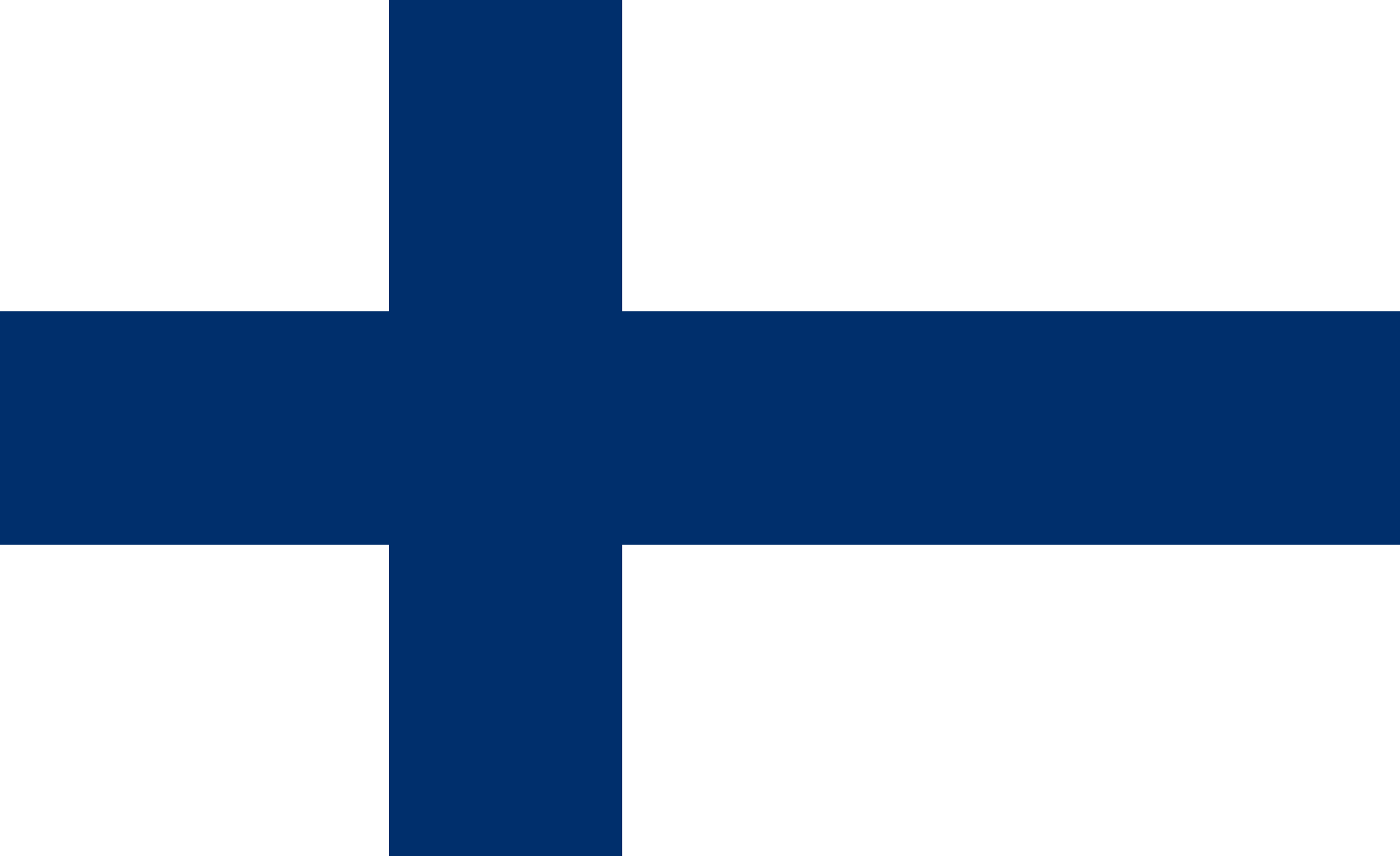
 From grand duchy to independence: 1917
A grand duchy of the Russian Empire since 1809, Finland was an autonomous state with its own budget and its own currency, the markka. After Russification began in 1899, however, the Tsar repeatedly dissolved the parliament between 1908 and 1917 and appointed the Senate as he pleased. The 1906 reform had nonetheless created a unicameral parliament elected by universal suffrage, women included, and the Social Democratic Party had become, relative to population, larger than any other socialist party in the world. When the February Revolution removed Nicholas II, the Russian Provisional Government's manifesto of 15 March restored the autonomy of 1809–1899. Oskari Tokoi of the Social Democrats, who had won an absolute majority in 1916, formed a Senate in March of six Social Democrats and six non-socialists, the world's first social democratic head of government. Power, however, slipped into the streets. Grain imports from southern Russia stopped, food shortages, unemployment and inflation piled up, and strikes for the eight-hour day and higher wages swept industry and farms. In July parliament passed the Power Act with the votes of the Social Democrats, the Agrarian League and others: all legislative power except foreign and military affairs lay with parliament, which alone could dissolve itself. The Regional Committee of the Finnish Soviets, led by the Bolshevik Ivar Smilga, promised to defend the parliament if it were attacked. But the Provisional Government survived the July Days, refused to accept the Act and, with the cooperation of Finnish conservatives, dissolved the parliament and sent more Russian troops. 1 2 3
In the elections of 1–2 October the Social Democrats gained votes but lost their absolute majority, and the non-socialist parties together won more than half the seats. The defeat radicalised the labour movement. When the Bolsheviks took power in Petrograd on 7 November, the Finnish parliament adopted a compromise put forward by the Agrarian leader Santeri Alkio: on 15 November it assumed supreme power on the basis of the Power Act and ratified the eight-hour day and universal suffrage in local elections. The same day the Soviet government proclaimed the right of the peoples of Russia to self-determination, including complete secession. On 1 November the Social Democrats had issued their programme We Demand, calling for a return to the situation before the July dissolution, the disbanding of the Civil Guards and elections to a constituent assembly; when it was rejected they called a general strike for 14–19 November. The strike leadership voted narrowly for revolution on the 16th, then called it off the same day for lack of activists to carry it out. Lenin and Stalin were urging the Finnish Social Democrats to take power, and according to Russian-language sources Joseph Stalin, the People's Commissar for Nationalities, addressed the party congress in Helsinki in person on 14 November. Most Finnish socialists, however, were moderates who preferred parliamentary methods, and the Bolsheviks called them "reluctant revolutionaries". During the strike the Finnish Red Guards executed several political opponents in the south and the first armed clashes took place; 34 people died. On 27 November the purely non-socialist Senate of Pehr Evind Svinhufvud was appointed, with the aims of separating Finland from Russia and strengthening the Civil Guards. 4 1 2 5
Svinhufvud's Senate laid the declaration of independence and a bill for a republican form of government before parliament on 4 December, and parliament adopted the declaration on 6 December. The Social Democrats voted against the Senate's text and offered their own declaration of sovereignty, but both camps supported independence as such. The conservatives hurried secession in order to contain the left and limit Bolshevik influence; the socialists distrusted sovereignty under conservative rule but feared losing nationalist workers. Independence still needed Russia's recognition. The socialists, who had been reluctant to negotiate with the Russian leadership in July, now sent two delegations to Petrograd to ask Lenin for it. Under heavy German pressure at Brest-Litovsk, Vladimir Lenin calculated that the Bolsheviks could hold the centre of Russia but had to give up peripheral territories such as Finland in the north-western corner. On the night of 31 December Svinhufvud's delegation received the Sovnarkom's decision recognising independence at the Smolny; Lenin, after an embarrassed refusal, came out into the corridor and shook Svinhufvud's hand. The All-Russian Central Executive Committee approved the decision on 4 January 1918. Soviet Russia was the first government outside Finland to recognise its independence. By the outbreak of the civil war Germany, Sweden, France, Austria-Hungary and others had followed, but Britain and the United States held back, watching Finland's ties with Germany. English-language sources explain that the Bolsheviks also hoped a communist revolution would one day bring Finland back to them. 2 1 6 7
Two armed camps: Red Guards and Civil Guards
The February Revolution dissolved the Finnish police, and in the vacuum both right and left set up their own security groups. At first they were local and largely unarmed, but by late 1917, with parliament dissolved and no strong government or national army, they became increasingly paramilitary. On the right, conservative academics, industrialists, major landowners and activists organised the Civil Guards (suojeluskunnat), later called the White Guards. Their number grew from 149 on 31 August 1917 to 251 at the end of September, 315 at the end of October, 380 at the end of November and 408 on 26 January 1918. In September a 200-strong cavalry school was set up on the Saksanniemi estate near Porvoo. There was also the Jäger battalion of some 1,900 Finnish volunteers trained in Germany in 1915–1917; its vanguard and German weapons arrived in October–November aboard a freighter and the German submarine UC-57, and around 50 Jägers were back by the end of the year. On the left, Workers' Order Guards were recruited through local Social Democratic branches and trade unions, and a minority of them were Red Guards in the tradition of 1905–1906. After the election defeat, the labour movement called on 20 October for more units, and the guards multiplied to 100–150 at the end of October, 342 at the end of November and 375 on 26 January 1918. Yet even the largest guard in Helsinki had only 20–30 military rifles. The coexistence of two armed forces split society into a state of dual power, and the decisive break came during the general strike. 1 8
The Russian army was still in Finland too. In January 1918 about 50,000 troops of the former Tsarist army were stationed there, demoralised, war-weary peasants hungry for the land the revolution had freed; most of them returned to Russia by the end of March. In early January the Red Guard commander-in-chief Ali Aaltonen went to Petrograd to buy weapons. There he took to drinking and for a while nobody knew where he was; on 13 January the Red Guard staff decided to fill his post quickly, but the same day Aaltonen reported that 10,000 rifles and 10 field guns would arrive within a few weeks. At the same time the Civil Guards were preparing to receive 60,000 rifles from Germany. The first local battles were fought between 9 and 21 January in southern and south-eastern Finland, mostly in the arms race and for control of Viipuri; at Taavetti station in Luumäki the Civil Guards seized 200 rifles. On 12 January parliament authorised the Svinhufvud Senate to establish order, and on 15 January Carl Gustaf Emil Mannerheim, a former general of the Imperial Russian Army, was appointed commander-in-chief of the Civil Guards, which the Senate designated as Finland's White Army. Mannerheim set up his headquarters in the Vaasa–Seinäjoki area on the west coast, issued the order to engage on the 25th, and obtained weapons by disarming the Russian garrisons of southern Ostrobothnia on 21–28 January. According to Russian-language sources the Russian garrisons in the north put up almost no resistance. 1 9 8 5
27–28 January 1918: Finland split in two
The Red Guards refused to accept White supremacy and set up a military authority of their own. Aaltonen established his headquarters in Helsinki and nicknamed it Smolna, after the Bolsheviks' Smolny. The Red order of revolution was issued on 26 January, and a red lantern, the signal of the rising, was lit in the tower of the Helsinki Workers' House. The Helsinki Red Guard and some units along the Viipuri–Tampere railway had been activated on 23–26 January to secure key points and escort a heavy shipment of Bolshevik weapons from Petrograd, and mass mobilisation began late on the 27th. Whites trying to seize the shipment clashed with Reds at Kämärä on the Karelian Isthmus that day, and 20–30 Finns died. On the 28th the Red Guards took control of Helsinki. The same day Social Democrats set up a revolutionary government against the Senate, the Finnish People's Delegation, chaired by Kullervo Manner, party chairman and Speaker of Parliament in 1917. Edvard Gylling took finance, Otto Wille Kuusinen education and Oskari Tokoi supply. Eero Haapalainen, a trade union leader without military training, replaced Aaltonen as commander-in-chief that day and joined the Delegation. The Delegation was supervised by the Central Workers' Council, and locally workers' councils replaced the old municipal authorities, keeping order, rationing food and running workplaces. But senior and middle-ranking officials of the old administration refused to cooperate, and new staff had to be chosen and trained from among junior clerks. 1 10 9 11 12 13
The leaders of Red Finland envisaged a path different from Lenin's dictatorship of the proletariat. Kuusinen's draft constitution of 23 February, influenced by the Swiss and American constitutions and the French Revolution, concentrated power in parliament with a lesser role for the government. It provided for a multi-party system, freedom of assembly, speech and the press, and wide use of referendums; to safeguard the labour movement it gave the people a right to "permanent revolution", and it would have transferred much of property to the state and local administrations. The concept of the dictatorship of the proletariat was absent. The draft was never finalised, however, and in practice a regime born of revolution and civil war leaned on violence, including political terror. The socialists themselves had to ask whether power won by revolution could give democracy a real chance, since restoring the strength they had held in parliament until July 1917 was one of the main aims of the January revolution. On territory, too, Red Finland did not abandon nationalism. Most Reds wanted a neutral, independent Finland, and some demanded that Aunus, Viena Karelia and Petsamo be joined to it. Only the Finnish Bolsheviks, few but influential in the Red Guards, supported annexation by Russia. Expansionists in the White camp coveted the same lands, so a Greater Finland was a dream shared across the divide. 10 1
The government of White Finland was Svinhufvud's Senate, called the Vaasa Senate because it made the west-coast town of Vaasa its capital from 29 January to 3 May. Svinhufvud himself hid in Helsinki, sending pleas for intervention to Germany and Sweden, before escaping to Vaasa via Berlin and Stockholm in March. According to Russian-language sources, Kaarlo Juho Ståhlberg, Kyösti Kallio and other politicians stayed hidden in Helsinki until the Germans arrived. Between 28 January and 3 February a front line running east–west across southern Finland took shape and changed little until the White offensive in March. The Red Guards held the south, with nearly all the large towns and industrial centres and the big estates with the most crofters and tenant farmers. The Whites held the agrarian north, with small and medium farms and crofters of better standing. Each side held enclaves behind the other's lines, such as the industrial towns of Varkaus, Kuopio and Oulu in White territory and Porvoo in Red territory. Each side fielded 70,000–90,000 Finns, with around 100,000 rifles and 300–400 machine guns. The Red Guards were mainly volunteers paid wages at first and included 2,600 women; the White Army was mostly conscripts, with 11,000–15,000 volunteers. Urban and rural workers made up most of the Red Guards, landowning farmers and the educated the backbone of the White Army. When the Whites began conscription in February, 30,000 labour supporters never reported. Both sides used boy soldiers aged 14 to 17. 1 10 6 5
 Soviet Russia and Red Finland
Soviet Russia supplied weapons and some men, but fewer men than is often assumed. Some 4,000–5,000 Red Russian soldiers supported the Finnish Reds, but only about 3,000, in separate small units of 100–1,000, fought at the front. Russian officers were divided. Mikhail Svechnikov led Finnish Red troops in western Finland in February and Konstantin Yeremeyev commanded Soviet forces on the Karelian Isthmus, while other officers, distrusting their revolutionary peers, cooperated with Mannerheim in disarming Russian garrisons. On 30 January Mannerheim told the Russian soldiers in Finland that the White Army was not fighting Russia but the Finnish Reds and the Soviet troops helping them. White propaganda nonetheless painted the war as a defensive struggle against Russian Bolsheviks and played down the Finns among the enemy. Weapons mattered more. In early February a train commanded by Jukka Rahja arrived from Petrograd with 15,000 rifles, machine guns, artillery and 2 million cartridges that Aaltonen had bought from the Bolsheviks. According to Russian-language sources, Lenin had promised military help as early as 13 January. The Reds also flew aircraft, but having no Finnish pilots they relied mostly on Russians, and poor command, fuel and maintenance kept their air effort ineffective. 1 8 5
On 1 March the People's Delegation and the Sovnarkom signed a treaty in Petrograd, Lenin and Stalin for the Soviet side, Edvard Gylling and Oskari Tokoi for the Finnish. The name "Finnish Socialist Workers' Republic" appears only in this treaty: the Delegation had been using "Republic of Finland", Lenin proposed adding "Socialist Workers' Republic" during the talks, and the Delegation later blamed its negotiators, saying the Finns themselves should have chosen the name. Gylling, the prime mover of the talks, hoped to reduce Russian influence in Finland and open the way to peace talks with White Finland. The negotiations showed that even between two socialist governments nationalism counted for more than international socialism. There were major disputes over the border between Red Finland and Soviet Russia; the Finns obtained Petsamo, but Aunus and Viena were left open. According to English-language sources Lenin, who had stressed self-determination before the revolution, leaned towards federalism once in power and expected Finland eventually to be joined to Russia. The treaty lost its significance quickly when the Treaty of Brest-Litovsk was signed two days later. Both unstable socialist states were absorbed in their own civil wars, and the fate of Red Finland was decided by power politics between Russia and Germany. 10 12 3 1
When Germany resumed its attack on Russia on 18 February, the number of Soviet soldiers fighting in Finland fell sharply. The Treaty of Brest-Litovsk of 3 March required Russian forces to leave Finland, and Bolshevik support was restricted to weapons and supplies. According to Russian-language sources, after the German Foreign Office protested on 30 March that Red Guards from Petrograd were still crossing into Finland in large groups, Lenin on 1 April forbade the official dispatch of troops to help the People's Delegation. Soviet units nonetheless fought on the Karelian Isthmus in the Battle of Rautu from February to April, defending the approaches to the capital. The Baltic Fleet left Helsinki too. Moved there from Tallinn on Lenin's orders in February, it broke through the ice with the help of icebreakers before the Germans arrived, and all its ships had reached Kronstadt and Petrograd by 22 April; they later played an important part in the defence of Petrograd. Pro-Red Russian troops still in Helsinki took no part in the battle for the city, in accordance with the treaty. On 11 May, at German insistence, some 2,100 former Russian subjects remaining in Helsinki were expelled. English-language sources judge that by agreeing at Brest not to meddle in the Finnish war, the Bolsheviks left the Finnish communists without the aid they had been promised. Russia's withdrawal in effect handed Red Finland's fate to Germany. 1 5 14 15 13
The Battle of Tampere
From February to early March the Red Guards mounted a general offensive along the front, but a chronic lack of skilled leaders left most attacks fruitless; field commanders were often elected by their men, and training and discipline were poor. On 20 March Haapalainen was removed as commander-in-chief after a series of defeats and replaced by the Bolshevik triumvirate of Eino Rahja, Adolf Taimi and Evert Eloranta. The Whites had two advantages: a professional command of Mannerheim, 84 Swedish volunteer officers and Finnish officers of the former Tsarist army, and 1,450 Jägers, most of whom arrived in Vaasa on 25 February. Hardened on the Eastern Front, the Jägers began rapid training of six conscript regiments at the end of February; 450 Jägers considered likely to side with the Reds were left in Germany. Mannerheim weighed whether to strike first at the industrial town of Tampere or at Viipuri, Karelia's main city, and judging Viipuri too risky he chose Tampere, a workers' town held by some 15,000 armed Red Guards. On 16 March he launched the main assault through the right flank of the Red defences at Längelmäki, 65 kilometres north-east of the town, while attacking along the north-western front at the same time. Some Red units collapsed and fled; others held their posts to the last. On the 24th the Whites cut the southern link at Lempäälä and on the 25th the western ones, encircling Tampere. The 1,000-strong Swedish Brigade of volunteers took part. 1 16
The Battle of Tampere pitted 16,000 Whites against 14,000 Reds in Finland's first large-scale urban battle. The fight for the town began on 28 March, on the eve of Easter, at the Kalevankangas Cemetery, a day later remembered as "Bloody Maundy Thursday". The Whites, some of whose units lost more than half their men, failed to win a decisive victory and had to reorganise. In the early hours of 3 April, after a heavy artillery barrage, they broke into the centre and advanced house by house and street by street, reaching the eastern bank of the Tammerkoski rapids that evening. Red attempts to relieve the town from outside along the Helsinki–Tampere railway all failed, among them a 3,500-strong counterattack at Lempäälä led by Eino Rahja. The Reds lost the western parts of the town on 4–5 April, and the City Hall was among their last strongholds. The battle ended on 6 April with the surrender of the Reds in Pyynikki and Pispala. Fighting harder on the defensive, the Reds forced Mannerheim to commit the best-trained Jäger detachments he had been saving for Viipuri. The Reds had capable local commanders such as Hugo Salmela at Tampere, but they could not change the course of the battle. On the last night Aaltonen led a unit through the siege and escaped across the ice of Lake Näsijärvi. 1 16 9
Tampere was the bloodiest battle of the war. The Whites lost 700–900 men, including 50 Jägers, the battalion's heaviest loss in any single battle of 1918. The Reds lost 1,000–1,500 killed and 11,000–12,000 captured. Seventy-one civilians died, mainly from shelling, and the eastern part of the town, built largely of wood, was completely destroyed. The Whites began executing surrendered Reds immediately. According to English-language sources, 1,000 Reds and 200 Russians, most of them soldiers, were executed after the battle. Leaflets in Mannerheim's name promised that prisoners would not be shot, yet one unit executed 20 surrendered Reds in the yard of the Näsinlinna palace. The prisoners were taken to a camp in the Kaleva district east of the centre, where 1,228 died of execution, disease or hunger over the next five months. According to some sources a mass grave at Kalevankangas Cemetery holds 2,751 Reds, 1,208 of them killed in action. After Tampere fell, the number of prisoners became too large for the Whites to go on shooting most captured Reds as before, and the war's first large camp was set up there. The defeat marked the beginning of Red Finland's collapse. On 8 April the People's Delegation left Helsinki for Viipuri, and on the 10th the Reds reorganised their whole administration, giving Kullervo Manner the supreme command and dictatorial powers. 1 16 17 10 13
 German intervention: from Hanko to Viipuri
Germany had not set its sights on Finland from the start. Finnish activists had repeatedly asked for German help since the February Revolution, but Germany, under pressure on the Western Front, did not want to jeopardise its armistice and peace talks with Soviet Russia. That changed on 10 February 1918, when Leon Trotsky broke off the talks at Brest in the hope of revolution in Germany. On the 13th the German leadership decided to retaliate by sending troops to Finland as well, inviting "requests for help" from Russia's western neighbours as a pretext; White Finland's representatives in Berlin duly made one on the 14th. Mannerheim wanted German weapons but opposed actual German intervention, trusting the Jägers and the demoralisation of the Russian army. The Vaasa Senate, however, relied on German military and political aid, and social liberals who had at first resisted it changed their minds as the war dragged on. The agreements of 7 March bound White Finland to the German sphere of influence. The German war leader Erich Ludendorff wanted to keep Petrograd under threat via the Viipuri–Narva area and to install a German-led monarchy in Finland. The Finnish Senate paid the full cost of the intervention and urged Finns to provide the German troops with food and shelter. According to Russian-language sources, Wilhelm II replied on 7–8 March that Germany would not wage war for Finnish interests against a Soviet government that had signed the Brest treaty, nor support Finnish military action beyond Finland's borders. 1 18 19
On 5 March a German naval squadron landed on the Åland Islands, which a Swedish expedition had occupied since mid-February and left in May. On 3 April the 10,000-strong Baltic Sea Division under Rüdiger von der Goltz landed unopposed at Hanko, west of Helsinki; just beforehand Russian sailors scuttled four submarines in Hanko harbour. On the 7th Colonel Otto von Brandenstein's 3,000-strong detachment took Loviisa east of Helsinki. Russian-language sources put the total of German troops in Finland at 14,000–15,000. At dawn on 12 April 2,000–3,000 German soldiers attacked Helsinki from the north-west, while Vice Admiral Hugo Meurer's squadron blocked the harbour, shelled the southern districts and landed marines. Around 7,000 Reds held the Workers' Hall, the railway station, Smolna and the Senate area, but their best troops were on other fronts, and Helsinki White Guards who had been in hiding joined the Germans as they advanced. On the 13th the Germans pushed into the working-class districts and shelled the Workers' Hall, putting out the red lantern of the Finnish revolution; at about 2 p.m. a white flag went up on the tower of the Kallio church. Sixty Germans, 300–400 Reds and 23 White Guards were killed, and around 7,000 Reds were captured. The Germans held a victory parade in the city on the 14th, then pushed on through Hyvinkää and Riihimäki to Hämeenlinna on the 26th. At Hyvinkää at least 150 Reds were executed by the Whites after the battle. 1 18 20 15 14 5
On 19 April Detachment Brandenstein took Lahti, cutting the western Red Guards off from the eastern ones. Between 22 April and 1 May several thousand western Reds and Red refugees tried to break through around Lahti on their way to Russia, but were held. Six hundred Reds and 80 Germans died, and 30,000 Reds were captured in and around the town. The long Red columns, which included women and children, suffered heavily under White attacks; for the Reds it was a "road of tears", for the Whites the sight of enemy caravans heading east was a moment of victory. Meanwhile the Whites turned to Viipuri, where 18,500 Whites faced 15,000 Reds. Having cut the Reds' link to Petrograd on the Karelian Isthmus on 20–26 April, they opened the final assault late on the 27th with a heavy Jäger artillery barrage, and in the early hours of the 29th took Patterinmäki, the symbolic last stand of the Red rising. Four hundred Whites and 500–600 Reds died, and 12,000–15,000 Reds were captured. The People's Delegation had already left for Petrograd by sea, and the flight of the leadership embittered many Reds. Haapalainen and Gylling stayed in Viipuri to organise its defence and escaped to Petrograd by motorboat in May. The last Red strongholds between Kouvola and Kotka fell by 5 May, and the war ended on the 15th, when the Whites took over Fort Ino, a Russian coastal artillery base on the Karelian Isthmus, from the Russian troops. On the 16th White Finland held a great victory parade in Helsinki led by Mannerheim. 1 21 22 11 5
Terror and the prison camps
Both sides used executions as political violence, known in Finland as the White Terror and the Red Terror. It combined a calculated part of the war planned by commanders with local, personal killings and revenge. At least a third of the Red Terror and most of the White Terror was centrally directed. In February the White high command set up a Desk of Securing Occupied Areas and issued Instructions for Wartime Judicature, later called the Shoot on the Spot Declaration, which let field commanders execute essentially anyone they saw fit. According to Russian-language sources, on 25 February Mannerheim ordered that anyone offering "armed resistance to the lawful forces" or "carrying arms without the army's knowledge" be shot on the spot. No order authorising Red Terror by the less organised Red Guard leadership has been found. Many executions were carried out by mounted Flying Patrols of 10 to 80 youths aged 15 to 20 under an adult leader with absolute authority. The Reds executed influential Whites, politicians, landowners, industrialists, police officers, civil servants, teachers and White Guards, and killed ten Lutheran priests and 90 moderate socialists. Executions peaked in February, as the Reds secured power, fell in March, when they could not take new ground, and rose again in April as they prepared to leave Finland. The two main centres of Red Terror were Toijala and Kouvola, where 300–350 Whites were executed from February to April. During the battle for Viipuri a drunken band of Reds entered Viipuri County Gaol and murdered 30 White Guard prisoners. 1 5 23
Comprehensive White Terror began with the general offensive in March, grew steadily and peaked at the end of the war; between late April and early May 200 Reds were shot a day. Its targets were Red Guard and party leaders, socialist members of parliament, local Red administrators and workers, and it was especially harsh on Russian soldiers who had helped the Finnish Reds. When Viipuri fell on 28–29 April, the Vaasa and Kajaani regiments of the White army killed people taken to be Russians at the Annenkrone fortifications, in the yard of Viipuri Castle and in the streets. Estimates range from some 50 to 500–600; Lars Westerlund puts the toll at 360–420. Thirty-seven of the dead were of other nationalities, Polish soldiers, Ukrainians, Estonians, Jews and Tatars. Most had no link to the Red Guards, and many had greeted the Whites as liberators. Mannerheim ordered an investigation and punishment when he heard of the killings on 2 May, and the next day Rudolf Walden telegraphed orders to prevent violence against innocent Poles, Ukrainians and Russians, but no one was ever charged. Overall figures differ slightly by source: English-language sources give about 1,500 victims of Red Terror and about 9,000 of White Terror, while another, citing the Finnish war victims database, gives about 1,600 and 8,100. White victims were recorded precisely; the number of Reds executed immediately after battles remains unclear. 1 23 24
When the war ended on 15 May, the Whites and Germans held about 80,000 Reds and their families, including, depending on the source, 4,700–5,000 women and 1,500 children, as well as some 8,000 Russians. Over the next two months they were moved from more than 60 small camps into 13 main ones, among them Suomenlinna, Hämeenlinna, Hennala at Lahti, Riihimäki, Tammisaari, Tampere and Viipuri. The Senate decided to hold prisoners until each one's role had been investigated. The war had wrecked agriculture, there was no central supply system, and parcels from families were banned until the end of August. In June 2,900 prisoners died of hunger, malnutrition-related disease or Spanish flu, in July 5,000, in August 2,200 and in September 1,000. At Tammisaari an average of 30 prisoners died each day in summer, a mortality rate of 34 per cent; elsewhere it ranged from 5 to 20 per cent. Deaths in the camps are estimated at about 12,500 (3,000–4,000 from Spanish flu), or 12,000–14,000 including executions, with a further 600 dying soon after release. Sexual violence against women prisoners long remained taboo. The Estonian-born Hans Kalm alone carried out more than 500 executions at Hennala, at least 200 of the victims women. Ali Aaltonen, captured near Lahti, was shot there by Kalm in May and buried in a mass grave of more than a thousand Reds. Of 1,482 children held in the camps, 104 died. 1 17 9
Legislation for a Treason Court was enacted on 29 May, and 145 lower courts under a Supreme Treason Court examined some 76,000 cases. Sixty-eight thousand Reds were convicted, mostly of treason; 39,000 were paroled, and the rest served on average two to four years. Of 555 death sentences, 113 were carried out. The courts, working in the condemnatory atmosphere of White Finland, fell short of impartiality, and some innocent people were found to have been imprisoned. Before they were set up, more than 5,000 surrendered Reds had already been executed on the decisions of local courts-martial. In August Robert Tigerstedt, chief physician of the Tammisaari camp, wrote in a secret report that such a death rate had never been seen even in Tsarist Russia; Social Democrats leaked it to the Swedish press and it spread across the Nordic countries and to Britain. The wealthy businessman Hjalmar Linder visited Suomenlinna and wrote that "the Red madness has turned into a White Terror"; denounced as a Red sympathiser, he had to leave the country. In September the camps passed from the army to a civilian correctional office and nearly 40,000 prisoners were paroled, with 10,000 more pardoned in October; one English-language source also credits Svinhufvud with pardoning 36,000 Red prisoners that autumn. At the end of 1919, 4,000 remained; 3,000 were pardoned in January 1920 and civil rights were restored to 40,000 former Reds. The last 50 were pardoned in 1927 by Väinö Tanner's Social Democratic government, and only in 1973 did the Finnish state pay compensation to 11,600 former prisoners. 1 17 6
From a planned kingdom to a republic
The Vaasa Senate returned to Helsinki on 4 May, but the capital was under German control. White Finland had in effect become a protectorate of the German Empire, and the White Army's quartermaster general Hannes Ignatius called von der Goltz "the true Regent of Finland". There was no armistice or peace negotiation between Reds and Whites, and no formal peace treaty ending the civil war was ever signed. On 18 May Svinhufvud became Protector of State, or Regent, and after he stepped down as chairman of the Senate on the 27th, Juho Kusti Paasikivi formed a conservative, monarchist Senate that asked the German troops to stay. Mannerheim clashed with the Senate over German hegemony and over his own plan to attack Petrograd, drive out the Bolsheviks and take Russian Karelia, and resigned as commander-in-chief on 25 May; the Germans opposed the plan because of their treaties with Lenin. Parliament became a rump: the Social Democrats, who had held 92 of 200 seats before the war, kept only a handful of deputies. In it the monarchists argued that the Swedish Instrument of Government of 1772 was still valid and the throne simply vacant; the republicans replied that the law had lapsed with the February Revolution, that parliament had assumed the Tsar's powers on 15 November 1917 and that a republic had been adopted on 6 December. When the republicans blocked a new monarchist constitution, the monarchists used the 1772 law to choose a king without amending the constitution. 1 25 6 20
On 9 October, under German pressure, parliament elected Prince Friedrich Karl of Hesse, brother-in-law of Wilhelm II, King of Finland. Svinhufvud had even travelled to Berlin to ask the Kaiser for his son Prince Oskar; for him monarchy was a means of securing German support rather than a conviction. One deputy proposed the title "King of Finland and Karelia". But when the Kaiser abdicated on 9 November and the armistice was signed on the 11th, everything changed. The Allies made it known that Finland's independence would be recognised only if it abandoned its alliance with Germany. Warned by the West, the government of Prime Minister Lauri Ingman, himself a monarchist, asked Friedrich Karl to give up the crown, and the king-elect, who had never set foot in Finland, renounced it on 14 December. Von der Goltz and his division left Helsinki on 16 December. Svinhufvud stepped down and Mannerheim became Regent. Mannerheim had gone to Sweden in June and, meeting Allied diplomats in Stockholm, made plain his opposition to the government's pro-German policy; in October the government sent him to Britain and France to seek recognition. As Regent he secured it: the United States and Britain recognised Finnish sovereignty on 6–7 May 1919. The Western powers wanted democratic republics in post-war Europe to draw the masses away from revolutionary movements. Finland had turned from a monarchist protectorate of the German Empire into an independent republic. 25 1 6 7
The first local elections under universal suffrage were held on 17–28 December 1918, and on 3 March 1919 came the first free parliamentary election since the civil war. With the left and the socialists able to vote, the republican parties won three-quarters of the seats. At its first official congress after the war, on 25 December 1918, the Social Democratic Party committed itself to parliamentary means and disavowed Bolshevism and communism. The architect of the new constitution was Kaarlo Juho Ståhlberg. Chairman of the Constitutional Committee since 1917, he supported a republic against the monarchists' constitutional monarchy throughout 1918 and kept redrafting the proposals, and his text was enacted as the Constitution Act on 17 July 1919. Regent Mannerheim, though a monarchist, ratified it. In the first presidential election, held in parliament on 25 July, Ståhlberg, backed by the Social Democrats, the Agrarians and the National Progressive Party, defeated Mannerheim by 143 votes to 50; Mannerheim had only the National Coalition and Swedish People's Party behind him. Ståhlberg was a moderate liberal reformer who favoured improving the material lot of workers and poor Finns. As president he pardoned most of the Red prisoners despite fierce criticism from the right, White veterans and senior officers, and signed laws giving trade unions equal standing with employers in collective bargaining and the Lex Kallio, which distributed land from large landowners to former tenant farmers and the landless. These reforms were meant to win even former Reds over to the democratic republic. 1 25 26 27 7
 Expeditions to the east: the heimosodat and the Petrograd question
The Vaasa Senate's foreign aims went beyond defeating the Reds and ending Bolshevik influence: it also sought to extend Finland into East Karelia, home to Finnic-speaking peoples. According to Russian-language sources, Mannerheim swore at Antrea station on 23 February that he would not sheathe his sword until the last of Lenin's soldiers had been driven out of Finland and White Sea Karelia. East Karelia had never belonged to the Swedish Empire or the Grand Duchy. According to the historian Aapo Roselius, some 10,000 Finnish volunteers took part in the expeditions and uprisings of 1918–1922 that Finns call the heimosodat, the "kinship wars". The first was the Viena expedition of March 1918. Kurt Martti Wallenius's Jägers crossed the border at Kuusamo but got bogged down fighting Finnish Red Guards, and the conscripts mutinied once the operation went beyond the border. About 350 volunteers under Carl Wilhelm Malm reached Kem on the White Sea in April, fell back to Uhtua and tried to win over the villages one by one. The population was split between those wanting independence, those wanting autonomy and a small minority favouring union with Finland, and for most of them practical matters such as food came first. To keep Germany and its Finnish allies away from the White Sea and the Murmansk railway, the British landed at Murmansk and used a battalion of 1,400 Red Finns and a "Karelian Regiment" to guard the line; Oskari Tokoi became political adviser to this British-organised Murmansk Legion. The Finns in Viena withdrew on 2 October after defeats in August and September. In May a Petsamo expedition of about 200 volunteers had also been turned back by a force from the British cruiser HMS Cochrane. 28 29 30 19 3
In the summer of 1918 petitions to join Finland arrived from across East Karelia, above all from Repola, which had voted for union. The Finnish army occupied Repola that autumn, on 15 October according to Russian-language sources. In January 1919 a small volunteer force took Porajärvi but was soon pushed out by Bolshevik troops. In February Mannerheim told the Western powers and the Russian Whites that Finland would attack the Bolsheviks in Petrograd if it received material and moral support, and at the same time the Aunus (Olonets Karelia) expedition was prepared. Its commander, Gunnar von Hertzen, reckoned that 1,000 Finnish volunteers would suffice if the Karelians joined in. The 1,000 volunteers crossed the border on the night of 21 April, aiming for Lodeynoye Pole, Petrozavodsk and the Murmansk railway, took Olonets on the 23rd and for a time threatened Petrozavodsk. But there were too few troops and few Karelian volunteers. Two thousand more volunteers were recruited and Aarne Sihvo took command, yet on 20 June Paavo Talvela's regiment was beaten just outside Petrozavodsk by the Red Army and Finnish Red Guards. On 26 June more than 600 Finns from the Red Officer School in Petrograd crossed Lake Ladoga and landed at Vitele behind the Finnish lines, and the expedition fell back with heavy losses. Its only result was that Porajärvi declared in June for union with Finland and was occupied by the regular army. In July, on the southern Karelian Isthmus, Ingrian Finnish refugees proclaimed a Republic of North Ingria (Kirjasalo), which never held more than about 30 square kilometres. 31 29 19 32
Finnish volunteers also crossed the sea to Estonia. After the 1st Finnish Volunteer Corps under Martin Ekström, the Sons of the North (Pohjan Pojat) raised by Hans Kalm, 2,213 men and 400 officials, crossed the Gulf of Finland on 12 January 1919. The Finnish committee had set a ceiling of 1,000 men, which Kalm ignored. They were thrown into the Battle of Paju on 31 January and in February crossed the border to take Marienburg in Latvia. Estonia's own war is covered in the event on the Baltic wars of independence. Petrograd itself, however, the Finns never marched on. Mannerheim saw the White victory in Finland as part of an all-Russian anti-Bolshevik struggle, but made recognition of Finnish independence by an authoritative Russian government the condition for an advance. In a telegram to the Allies of 4 June, Alexander Kolchak accepted Finland's independence only de facto, leaving recognition de jure to a future Constituent Assembly. According to Russian-language sources Mannerheim concluded a secret agreement on 18 June with Nikolai Yudenich, who was then in Finland, but it produced no practical result. Ahead of the presidential election the Social Democratic press seized on the Kolchak government's ambiguity to portray Mannerheim's friendship with "White Russia" as a threat to independence. Ståhlberg, who favoured peace with Soviet Russia, won the July election. When Yudenich's North-Western Army reached the outskirts of Petrograd in October, Mannerheim wrote that if the Whites were beaten Finland would bear the blame, but he no longer held office. 33 28 34 35 27
The Treaty of Tartu of 1920 and after
In 1920 the situation in the east changed sharply. After the Allies left northern Russia in the autumn of 1919 and the Whites collapsed, the Provisional Government of Karelia, which had resolved at Uhtua on independence for White Sea Karelia, was driven into Finland by the Red Army in May. On 8 June the Karelian Workers' Commune, an autonomous region of the Russian SFSR, was created at Petrozavodsk. Edvard Gylling stood behind the idea: head of the Communist Party of Finland's Stockholm bureau, he went to Moscow in May at Lenin's invitation to report on the feasibility of an autonomous Karelian republic. In the north, Wallenius led another expedition into Petsamo in January on the pretext of a request from Yevgeny Miller to reconnect a telegraph line, but a Soviet landing on 22 March forced it back towards Norway. In July the Red Army drove the Finns out of most of East Karelia, leaving them only in Repola and Porajärvi. The negotiations that opened at Tartu in June were led on the Finnish side by Juho Kusti Paasikivi, with Väinö Tanner, Väinö Voionmaa and Rudolf Walden among the delegates; the Soviet delegation included Platon Kerzhentsev. According to Russian-language sources, Foreign Minister Rudolf Holsti wanted a border running from Lake Ladoga through Lake Onega to the White Sea, while Paasikivi thought only territory whose inhabitants wished it should be joined. Finland proposed a referendum in East Karelia but dropped it in the face of Soviet opposition. 36 12 30 37 38
After almost five months of talks, the treaty was signed on 14 October in the building of the Estonian Students' Society at Tartu. The border followed the old line between the Grand Duchy and the Russian Empire. Finland gained Petsamo with its ice-free harbour on the Arctic Ocean, which Alexander II had promised to Finland in 1864 in exchange for land on the Karelian Isthmus. In return Finland gave back Repola and Porajärvi, annexed and occupied after the Viena and Aunus expeditions, agreed to withdraw its troops by 14 February 1921, and handed North Ingria to Russia; the Soviet side in exchange promised cultural autonomy for East Karelia. The Soviets guaranteed Finnish merchant ships free passage from Finnish ports on Lake Ladoga via the Neva to the Gulf of Finland, and Finland guaranteed land transit to Norway through Petsamo. Finland agreed to disarm Fort Ino opposite Kronstadt and to demilitarise its outer islands in the Gulf of Finland. According to Russian-language sources the Central Executive Committee of the Russian SFSR approved the treaty on 23 October and the Finnish parliament on 1 December, and President Ståhlberg ratified it on 11 December; ratifications were exchanged in Moscow on 31 December. This treaty is distinct from the Treaty of Tartu that Estonia signed with Soviet Russia in the same town in February. Nationalists on the Finnish right called a treaty that gave up the dream of a Greater Finland shameful, but Paasikivi later admitted that the border was too good for Finland to last. 38 30 31 36 37
The eastern border stayed restless after the treaty. When the Finnish foreign ministry ordered him to stop the people of Repola and Porajärvi from arming themselves, Bobi Sivén, the young police chief of Repola, shot himself on 12 January 1921, leaving letters that accused Finland of "betraying" the East Karelians. With promised autonomy poorly carried out and food scarce, East Karelian separatists rose in the autumn of 1921, joined by some 550 Finnish volunteers, mostly as officers and squad leaders. The Finnish government refused official involvement but did not stop volunteers crossing the border, and the Soviet side treated this as military intervention. Some 20,000 Red Army troops counterattacked and crushed the rising by February 1922, and about 30,000 East Karelian refugees crossed into Finland. In Russia the expeditions of 1918–1920 and the conflict of 1921–1922 are counted as a Soviet–Finnish war, while Finnish historiography does not regard the expeditions as wars against Russia. The Karelian Workers' Commune became the Karelian Autonomous Soviet Socialist Republic in 1923, and Gylling, as chairman of its Council of People's Commissars until 1935, pursued a Finnish-language policy. Bringing in emigrants from North America and Finland to a region where Finns were a minority, it was condemned in the 1930s as "nationalist chauvinism"; Gylling was removed in 1935 and executed in 1938, and Eero Haapalainen was shot in Petrozavodsk in 1937. The border drawn at Tartu held until 1939, when the Soviet Union broke the treaty by starting the Winter War. 36 12 11 38
The war's very name is an interpretation. During the war both sides spoke of a War of Independence (vapaussota): liberation from capitalism for the Reds, freedom from Soviet Russian influence for the Whites. The Reds and their supporters also spoke of Class War and Revolution, the Whites of the Red Rebellion, and the Social Democrats rebuilt after the defeat increasingly used Civil War. In a 2008 survey of 1,005 people by the newspaper Aamulehti, 29 per cent chose Civil War, 25 per cent Citizen War, 13 per cent Class War, 11 per cent War of Independence and 5 per cent Red Rebellion. English-language sources put the dead at 35,000–38,000 out of a population of about three million, with some 15,000 children orphaned; most deaths occurred not on the battlefield but in the camps and the terror. Society split into "citizens of two nations": Whites were called "butchers" (lahtari), Reds "red Russkies" (punikki). Until the 1950s mainstream literature took the victors' view, and the Reds' story was told widely only after Väinö Linna's trilogy Under the North Star (1959–1962). Reconciliation came slowly. Kyösti Kallio appealed in his Nivala address of 5 May 1918 to rebuild a nation not divided into Reds and Whites, and Väinö Voionmaa lamented in 1919 that the young country had lost almost everything in the war. English-language sources see the Reds' defeat, the failure of most White goals and the simultaneous weakness of Germany and Russia as the basis of the Finnish compromise. The exiled leaders, meanwhile, founded the Communist Party of Finland in Moscow on 29 August 1918, and the suffering of the camps increased support for communism in Finland. 1 17
Consequences
The Whites won in May 1918, and the Red leadership fled to Soviet Russia and founded the Communist Party of Finland. A republican constitution was adopted in 1919, and under the Treaty of Tartu of 14 October 1920 Finland gained Petsamo and withdrew from Repola and Porajärvi in East Karelia.
Timeline & Map
- 1917.03.15Provisional Government restores autonomy
After the February Revolution the Russian Provisional Government restored the autonomy of 1809–1899. Oskari Tokoi formed his Senate the same month.
- 1917.10.01–10.02Finnish parliamentary election
In elections held after the July dissolution, the Social Democrats lost their absolute majority.
- 11917.11.14–11.19General strike
The Social Democrats called a general strike behind their We Demand programme. On the 15th parliament assumed supreme power; 34 people died in clashes during the strike.
- 21917.12.06Declaration of independence
Parliament adopted the declaration of independence presented by the Svinhufvud Senate.
- 1917.12.31Sovnarkom recognises independence
At the Smolny Lenin handed Svinhufvud's delegation the decision recognising independence, the first by any government outside Finland.
- 31918.01.27–01.28Civil war begins; People's Delegation formed
A red lantern was lit on the Helsinki Workers' House and the Red Guards took the capital. On the 28th the People's Delegation was formed under Kullervo Manner.
- 41918.01.29The Vaasa Senate
Svinhufvud's Senate made Vaasa its capital, and Mannerheim's White Army armed itself by disarming Russian garrisons in southern Ostrobothnia.
- 1918.03.01Red Finland–Soviet Russia treaty
The People's Delegation and the Sovnarkom signed a treaty in Petrograd; the name Finnish Socialist Workers' Republic appears only in it.
- 1918.03.03Treaty of Brest-Litovsk
Russia had to withdraw its forces from Finland, and Bolshevik aid was reduced to weapons and supplies.
- 51918.03.15Viena expedition
Mannerheim approved expeditions into East Karelia; volunteers reached Kem on the White Sea but withdrew in October.
- 61918.03.28–04.06Battle of Tampere
The Whites took Tampere in the bloodiest urban battle of the war; 11,000–12,000 Reds were captured.
- 71918.04.03Baltic Sea Division lands at Hanko
Some 10,000 German troops under Rüdiger von der Goltz landed unopposed.
- 81918.04.12–04.13Battle of Helsinki
German troops took Helsinki; a white flag went up on the Kallio church tower and some 7,000 Reds were captured.
- 91918.04.19–05.01Battle of Lahti
Detachment Brandenstein took Lahti, splitting the Reds; 30,000 Reds fleeing east were captured.
- 101918.04.29Fall of Viipuri and massacre
The Whites took the last major Red stronghold; around 360–420 people taken to be Russians were killed during and after the capture.
- 111918.05.16Victory parade in Helsinki
Having ended the war the day before by taking over Fort Ino, the Whites paraded behind Mannerheim.
- 121918.06–09Mass deaths in the prison camps
Hunger, disease and Spanish flu killed more than 10,000 prisoners in four months; mortality at Tammisaari reached 34 per cent.
- 1918.10.09German prince elected king
The rump parliament elected Prince Friedrich Karl of Hesse King of Finland; he renounced the throne on 14 December.
- 131918.10.15Occupation of Repola
The Finnish army occupied Repola in East Karelia, which had voted to join Finland (date from Russian-language sources).
- 1918.12.12–12.16Mannerheim Regent; Germans leave
Svinhufvud stepped down and Mannerheim became Regent; von der Goltz's division left Helsinki on the 16th.
- 1919.01.12Finnish volunteers cross to Estonia
Hans Kalm's 2,213-strong Sons of the North crossed the Gulf of Finland to join the Estonian War of Independence.
- 141919.04.21Aunus expedition
1,000 volunteers entered East Karelia and took Olonets on the 23rd, but fell back at the end of June.
- 151919.07.17–07.25Republican constitution and President Ståhlberg
The Constitution Act was enacted on the 17th, and on the 25th parliament elected Ståhlberg first president by 143 votes to 50.
- 161920.06.08Karelian Workers' Commune founded
An autonomous region of the Russian SFSR was set up at Petrozavodsk, on a plan put forward by Edvard Gylling.
- 1920.10.14Treaty of Tartu between Finland and Soviet Russia
Finland gained Petsamo and agreed to leave Repola and Porajärvi; the Soviet side promised cultural autonomy for East Karelia.
Related people 25
Red Finland and the Red Guards7
Leadership3
One of the three men who replaced Haapalainen at the head of the Red Guards in March 1918, three days later he took command of the Lempäälä front south of Tampere, and he fled to Soviet Russia after the defeat.
Chairman of the People's DelegationKullervo Manner1880–1939Headed the Red Finnish government and on 10 April 1918 took over the supreme command with dictatorial powers; fled to Soviet Russia after the defeat.
Commander-in-chief of the Red GuardsEero Haapalainen1880–1937Commanded the Red Guards from 28 January to 20 March 1918, then organised the defence of Viipuri before escaping to Petrograd.
Participants4
Drafted a constitution for Red Finland on 23 February 1918 that omitted the dictatorship of the proletariat, and after the defeat helped found the Communist Party of Finland in Moscow.
Commissar for FinanceEdvard Gylling1881–1938Led the talks for and signed the 1 March 1918 treaty with Soviet Russia, and in 1920 put the plan for Karelian autonomy to Lenin.
First commander-in-chief of the Red GuardsAli Aaltonen1884–1918Bought weapons from the Bolsheviks in Petrograd and broke out of besieged Tampere, but was shot at the Hennala camp in May 1918.
Commissar for SupplyOskari Tokoi1873–1963Chairman of the Senate in 1917, he joined the Red government, signed the 1 March treaty and in 1919–1920 advised the Murmansk Legion.
White Finland and the Civil Guards6
Leadership2
Presented the declaration of independence, obtained Lenin's recognition, led the Vaasa Senate, sought German intervention and was Regent from May to December 1918.
White commander-in-chief, RegentCarl Gustaf Emil Mannerheim1867–1951Led the Whites to victory at Tampere and Viipuri, and as Regent from December 1918 to July 1919 won Western recognition; considered but never launched an advance on Petrograd.
Participants4
Formed a monarchist Senate in May 1918 that asked German troops to stay, and led the Finnish delegation at Tartu in 1920.
Agrarian League politicianKyösti Kallio1873–1940In his Nivala address of 5 May 1918 called for a democratic republic not divided into Reds and Whites.
Delegate at TartuRudolf Walden1878–1946Telegraphed orders to stop violence against innocent civilians after the Viipuri massacre, and sat on the Tartu delegation.
Regimental commander, Aunus expeditionPaavo Talvela1897–1973Attacked Petrozavodsk on 20 June 1919 and was beaten by the Red Army and Finnish Red Guards.
The government of the Finnish republic (1919–1920)3
Participants2
Led the rebuilt Social Democratic Party and sat on the Tartu delegation; his government pardoned the last Red prisoners in 1927.
Social Democratic deputy, Tartu delegateVäinö Voionmaa1869–1947A moderate Social Democrat who lamented the war's damage in 1919 and sat on the Tartu delegation.
Soviet Russia5
Participants4
Urged the Finnish Social Democrats to take power in November 1917 and signed the treaty of 1 March 1918.
Head of the Regional Committee of Finnish SovietsIvar Smilga1892–1937Pledged in July 1917 to defend the Finnish parliament; according to Russian-language sources he witnessed and reported White atrocities.
Negotiator at Brest-LitovskLeon Trotsky1879–1940Broke off the Brest-Litovsk talks on 10 February 1918, prompting Germany's decision to intervene in Finland.
Soviet delegate at TartuPlaton Kerzhentsev1881–1940Sat on the Soviet delegation at the Tartu peace talks with Finland in 1920.
The German Empire2
The Russian Whites2
Participants2
According to Russian-language sources signed a secret agreement with Mannerheim on 18 June 1919, which did not bring Finland into the war.
Supreme Ruler of the Russian WhitesAlexander Kolchak1874–1920In June 1919 accepted Finnish independence only de facto, leaving recognition to a Constituent Assembly, and so did not meet Mannerheim's condition for intervening.
Related terms
Sources: reference 1reference 2reference 3reference 4reference 5reference 6reference 7reference 8reference 9reference 10reference 11reference 12reference 13reference 14reference 15reference 16reference 17reference 18reference 19reference 20reference 21reference 22reference 23reference 24reference 25reference 26reference 27reference 28reference 29reference 30reference 31reference 32reference 33reference 34reference 35reference 36reference 37reference 38
← Historical events